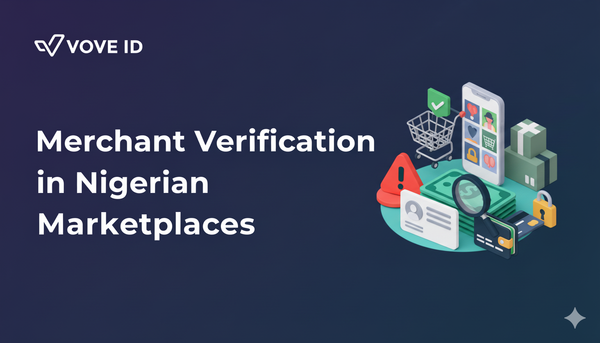
Merchant Verification in Ghana’s Fintech Ecosystem: A Practical Compliance Guide for 2026
Learn how fintechs and marketplaces in Ghana can onboard merchants compliantly in 2026 with Ghana Card, KYB, and automated AML checks using VOVE ID.
VOVE ID helps fintechs and payment platforms in Ghana build compliant merchant onboarding flows that meet strict regulatory expectations while maintaining fast user experience.
Ghana’s fintech sector continues to scale rapidly, driven by mobile money, digital payments, and platform-based commerce. At the same time, regulators are tightening enforcement around onboarding, identity verification, and AML controls.
For marketplaces, PSPs, and aggregators, this creates a clear requirement: merchant verification must be structured, risk-based, and fully auditable.
Why Merchant Verification Matters in Ghana

Merchant onboarding remains one of the highest-risk entry points for financial crime.
Key risks:
- Shell merchants used for fund routing
- Identity theft and synthetic identities
- Informal businesses with weak documentation
- Abuse of mobile money infrastructure
Under Ghana’s AML framework (Act 1044), institutions must perform Customer Due Diligence (CDD) before establishing business relationships [3].
The Regulatory Stack Behind Merchant Onboarding
Merchant verification in Ghana is built on:
- Anti-Money Laundering Act, 2020 (Act 1044)
- Payment Systems and Services Act, 2019 (Act 987)
- BoG licensing and compliance requirements
- AML/CFT Guidelines (updated 2025)
The Bank of Ghana plays the central supervisory role, with enforcement support from the Financial Intelligence Centre.
Critical requirement: Ghana Card
The Ghana Card is now mandatory for onboarding across financial institutions.
- It is the primary identification document for financial transactions
- It is linked to biometric verification
- It enables traceability of all account holders
This requirement was reinforced in updated BoG guidance in 2026 [1][2].
How Merchant Verification Works in Practice (Ghana Flow)
A compliant onboarding flow combines KYC, KYB, and AML into a single pipeline:
Step 1: Merchant profile creation
Collect:
- Business name
- Business type
- Contact details
- Intended transaction profile
Step 2: Identity verification (KYC layer)
Verify the merchant owner:
- Ghana Card validation (primary requirement)
- For non-citizens: Non-Citizen Ghana Card or refugee ID (where applicable)
- Face match + liveness check
BoG requires identity to be tied to a unique national ID [1].
Step 3: Business verification (KYB layer)
For registered entities:
- Validate registration via Registrar-General’s Department
- Confirm Tax Identification Number
- Extract directors and shareholders
For informal merchants, a tiered or limited-access approach is common: merchants can start processing transactions with restrictions until full registration and verification are completed. This allows fintechs to onboard a large share of Ghana’s small business sector without regulatory non-compliance.
BoG licensing requirements explicitly require ownership transparency, including UBO disclosures [4].
Step 4: UBO identification
- Identify individuals with ≥20–25% ownership or control
- Verify identities
- Perform sanctions and PEP screening
Step 5: Risk scoring
Risk is assigned based on:
- Industry
- Ownership structure
- Transaction expectations
- Geographic exposure
Ghana applies a risk-based AML approach, where higher-risk profiles require stronger controls [6].
Step 6: Account activation with controls
- Low risk → full access
- Medium risk → transaction limits
- High risk → enhanced due diligence
Step 7: Ongoing monitoring (AML layer)
Required under AML/CFT rules:
- Transaction monitoring
- Suspicious activity detection
- STR filing to the Financial Intelligence Centre
Typical merchant red flags in Ghana include:
- Sudden spikes in mobile money inflows or outflows inconsistent with declared activity
- Unusual cross-border transaction flows, especially involving high-risk jurisdictions
- High volume of peer-to-peer transfers instead of expected merchant payments
- Frequent transaction splitting to avoid reporting thresholds
- Mismatch between declared business activity and actual transaction patterns
- Rapid transaction bursts immediately after onboarding
- Multiple merchant accounts linked to the same identity, phone number, or device
These indicators align with monitoring expectations from the Bank of Ghana and the Financial Intelligence Centre.
Where Most Fintechs Struggle
Ghana Card dependency
Despite standardisation, real-time verification access can be operationally complex.
Informal merchant base
A large share of businesses operate without full registration, requiring hybrid onboarding approaches.
Fragmented infrastructure
Verification requires combining multiple systems and registries.
Rising fraud sophistication
Including synthetic identities, mule accounts, and account takeovers.
How VOVE ID Solves This in Ghana
VOVE ID provides a unified merchant onboarding infrastructure:
- Ghana Card-based identity verification
- Biometric liveness and fraud detection
- Automated KYB (business + UBO checks)
- Built-in AML screening (sanctions, PEP, adverse media)
- Risk-based onboarding engine
This allows fintechs to align with Bank of Ghana expectations without building fragmented compliance systems.
Practical Checklist for Ghana Merchant Onboarding
Identity (KYC)
- Verify Ghana Card
- Handle non-citizen cases (Non-Citizen Card, refugee ID)
- Perform biometric verification
- Link identity to account
Business (KYB)
- Validate registration
- Verify TIN
- Identify UBOs
- Apply tiered/limited access for informal merchants
Risk & AML
- Assign risk score
- Set transaction limits
- Enable monitoring rules
- Prepare STR reporting
Operations
- Maintain audit trail
- Store records (aligned with AML requirements)
- Conduct periodic reviews
Merchant verification in Ghana has evolved into a continuous compliance process combining identity verification, business checks, and real-time monitoring.
Fintechs that implement structured, automated onboarding systems are better positioned to scale while meeting regulatory expectations.
FAQ
1. Is merchant verification mandatory in Ghana?
Yes. Financial institutions must verify both individuals and businesses before enabling transactions.
2. Is the Ghana Card required for onboarding?
Yes. It is the primary identification document for financial services [1][2].
3. Can non-citizens onboard as merchants?
Yes, using Non-Citizen Ghana Card or Refugee ID, as specified in the Supervisory Guidance Note [1] and Notice BG/GOV/SEC/2025/36 [2].
4. Do fintechs need to verify beneficial owners?
Yes. UBO identification is required under AML and licensing frameworks [4].
5. Is ongoing monitoring mandatory?
Yes. Continuous transaction monitoring and STR reporting are required under AML rules [3][5].
Streamline your merchant onboarding today with VOVE ID. Ensure compliance, reduce fraud, and scale faster. Request a demo now.
Sources
[1] Supervisory Guidance Note on the Use of the Ghana Card (October/November 2025, effective 2026, Bank of Ghana)
[2] Notice BG/GOV/SEC/2025/36 — Revised Ghana Card Notice (November 2025, Bank of Ghana)
[3] Anti-Money Laundering Act, 2020 (Act 1044)
[4] Bank of Ghana Licensing & Ownership Requirements
[5] National AML/CFT/CPF Policy 2025–2029 + AML/CFT/CPF Guidelines Updates including AML/CFT/CPF Agency Banking Guidelines (September 2025, BoG/FIC)
[6] Risk-Based AML Approach in Ghana (BoG, 2025–2026)
Disclaimer: This guide is based on publicly available BoG directives as of March 2026; always consult latest official sources or legal advisors for implementation.