AML Compliance in Guinea 2026: Real Challenges, Risk Mitigation & Solutions for Fintechs
AML compliance in Guinea 2026: challenges, fraud trends, informal economy, and practical solutions for fintechs using VOVE ID to automate CDD & EDD.
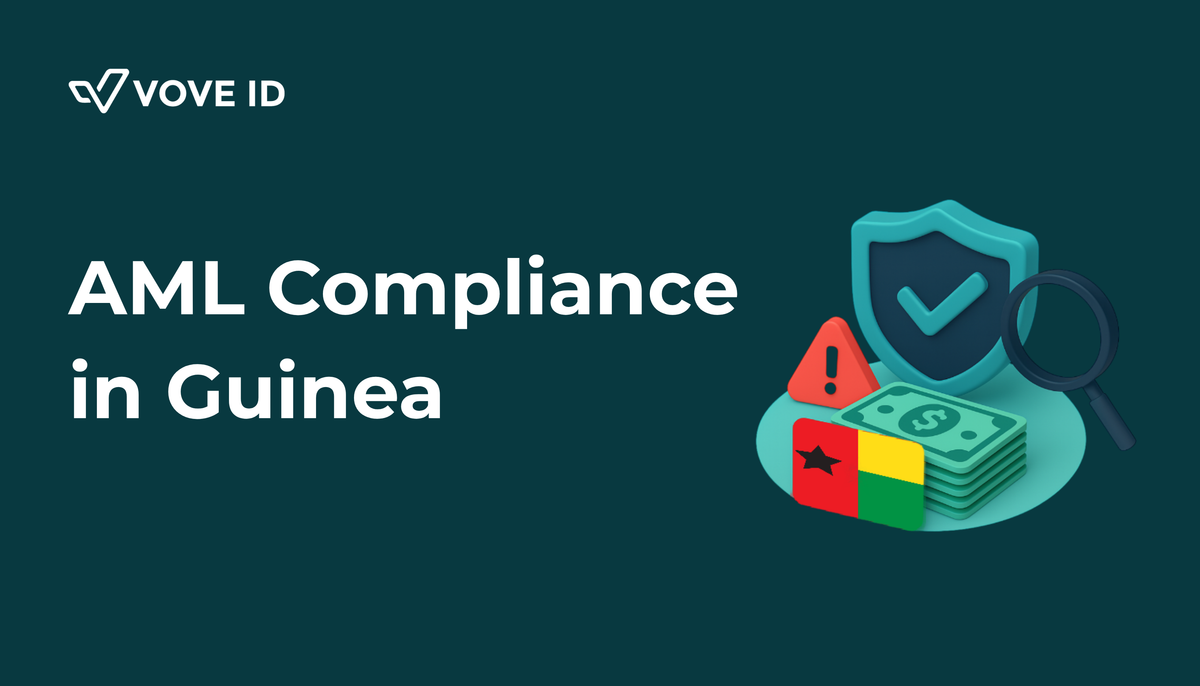
AML compliance in Guinea comes with real operational challenges.
A large part of the population operates outside the formal economy, reliable customer data is often missing, and fraud patterns in digital finance are evolving quickly. In that environment, applying standard AML procedures without adaptation usually leads to friction, delays, or blind spots.
VOVE ID helps fintechs handle this reality by combining identity verification, AML screening, and risk scoring into a single workflow that actually works under these conditions.
Regulatory context (2023–2025)
Guinea’s AML/CFT framework is built on national legislation and regional alignment with GIABA standards.
From a regulatory standpoint, expectations are clear. Financial institutions are required to perform customer due diligence, assess risk, monitor transactions, and report suspicious activity. These requirements follow a risk-based approach and align with broader West African AML frameworks.
At the same time, assessments show that implementation remains uneven. The GIABA Mutual Evaluation Report (2023) highlights low effectiveness in key areas such as preventive measures and beneficial ownership transparency. The 2025 follow-up notes improvements in technical compliance, but does not change the overall picture.
In practice, this creates a gap:
rules are defined, but applying them consistently requires additional effort from financial institutions.
Where AML breaks in practice
Informal economy
According to ILO data (2025), around 77.4% of the workforce operates in the informal sector.
This affects almost every AML control. Customers may not have consistent proof of income, documentation can be incomplete, and financial activity often happens outside traceable channels. As a result, standard verification steps become harder to rely on.
Fraud in digital finance
Reports from the GSMA and INTERPOL point to increasing fraud across West Africa, especially in mobile money.
Common patterns include SIM-swap attacks, social engineering, and account takeovers. These are fast-moving risks, and manual controls usually react too late.
Limited visibility into ownership
For business-related AML, identifying who actually controls a company is still difficult.
Ownership records are not always complete, and connections between individuals and businesses are not always obvious. This creates exposure, especially when higher-risk sectors are involved.
Manual processes slow everything down
In many cases, AML still depends on:
- manual screening
- periodic reviews
- disconnected tools
This makes onboarding slower and increases the risk of missing important signals.
How AML actually works on the ground
A workable AML setup in Guinea usually combines standard requirements with practical adjustments.
It starts with customer due diligence (CDD). At onboarding, institutions collect basic information, verify identity, and run sanctions and PEP checks. That part is relatively straightforward.
The next step is risk classification. Instead of treating all customers equally, institutions assign a risk level based on profile, geography, and expected activity. Higher-risk cases trigger enhanced due diligence (EDD), which involves deeper checks and closer monitoring.
After onboarding, the focus shifts to transaction monitoring. This is where many systems struggle. Without continuous monitoring, unusual patterns are easy to miss, especially in cash-heavy or high-volume environments.
Finally, institutions are expected to report suspicious activity and maintain records for audit purposes. These steps are standard, but they only work well if the earlier stages are solid.
Manual vs automated AML
The difference between manual and automated AML is not just speed, but consistency.
| Process | Manual approach | With VOVE ID |
|---|---|---|
| Identity verification | Takes days | Completed in minutes |
| Screening | Done in batches | Real-time |
| Monitoring | Periodic checks | Continuous |
| Reporting | Manual compilation | Structured and ready for audit |
In practice, automation reduces delays and makes it easier to apply the same level of control across all customers.
How VOVE ID supports AML in Guinea
VOVE ID is designed for environments where data is incomplete and risk signals are not always obvious.
It brings together several layers:
- identity and document verification
- sanctions and PEP screening
- continuous risk scoring
- monitoring for suspicious activity
- support for business-related checks, including UBO analysis
Instead of relying on perfect data, it helps institutions work with what is available and still reach defensible decisions.
Practical AML checklist
To stay compliant and operationally effective, financial institutions typically need to:
- perform customer due diligence (CDD) at onboarding
- screen customers against sanctions and PEP lists
- assign and document risk levels
- apply enhanced due diligence (EDD) for higher-risk cases
- monitor transactions continuously
- investigate unusual activity
- keep records for at least five years
- report suspicious transactions when required
What to expect next
Regulatory pressure in Guinea is likely to increase, especially around transparency and enforcement.
At the same time, infrastructure limitations will remain. That means AML processes will need to stay flexible, combining automation with human review where necessary.
Conclusion
If you operate in Guinea or across West Africa, AML needs to work in real conditions, not just in theory.
VOVE ID helps you automate due diligence, monitor risk in real time, and stay aligned with regulatory expectations.
Book a demo to see how AML workflows can be implemented in practice.
FAQ
1. Is AML mandatory in Guinea?
Yes, financial institutions must implement AML/CFT controls under national law and central bank supervision.
2. Why is AML difficult in practice?
Because a large part of the economy operates informally, which makes verification and monitoring less straightforward.
3. What are the main risks?
Fraud, unclear ownership structures, and cash-based transactions.
4. Can AML be automated?
Many parts can be automated, but high-risk cases still require manual review.
5. How fast can AML checks be done?
With automated tools, onboarding checks can be completed in minutes, while monitoring runs continuously.
References
- GIABA – Mutual Evaluation Report: Guinea (2023)
- GIABA – 2nd Enhanced Follow-Up Report (2025)
- GSMA – State of the Industry Report on Mobile Money 2025
- INTERPOL – Africa Cyberthreat Assessment Report 2025
- ILO (2025) via Ecofin Agency – Informal economy in Guinea
- BCRG – AML/CFT supervisory expectations (2024–2025)