AML in Burkina Faso: Compliance Framework
AML in Burkina Faso explained: regulatory framework, supervisory focus, key risk areas, and practical compliance expectations under WAEMU AML/CFT rules.
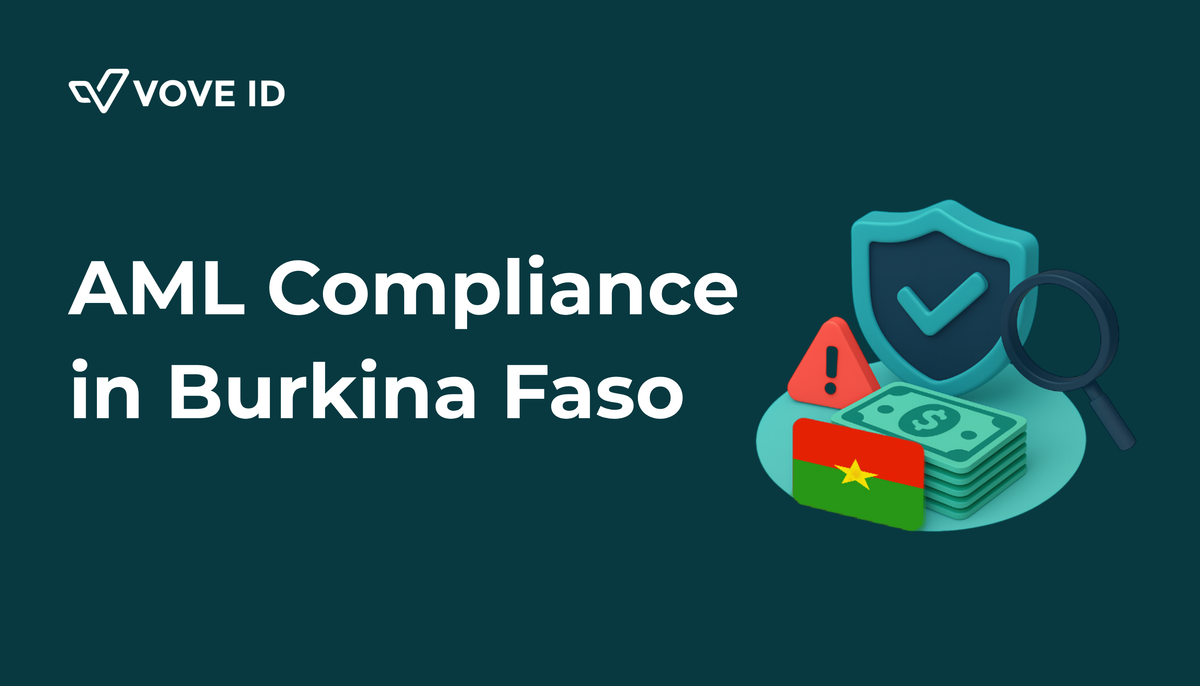
Anti-money laundering (AML) obligations in Burkina Faso form part of a broader regional framework designed to address financial crime risks across West Africa. For banks, fintech companies, payment service providers, and other obligated entities, AML compliance is no longer assessed solely through the presence of formal policies. Supervisors increasingly focus on whether institutions can demonstrate effective risk identification, control implementation, and governance in day-to-day operations.
This article provides an overview of the AML framework in Burkina Faso, explains how regional and national rules interact, and highlights the areas regulators most closely scrutinise during inspections, including how structured onboarding and CDD processes supported by tools such as VOVE ID fit into broader AML control environments.
This article is part of our Burkina Faso compliance series, alongside our KYC and KYB overviews.
 Anastasiia
 Anastasiia
Regulatory framework and institutional setting
Burkina Faso’s AML regime is primarily shaped by the harmonised legal framework of the West African Economic and Monetary Union (WAEMU). Core AML obligations are established under Règlement n°15/2002/CM/UEMOA, as amended, which sets out requirements on customer due diligence, record-keeping, internal controls, and suspicious transaction reporting.
These regional rules are complemented by supervisory guidance, including Instruction n°008-05-2015 issued by the BCEAO, which clarifies operational expectations for regulated institutions.
AML oversight involves several authorities:
- BCEAO and the WAEMU Banking Commission, supervising banks, payment institutions, and e-money issuers
- National authorities and professional bodies overseeing DNFBPs
- CENTIF Burkina, responsible for receiving, analysing, and disseminating suspicious transaction reports
While the legal framework is regional, enforcement is carried out locally, with supervisors assessing how AML controls are applied in practice.
Scope of AML obligations
AML requirements apply to a broad range of obligated entities, including:
- Banks and microfinance institutions
- Payment institutions and electronic money issuers
- Insurance companies and intermediaries
- Foreign exchange bureaus
- Designated non-financial businesses and professions (DNFBPs), such as notaries, lawyers, real estate agents, casinos, and dealers in precious metals or stones
Foreign fintechs providing services connected to Burkina Faso may also fall within scope, particularly when operating through partnerships with locally supervised entities.
Risk-based approach as the foundation of AML
A risk-based approach underpins AML compliance in Burkina Faso. Institutions are required to identify, assess, and understand their money laundering and terrorist financing risks, taking into account:
- Customer types and business relationships
- Products and services offered
- Delivery channels, including non-face-to-face relationships
- Geographic exposure
Supervisors increasingly expect risk assessments to be specific, documented, and actively used to determine the nature and intensity of AML controls, rather than treated as static compliance documents.
Customer due diligence and record-keeping
Customer due diligence (CDD) is a core AML obligation and applies throughout the lifecycle of the business relationship. Obligated entities must:
- Identify and verify customers and, where applicable, beneficial owners
- Understand the purpose and intended nature of the relationship
- Keep customer information accurate and up to date
Records related to identification, due diligence, and transactions must generally be retained for at least ten years after the end of the business relationship. In practice, inspection findings often focus on whether records are complete, internally consistent, and readily retrievable.
Suspicious transaction reporting
Suspicious transaction reporting is a central pillar of the AML framework. Obligated entities must submit Suspicious Transaction Reports (STRs) to CENTIF Burkina when there are reasonable grounds to suspect that funds may be linked to criminal activity or terrorist financing.
Supervisory reviews frequently identify weaknesses such as:
- Delayed submission of STRs
- Insufficient or generic narratives
- Weak internal escalation and decision-making processes
Tipping-off customers is strictly prohibited and remains a sensitive focus area during inspections.
Internal controls, governance, and training
Effective AML compliance depends on robust internal controls and clear governance arrangements. Regulators expect institutions to demonstrate:
- Clearly defined AML policies and procedures
- Independent compliance functions with adequate authority and resources
- Ongoing staff training proportionate to risk exposure
- Regular internal reviews and audits of AML controls
Increasingly, supervisors assess whether AML responsibilities are clearly understood across business, compliance, and senior management levels.
Supervisory focus and enforcement trends
Following Burkina Faso’s exit from enhanced regional monitoring by GIABA, supervisors have intensified their focus on the effectiveness of AML frameworks rather than their formal design. On-site inspections increasingly test whether controls operate as described and whether institutions can clearly explain their risk mitigation decisions.
Common inspection findings include:
- Weakly documented risk assessments
- Inconsistent application of AML controls across business lines
- Over-reliance on manual processes
- Limited evidence that identified risks drive operational decisions
This reflects a broader regional shift toward outcome-based supervision.
Operational challenges for compliance teams
Institutions operating in Burkina Faso and across WAEMU jurisdictions commonly face:
- Limited access to reliable and up-to-date data sources
- Variability in customer documentation quality
- Fragmented AML processes across entities or countries
- Challenges in maintaining consistent standards at scale
These issues can translate into regulatory findings where institutions are unable to clearly demonstrate how AML controls are applied in practice.
Role of technology in AML programmes
Technology plays an increasingly important role in supporting AML compliance, particularly in customer onboarding, documentation management, and audit readiness. Digital solutions help standardise processes, reduce manual errors, and support consistency across business lines and jurisdictions.
In practice, digital solutions for onboarding and customer due diligence, such as VOVE ID, allow institutions to standardise documentation, improve audit readiness, and clearly demonstrate the consistent application of AML controls during supervisory reviews.
Final considerations
AML compliance in Burkina Faso is firmly anchored in a regional WAEMU framework, with supervisors placing growing emphasis on practical effectiveness, governance, and risk ownership. Institutions are expected not only to meet formal requirements, but also to demonstrate a clear understanding of their risk exposure and control environment.
By aligning AML policies with operational reality and supporting them with appropriate technology, compliance teams can strengthen resilience, improve inspection outcomes, and meet supervisory expectations in Burkina Faso and across West Africa.
Operating in West Africa or managing AML compliance across WAEMU jurisdictions? Book a demo to see how VOVE ID supports compliant and scalable customer due diligence processes.