AML in Madagascar 2026: How Fintechs Detect Real Risk in Low-Data Environments
AML Madagascar 2026: practical guide for fintechs. Learn adaptive risk detection, SAMIFIN reporting, and mobile money AML strategies with VOVE ID.
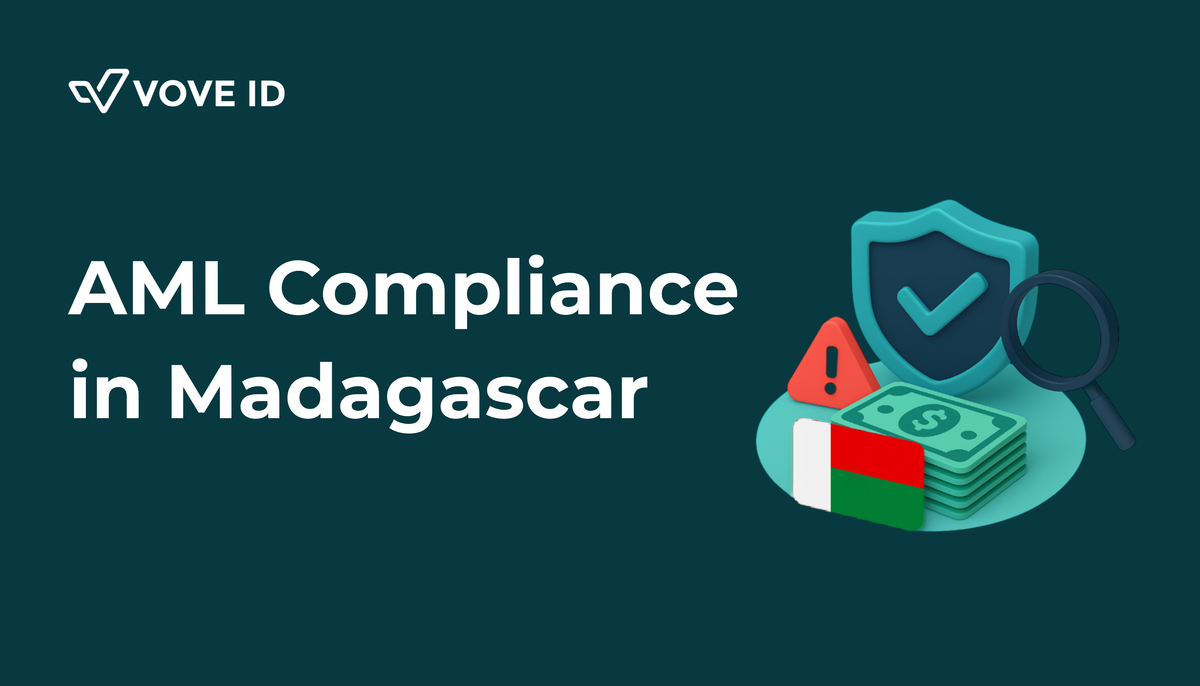
AML Madagascar compliance goes beyond ticking regulatory boxes. Fintechs face a unique challenge: detecting financial crime with limited, fragmented, and inconsistent data. Mobile money adoption is rising, new users enter the formal financial system for the first time, and regions such as rice farming areas and mining hubs pose higher trade-based money laundering risks, often involving informal cross-border networks.
While Madagascar has formally adopted FATF-aligned standards, the operational reality is more complex. Historical transaction data is sparse, corporate records are fragmented, and traditional AML approaches fail to provide meaningful insights. Fintech compliance teams must rely on adaptive, context-driven AML strategies.
VOVE ID helps fintechs navigate these low-data challenges, enabling dynamic risk assessment and compliance workflows that keep operations moving while meeting regulatory standards.
🇲🇬 Why AML in Madagascar requires a different approach
The Malagasy financial ecosystem is still developing. Cash usage remains high outside urban centers, and many first-time users engage with mobile wallets or fintech services. This expansion improves financial inclusion but complicates AML monitoring.
Key operational challenges include:
- Limited historical data for individual and corporate customers
- Incomplete identity verification, especially in rural or mobile-first onboarding
- Low contextual visibility into transaction purpose and counterparties
- Regional risk variations, such as higher trade-based money laundering in mining zones or among certain cross-border trade communities
Traditional rule-based monitoring often fails. AML teams must focus on adaptive risk assessment, combining behavioral patterns, transaction monitoring, and contextual intelligence.
Regulatory framework: AML and SAMIFIN
AML compliance in Madagascar is governed by Law No. 2018-043, enforced by SAMIFIN, the national Financial Intelligence Unit.
Core obligations include:
- Customer Due Diligence (CDD) and Enhanced Due Diligence (EDD)
- Ongoing transaction monitoring and risk-based scoring
- Suspicious Transaction Reporting (STR) to SAMIFIN
- Record-keeping and full auditability
Institutions must implement internal AML programs with dynamic risk management rather than relying on static rules.
The real challenge: AML without reliable data
The central constraint in Madagascar is operational visibility. AML teams often operate with:
- Fragmented customer histories
- Partial or inconsistent identity data
- Limited transaction context
These gaps make automated rule-based monitoring ineffective or produce excessive false positives. Effective AML relies on continuous, adaptive monitoring and human-in-the-loop decision-making.
A practical AML workflow for Madagascar
An effective AML setup combines automation with structured human oversight. Key steps include:
- Risk-based onboarding (CDD/EDD) – Apply deeper checks for higher-risk profiles from the start
- Baseline risk segmentation – Classify customers using geography, product usage, and risk factors
- Transaction monitoring – Track behavior continuously, focusing on patterns rather than isolated events
- Scenario detection – Identify unusual transaction volumes, rapid fund movement, or inconsistent activity
- Alert generation and prioritization – Combine multiple signals to reduce false positives
- Investigation and escalation – Analysts review flagged cases using all available context
- STR reporting to SAMIFIN – Submit reports when regulatory thresholds are met
- Ongoing monitoring and re-risking – Update profiles dynamically as new behavior emerges
Where AML programs typically fail
Failures in Madagascar are often operational:
- Excessive false positives from rigid rules
- Poor integration between KYC and transaction monitoring
- Inadequate alert prioritization
- Limited context for investigations
Teams can face backlogs while real risk remains undetected.
How VOVE ID supports AML operations in Madagascar
VOVE ID allows fintech teams to connect fragmented data into actionable risk intelligence. In practice, this enables:
- Linking onboarding data with transaction monitoring to improve context
- Applying dynamic risk scoring that adapts to customer behavior
- Integrating sanctions, PEP, and adverse media screening into workflows
- Reducing false positives through multi-signal analysis
- Maintaining full audit trails for compliance and investigations
This approach gives teams visibility into emerging risk patterns while keeping operations manageable.
Practical checklist for AML readiness
- Compliance framework – Policies aligned with Law 2018-043; STR reporting procedures to SAMIFIN; internal risk assessment methodology
- Monitoring setup – Transaction monitoring adapted to mobile money and low-data environments; anomaly detection; alert prioritization
- Operations – Trained investigation team; escalation workflows; documentation and audit trails
- Technology – Integrated KYC/AML data; dynamic risk scoring; scalable alert handling
Final take
AML in Madagascar requires adaptability. Teams succeed by combining behavioral analysis, dynamic risk scoring, and continuous monitoring. This approach reduces operational load while ensuring compliance, which VOVE ID supports with purpose-built workflows.
FAQ
1. Is AML compliance mandatory in Madagascar?
Yes. Law No. 2018-043 requires regulated entities to implement AML controls and report suspicious transactions.
2. Who regulates AML in Madagascar?
SAMIFIN is the Financial Intelligence Unit responsible for receiving and analyzing STRs.
3. What makes AML in Madagascar challenging?
Limited and fragmented data, especially for first-time financial users.
4. Can AML be fully automated?
No. Automation supports detection, but human analysis is essential for investigations.
5. How should fintechs approach AML strategy?
Combine risk-based onboarding, adaptive monitoring, and continuous risk reassessment in low-data environments.
Take Action
If your AML process struggles with incomplete data, generates false positives, or lacks context, particularly in Madagascar or similar markets, your tooling may not fit local realities.
VOVE ID helps fintech teams detect risk efficiently while keeping operations compliant.