CBN Baseline Standards 2026: KYC, KYB & AML Compliance Guide for Nigerian Fintechs
Three separate compliance workstreams, one CBN expectation: a single connected customer view from onboarding to reporting.
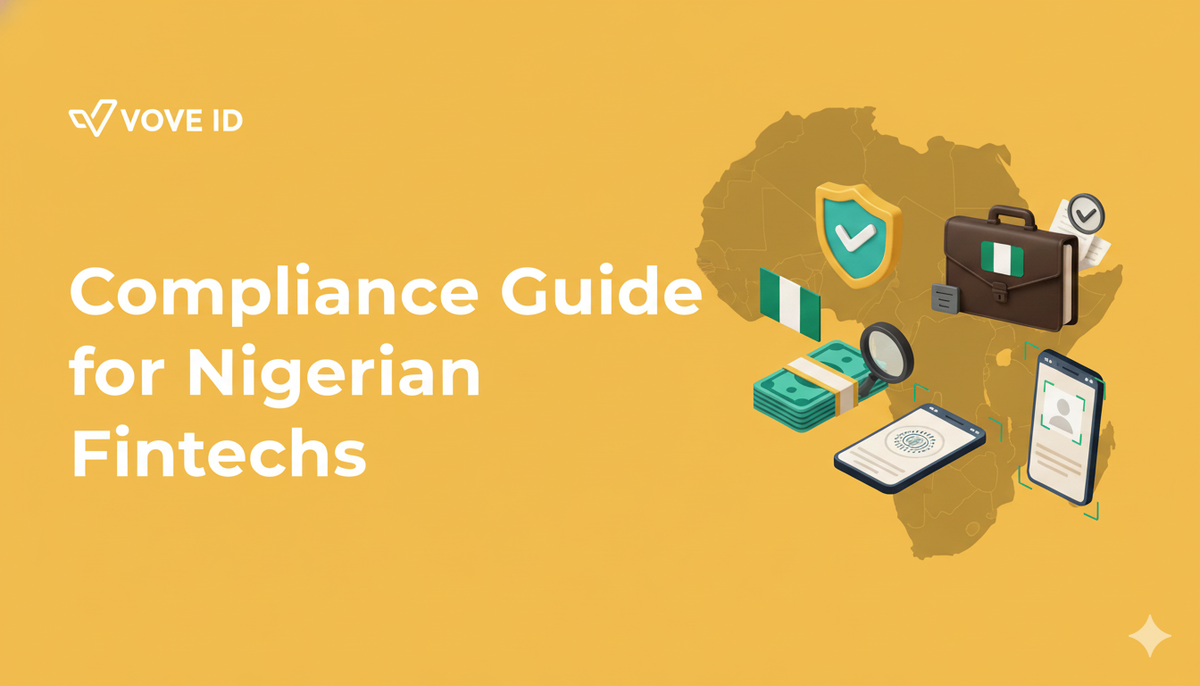
Nigeria remains Africa's largest fintech market, with continued growth in mobile payments, digital lending, remittances, and online marketplaces — and continued regulatory scrutiny to match. Many teams still manage KYC, KYB, and AML as three separate systems: identity checks in one place, business verification handled manually or as an afterthought, AML monitoring bolted on separately. That fragmentation is exactly what the CBN's Baseline Standards for Automated AML Solutions were written to close. VOVE ID is built to run these three workstreams as one connected workflow rather than three disconnected tools.
For the full technical breakdown of the circular itself — deadlines, the ten capability requirements, and how to prepare a roadmap — see our CBN Baseline Standards guide. (Note: the sister article's live URL currently has the known Ghost slug bug — confirm the actual working link before publishing this cross-reference.)
Why "Three Systems" Breaks Down
A customer's KYC file, a business's KYB record, and an account's AML monitoring history are, in practice, describing the same relationship from three angles. When they live in disconnected systems, a compliance officer reconstructing a case after the fact has to manually stitch together onboarding data, ownership records, and transaction alerts — exactly the kind of gap CBN examinations are now designed to surface. The Baseline Standards push explicitly toward a single, unified customer view connecting onboarding information to ongoing transactional behavior.
KYC: The Onboarding Layer
Identity verification in Nigeria runs on BVN and NIN, cross-checked against government identity data, with mandatory biometric and liveness checks under the Baseline Standards to guard against deepfakes and presentation attacks. Mobile-first and agent-assisted onboarding remain dominant outside major urban centers, which introduces its own risks — SIM-swap fraud tied to BVN-registered numbers, synthetic identity creation, and occasional agent collusion.
For the full breakdown of Nigeria's KYC requirements, see our Nigeria KYC guide, and for the underlying framework, our KYC requirements explained.
KYB: The Business Layer
For marketplaces, SME lenders, and merchant-acquiring platforms, business verification runs through the CAC registry, beneficial-ownership identification, and authorized-representative checks. The recurring operational problem is inconsistent CAC records and the difficulty of identifying real beneficial owners behind informal or family-run structures — the same gap the Baseline Standards' beneficiary-screening emphasis is meant to close.
For the full breakdown of Nigeria's KYB requirements, see our Nigeria KYB guide, and for the underlying framework, our KYB requirements explained. For merchant-specific onboarding at scale, see our merchant verification guide.
AML: The Ongoing Layer
Continuous, behavior-based transaction monitoring has replaced periodic batch review as the expected standard, with automated sanctions, PEP, and adverse-media screening and STR filing to the NFIU on established suspicion. High transaction volumes and frequent cross-border remittance activity make the "single unified customer view" requirement difficult to satisfy in practice with fragmented tooling.
For the full breakdown of Nigeria's AML obligations, see our AML compliance guide for Nigeria, and for the underlying framework, our AML requirements explained.
Where the Three Actually Connect
- Capture identity and business data together at onboarding — NIN/BVN and CAC records where applicable.
- Run identity verification, liveness checks, and beneficial-ownership screening as one step, not sequential silos.
- Apply risk scoring that reflects both onboarding data and expected transaction pattern, not one or the other.
- Route higher-risk cases to review with the onboarding file already attached — not a case opened from scratch.
- Keep monitoring, alerts, and reporting tied back to the same customer and business record used at onboarding.
Key Deadlines
- 10 June 2026 — implementation roadmap due to the CBN Compliance Department.
- 10 September 2027 — full compliance for deposit money banks (18 months).
- 10 March 2028 — full compliance for fintechs, PSPs, and mobile money operators (24 months).
For the complete source-linked implementation checklist tying all three together, see VOVE ID's Nigeria compliance checklist.
Final Thoughts
Nigeria's 2026 regulatory shift isn't really about any one of KYC, KYB, or AML individually — it's about whether an institution can show a single, connected customer record spanning all three.
VOVE ID brings identity verification, business verification, and AML monitoring together in one workflow, built around Nigeria's specific identity and registry infrastructure.
This article is intended for general informational purposes only and does not constitute legal, financial, or regulatory advice. Requirements may vary by institution type and licensing status. For binding compliance obligations, consult the relevant regulator or a qualified professional.