South Africa KYB Failures in 2026: Where Business Verification Breaks
Why KYB fails in South Africa even when onboarding looks complete. A breakdown of ownership gaps, authority issues, and FICA-driven compliance risks.
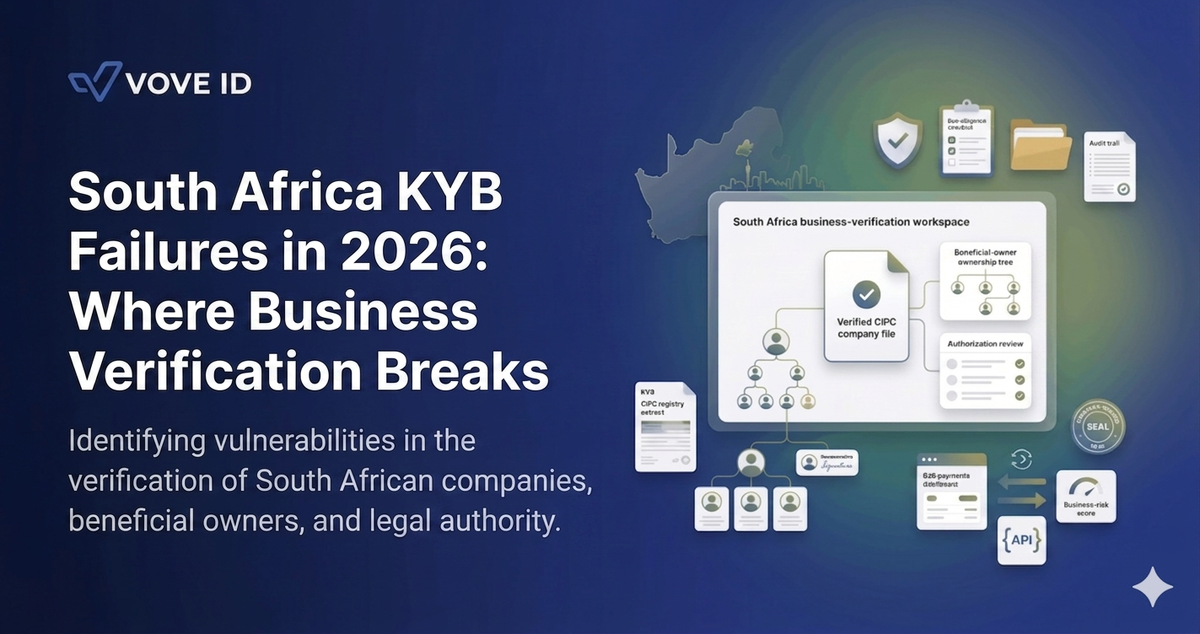
South Africa KYB in 2026 often looks complete long before it actually is. Teams can verify a company record, collect documents, and pass onboarding checks, yet still miss gaps in ownership, control, or authority that later create compliance exposure under the Financial Intelligence Centre Act. This is exactly where operational workflows — including solutions like VOVE ID — start to matter more than raw data access.
South Africa remains one of the most mature fintech markets on the continent.
That maturity creates a predictable failure pattern.
Teams assume the hard part is retrieving company data from Companies and Intellectual Property Commission. In practice, the harder problem is determining whether the ownership structure, control logic, and representative authority actually hold together under scrutiny.
This is where South Africa KYB starts looking sufficient when it is not.
Why the South Africa KYB framework still produces weak onboarding outcomes
South African KYB does not fail because the regulatory structure is unclear.
It fails because the framework is interpreted too narrowly at the operational level.
FICA defines the obligation — not the outcome
The Financial Intelligence Centre Act requires institutions to:
- identify and verify customers
- understand beneficial ownership and control
- maintain records
- perform ongoing due diligence
But the law does not guarantee that teams reconstruct ownership or authority correctly. It defines what must be achieved, not how well it must be executed.
CIPC creates a reliable baseline — and a false ceiling
The Companies and Intellectual Property Commission is the primary source for:
- entity existence
- registration details
- company status
- beneficial ownership filings (since 2023)
This creates a common issue.
Teams treat registry confirmation as a completed KYB step, when it is only the starting point. A record can be accurate and still leave unresolved questions about indirect ownership, control rights, or recent structural changes.
Regulated partners raise the real standard
Even where licensing requirements differ, fintechs operating with:
- payment flows
- lending infrastructure
- treasury services
are indirectly held to the expectations of South Africa’s AML ecosystem.
Weak KYB is rarely discovered at onboarding.
It is discovered during:
- partner due diligence
- transaction monitoring reviews
- audit or remediation processes
Where South Africa KYB checks usually fail
A compliant-looking file can still contain structural gaps. The failure points are consistent.
1. Entity verification creates false confidence
Confirming:
- legal name
- registration number
- status
answers whether the company exists.
It does not answer:
- who controls it
- whether the structure is coherent
- whether the relationship makes sense
2. Ownership tracing stops too early
Many workflows capture only immediate shareholders.
In practice, South African KYB often requires:
- tracing through holding companies
- identifying natural persons behind layered ownership
- resolving nominee or trust structures
Incomplete ownership mapping is one of the most common causes of downstream AML issues.
3. Authority chains break silently
The onboarding representative is not always authorized.
Failures typically include:
- verifying the wrong individual
- missing director-level authority checks
- relying on documents that do not confirm signing rights
This creates a structurally valid file with the wrong decision inside it.
4. Screening is disconnected from context
Sanctions or PEP screening may be completed, but without:
- linking results to ownership
- aligning risk scoring to business activity
- incorporating adverse media properly
Screening becomes a checklist item instead of a risk-control mechanism.
5. KYB is treated as a one-time event
Under the Financial Intelligence Centre Act, due diligence is ongoing.
Failures occur when:
- ownership changes are not captured
- new controllers are not reviewed
- risk profiles are not updated
A clean onboarding file degrades quickly without monitoring.
6. Audit trails are incomplete
Many teams cannot clearly explain:
- how ownership was determined
- why the entity was approved
- what risk level was assigned
This becomes a problem during:
- audits
- partner reviews
- regulatory inquiries
A realistic South Africa KYB failure
A B2B payments platform onboards a South African logistics company.
The onboarding file includes:
- a Companies and Intellectual Property Commission extract
- director details
- proof of address
- representative ID
The case appears complete.
In reality:
- ownership runs through two layers
- one shareholder is another company
- the onboarding representative is not a listed director
- no authority chain is validated
- no recent ownership changes are reviewed
The issue is not missing data.
The issue is incomplete reconstruction.
Why South Africa KYB breaks in practice
Registry data does not resolve control
A registry confirms structure, not necessarily real control or influence.
Authority logic is often under-validated
Teams can verify identity without verifying authorization.
Risk evolves after onboarding
Customer profiles change through:
- ownership updates
- transaction behavior
- geographic exposure
Without monitoring, KYB becomes outdated quickly.
How a South Africa KYB workflow should actually run
A defensible workflow connects verification to risk and monitoring:
- Entity verification via Companies and Intellectual Property Commission
- Ownership reconstruction to natural persons
- Authority validation for representatives
- Screening and risk classification
- Decisioning with documented rationale
- Ongoing monitoring and refresh triggers
This is not a sequence of checks.
It is a single control system.
South Africa KYB checklist (operational view)
- Entity confirmed through Companies and Intellectual Property Commission
- Ownership traced to ultimate natural persons
- Control structure understood and documented
- Representative authority verified
- Identity verification completed
- Sanctions and risk screening performed
- Risk classification assigned
- Monitoring triggers defined
- Audit trail consolidated
 Anastasiia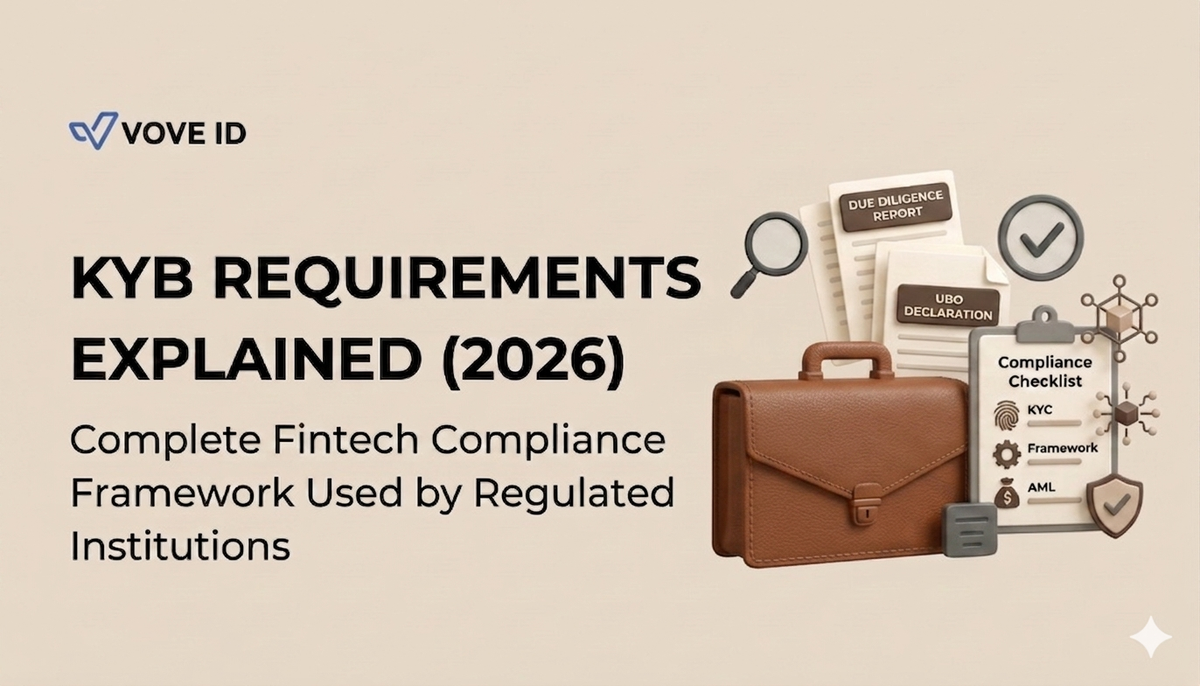
Explore how to structure KYB workflows across jurisdictions in our KYB guide
Conclusion
South Africa KYB in 2026 does not fail at the level of data access.
It fails at the level of interpretation.
A company record, a set of documents, and a completed checklist do not guarantee that ownership, control, and authority are correctly understood. Under the Financial Intelligence Centre Act, that understanding is what defines whether onboarding is actually compliant.
The difference between a clean file and a defensible one is reconstruction.
Want to see how South Africa KYB workflows can be structured around ownership reconstruction, authority validation, and ongoing monitoring in one system?