AML for Banking as a Service (BaaS) Providers: The Complete Compliance Playbook
AML in BaaS is not standard fintech compliance. This guide explains how to design KYB, monitoring, and escalation across sponsor banks, platforms, and program clients.
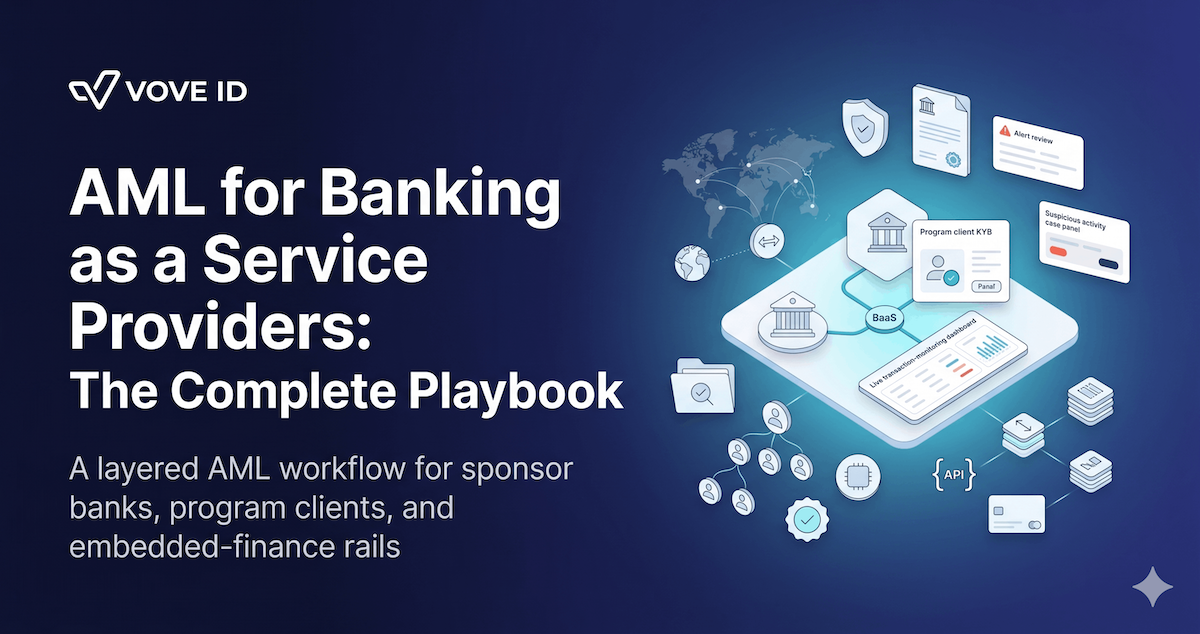
A BaaS provider needs an AML program that is explicitly designed for a multi-layer operating model: sponsor bank, platform, program client, and end-user payment flows. In 2026, regulators and bank partners do not treat Banking as a Service as outsourced compliance. They treat it as a distributed control system where weaknesses at one layer propagate across the entire stack.
What AML compliance does a BaaS provider need?
A BaaS provider needs risk-based onboarding of program clients, beneficial-owner review tied to program risk, sanctions and watchlist controls across all relevant parties, monitoring of end-user payment flows inside program structures, escalation and reporting paths aligned with sponsor-bank expectations, and governance that makes control ownership across the stack auditable in practice.
BaaS founders often describe their business as infrastructure.
That is true commercially. It is incomplete operationally.
The moment a platform enables other companies to launch accounts, cards, wallets, payouts, or embedded payment products, it becomes part of a layered financial system with shared AML exposure. The platform is not just shipping APIs; it is shaping how regulated activity flows across multiple actors with different visibility and incentives.
That is why AML fails in BaaS earlier than teams expect: not because controls do not exist, but because they are not aligned across layers.
This is not a general AML design problem. It is a BaaS system-design problem.
For more details about AML, read our guide:
 Anastasiia
Why BaaS creates compounded AML risk
A standard fintech typically manages one primary customer layer.
A BaaS provider operates across at least three:
- the sponsor bank or regulated principal
- the program or fintech client using the platform
- the end users or merchants transacting through that client
Each layer introduces its own due diligence, monitoring scope, and escalation requirements.
The risk compounds further when multiple product rails are active simultaneously:
- account issuance and custody-like flows
- card programs under BIN sponsorship
- merchant settlement and acquiring-like behavior
- stored value or treasury workflows
- cross-border payouts and corridor exposure
- nested wallets and sub-account structures
In these environments, risk propagates:
- weak onboarding at the program level affects end-user flows
- limited monitoring at the platform level delays detection
- sponsor-bank visibility arrives too late to act efficiently
This is why BaaS AML cannot be reduced to “good onboarding” or “bank oversight.” It requires aligned controls across the stack.
The BaaS-specific AML control model
The regulatory perimeter varies by jurisdiction and licence structure, but the operating model below reflects what sponsor banks and supervisors increasingly expect in BaaS environments.
1. Program-level KYB as a monitoring dependency (not a standalone check)
In BaaS, KYB is not just identity verification. It is the input layer for downstream monitoring and risk decisions.
The platform needs a defendable view of each program client:
- ownership and beneficial owners
- control persons and governance structure
- business model and revenue drivers
- target customer segments
- geographic exposure and corridors
- intended product usage and payment flows
This is not “KYB completeness.” It is context creation.
Without this context:
- monitoring thresholds are blind
- anomaly detection lacks baseline behavior
- sponsor-bank reviews rely on fragmented data
In BaaS, weak KYB does not stay local. It propagates into transaction risk.
2. Control allocation mapped to real operations (not just contracts)
Control ownership in BaaS often exists on paper but fails in execution.
A workable model requires operational clarity, not contractual abstraction.
For each program, the platform must be able to explain who actually performs:
- program client KYB
- end-user KYC / KYB (where applicable)
- sanctions and PEP screening
- transaction monitoring across program flows
- alert review and case handling
- suspicious activity escalation and reporting
- evidence retention and audit support
Ambiguity here creates systemic gaps:
- duplicated checks in low-risk areas
- unowned controls in high-risk flows
- delayed escalation due to unclear responsibility
In sponsor-bank environments, control ambiguity becomes audit failure.
3. Monitoring payment flows inside program structures
BaaS AML cannot rely on customer files alone. It requires visibility into how money actually moves through program configurations.
This includes detecting signals such as:
- volume spikes after program launch or feature changes
- merchant or user behavior inconsistent with approved models
- structuring or velocity anomalies across sub-accounts
- corridor exposure outside declared geographies
- nested account usage that obscures payer/beneficiary identity
- sanctions exposure emerging post-onboarding
- payout patterns inconsistent with stated use cases
The key distinction is structural:
- not “customer monitoring”
- but program-aware flow monitoring
This is what differentiates software infrastructure from regulated payment orchestration.
4. Escalation paths aligned with sponsor-bank expectations
In BaaS, escalation is not an internal process. It is a cross-entity workflow.
A functional model requires:
- triage logic that separates noise from high-risk signals
- structured case handling with investigator rationale
- ability to pause, limit, or reject activity at the platform level
- coordination protocols with the sponsor bank
- escalation into SAR / STR processes under applicable regimes
- audit-ready evidence linking onboarding context to transaction behavior
The constraint is not detection. It is time-to-decision under shared responsibility.
If the platform cannot reconstruct the full context quickly, escalation slows, and risk accumulates across the stack.
Why sponsor-bank coverage is not a substitute for platform controls
Sponsor banks remain central to BaaS models, but their oversight does not replace provider responsibilities.
In practice, banks expect the platform to deliver:
- structured client due diligence
- usable monitoring data across program activity
- clear escalation signals and context
This creates a dependency chain:
- weak KYB → degraded monitoring signals
- weak monitoring → delayed bank visibility
- fragmented data → ineffective audits
As a result, AML becomes a commercial gating factor:
- banks restrict program approvals
- higher-risk clients face onboarding friction
- platform growth slows due to compliance uncertainty
In BaaS, compliance design directly affects distribution capacity.
What a scalable BaaS AML stack looks like
A robust BaaS AML architecture typically includes:
- Program client KYB linked to risk scoring
- Pre-launch program risk assessment (products, corridors, user types)
- Conditional end-user KYC/KYB based on use case
- Sanctions and watchlist screening across all relevant entities
- Flow-level transaction monitoring across program structures
- Case management and escalation integrated with sponsor-bank workflows
The critical property is shared context:
- onboarding → informs monitoring
- monitoring → feeds escalation
- escalation → references original risk assumptions
If these layers are disconnected, the system devolves into manual reconstruction.
What regulators and bank partners expect in BaaS specifically
While global standards (e.g., FATF) define baseline AML obligations, expectations in BaaS focus on operational coherence across layers.
Across major markets, supervisors and sponsor banks are increasingly aligned on:
- stronger program-level due diligence before launch
- explicit allocation of AML responsibilities across entities
- deeper monitoring coverage inside payment flows
- faster escalation of suspicious behavior with full context
- auditability of decisions across the entire stack
The consistent direction is clear:
AML in BaaS is not evaluated as a standalone function. It is evaluated as a system spanning multiple actors.
How VOVE ID helps BaaS providers operationalize layered AML
VOVE ID supports BaaS and payment-infrastructure teams in structuring AML across the full stack:
- KYB on fintech and merchant program clients
- beneficial-owner and control-person verification
- sanctions and PEP screening across entities
- monitoring aligned with program-level payment flows
- alert handling with audit-ready case context
This allows platforms to:
- onboard program clients with consistent risk context
- evaluate higher-risk programs before launch
- maintain visibility across nested payment activity
- present coherent control frameworks to sponsor banks and auditors
The objective is not to reduce AML scope, but to align it with how BaaS systems actually operate.
Practical BaaS AML checklist
Before launching or expanding a program, a BaaS team should be able to answer:
- Do we understand ownership, control, and business model at the program level?
- Is KYB structured in a way that supports monitoring decisions later?
- Who owns each AML control in real operations across the stack?
- Can we monitor payment flows without losing underlying customer context?
- Are escalation paths aligned with sponsor-bank expectations?
- Can we produce a single audit trail from onboarding through transaction review?
If any answer is weak, the platform is not ready for scale in a BaaS environment.
Conclusion
AML in BaaS is fundamentally different from standard fintech AML because risk is distributed across a chain of participants.
That chain only works when KYB, monitoring, and escalation remain connected across sponsor bank, platform, program client, and end-user flows. When those connections break, growth continues, but control integrity degrades.
The strongest BaaS providers in 2026 treat AML as part of their infrastructure layer — not as a separate review function, but as a system that evolves with every program they launch.
Want to structure KYB, monitoring, and escalation into one coherent AML layer across your BaaS stack?