AML Compliance in Mauritania (2026): Obligations, Risks, and What the CTRF Expects
Mauritania's AML framework runs through the CTRF and BCM — but fishing, mining, and mobile money create sector-specific ML risks that generic compliance programs miss.
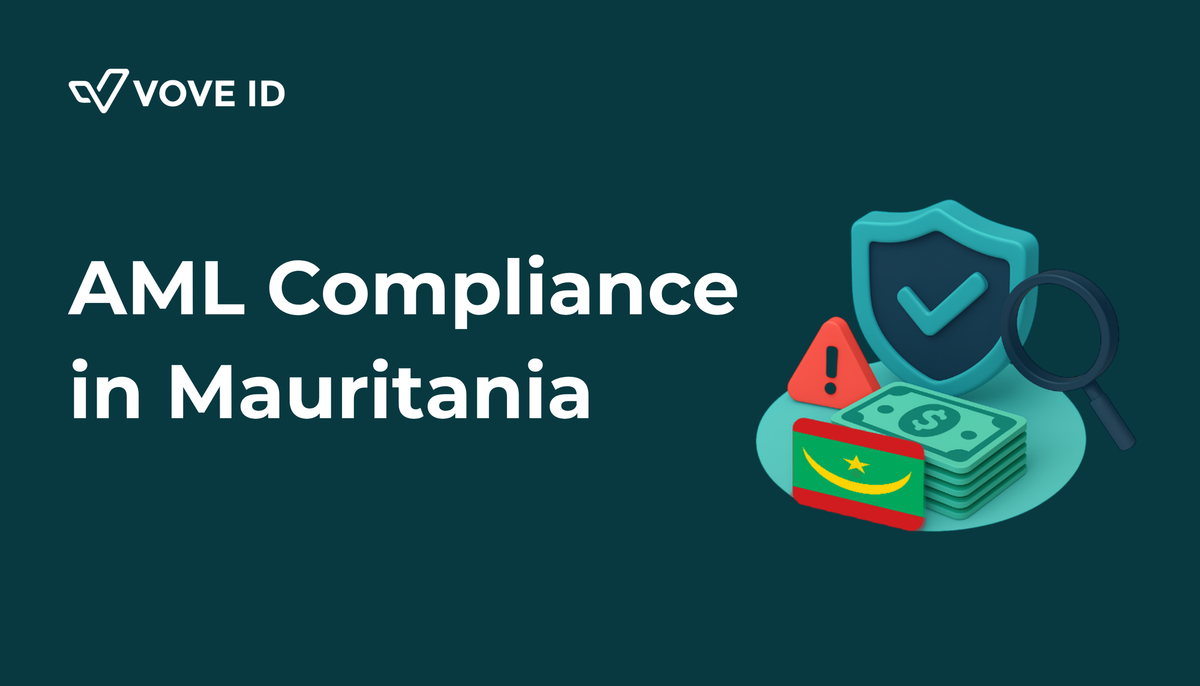
Mauritania doesn't carry the same compliance headline risk as FATF-listed jurisdictions, but that can lead regulated institutions to underweight what the framework actually requires. The AML/CFT regime is substantive: a dedicated financial intelligence unit (CTRF), BCM supervisory authority over financial institutions, and GIABA mutual evaluation obligations that assess program effectiveness — not just whether the laws exist. For fintechs and regulated businesses with exposure to Mauritania, VOVE ID supports the sanctions screening and transaction monitoring components of AML programs operating in this jurisdiction.
This guide covers Mauritania's AML obligations in 2026. For the underlying AML framework, see our AML Requirements Explained 2026: Compliance Operating System for Regulated Financial Institutions.
The Legal Framework
The primary AML/CFT legislation is Ordinance No. 2007-006 on the prevention and repression of money laundering and terrorism financing. This ordinance established the core obligations for financial institutions and designated non-financial businesses and professions (DNFBPs): CDD, STR reporting, record retention, and cooperation with the CTRF.
The ordinance has been supplemented by BCM circulars that operationalize requirements for banks, microfinance institutions, and payment service providers. The legislative framework aligns with the FATF Recommendations and GIABA standards, though GIABA's 2020 mutual evaluation of Mauritania identified gaps in effectiveness — particularly around STR filing rates, DNFBPs supervision, and FIU operational capacity.
The CTRF: Financial Intelligence Unit
The Cellule de Traitement du Renseignement Financier (CTRF) is Mauritania's financial intelligence unit, responsible for receiving, analyzing, and disseminating financial intelligence to law enforcement and judicial authorities. All AML-reporting obligations for financial institutions flow to the CTRF.
The CTRF operates under the Ministry of Finance and is a member of the Egmont Group of Financial Intelligence Units, which allows international exchange of financial intelligence between member FIUs.
STR and CTR Obligations
Suspicious transaction reports (STRs) are required when a financial institution has reasonable grounds to suspect that a transaction or proposed transaction involves proceeds of crime or is connected to terrorism financing — regardless of the amount. The obligation is triggered by suspicion, not by a monetary threshold.
STRs must be filed with the CTRF promptly. Ordinance No. 2007-006 does not specify a fixed filing deadline in the same way some jurisdictions do (Tanzania's 24-hour rule being an example), but the expectation is that reports are filed as soon as suspicion is formed — not held pending further internal review.
Cash transaction reports (CTRs) apply above defined thresholds. Regulated institutions must report cash transactions above the applicable threshold to the CTRF. The specific MRU (ouguiya) threshold should be confirmed against current BCM circular guidance, as thresholds can be updated by regulatory circular without legislative amendment.
Tipping off is prohibited — once an STR is filed or a suspicious transaction is identified, the institution cannot alert the customer that a report has been made.
Sanctions Screening
Mauritania applies UN Security Council sanctions, which are directly binding. BCM-supervised institutions are required to screen customers and transactions against:
- UN consolidated list
- Domestic terrorist designation lists
Institutions with international correspondent relationships or significant cross-border payment volume typically also screen against EU, OFAC, and UK sanctions lists as part of their own risk management framework, even where not explicitly required by BCM.
Mauritania has faced international scrutiny in relation to terrorism financing risk, given its geographic position bordering the Sahel and Mali. Transactions with counterparties in the Sahel corridor — including Mali, Niger, and Burkina Faso — warrant elevated scrutiny given the regional security context and active terrorist financing typologies in those jurisdictions.
VOVE ID provides sanctions screening against UN, EU, OFAC, and UAE lists — covering the major international programs relevant to Mauritanian compliance exposure.
Sector-Specific ML Risks
Mauritania's economy creates specific money laundering typologies that a generic AML program may not adequately address.
Fishing sector: The fishing industry is a major foreign exchange earner, heavily dependent on access agreements with the EU and China. Fishing quota fraud, under-invoicing of catches, and the use of fishing vessels for non-declared activities have been identified as ML typologies in West African maritime economies. Companies holding fishing licenses, particularly those with foreign joint venture partners, carry elevated sector risk.
Extractive industries (mining): Iron ore (dominated by SNIM), gold, and artisanal and small-scale mining (ASM) activities create distinct risks. ASM gold — informal, cash-intensive, with limited documentation — is a well-documented ML vehicle across West Africa. For financial institutions with clients in the mining sector, transaction patterns consistent with cash conversion from ASM activity require enhanced monitoring.
Mobile money: Mauritania's mobile money sector (Mattel, Mauritel) has grown, and BCM supervises these platforms under the AML framework. Mobile money layering — using multiple accounts or agents to break down cash amounts below reporting thresholds — is a known typology. For platforms operating mobile wallets, monitoring for structuring patterns is part of baseline AML program design.
Trade-based money laundering (TBML): Given Mauritania's position as a transit country for trade between the Maghreb and Sub-Saharan Africa, over- and under-invoicing in trade transactions is a relevant typology. Financial institutions financing trade with Mauritanian counterparties should be alert to invoice values that diverge significantly from market prices for the goods involved.
PEP Risk
As noted in the KYB guide, Mauritania's political economy creates above-average PEP exposure. Senior officials in fishing, mining, and banking sectors overlap with state ownership structures. AML programs must account for domestic PEP classifications, not just those appearing on international databases.
PEP transactions require:
- Senior management approval before the relationship is established
- Documented source of wealth
- Enhanced ongoing monitoring
- Annual or more frequent file review
Correspondent Banking and De-Risking Risk
Mauritanian banks maintain correspondent relationships with international banks, primarily in France and the Gulf. As global correspondent banks have tightened risk appetite for West African jurisdictions, some Mauritanian institutions have experienced difficulty maintaining correspondent relationships. This de-risking pressure is a systemic risk for the financial sector — it can push transactions toward informal channels and reduce AML transparency rather than increasing it.
For international fintechs running remittance corridors into Mauritania, correspondent bank concentration is a real operational risk. Understanding which correspondent banks serve a Mauritanian partner institution — and their risk appetite for the corridor — is part of due diligence.
Record Retention
Under Ordinance No. 2007-006:
- Customer identification and CDD records: 5 years from end of the business relationship
- Transaction records: 5 years from the date of the transaction
Records must be available to the CTRF and other competent authorities on request within a reasonable timeframe.
What a Defensible AML Programme Looks Like
For a fintech or regulated institution with Mauritanian exposure, the minimum defensible program includes:
- Risk-based CDD with documented risk assessment for Mauritanian customer segments
- STR reporting to CTRF triggered by suspicion (not by amount)
- CTR filing above BCM-specified thresholds
- Sanctions screening against UN list (mandatory) and major international lists (best practice)
- PEP screening with domestic Mauritanian coverage — not just international databases
- Enhanced monitoring for fishing, mining, and mobile money transaction patterns
- Correspondent banking due diligence for MRU-denominated flows
- 5-year record retention with audit-ready logging
The GIABA mutual evaluation framework means regulators assess whether the program works, not just whether the policies exist. STR filing rates, PEP file quality, and the capacity to reconstruct transaction histories for CTRF requests are all effectiveness indicators.
Running AML compliance for a product that touches Mauritanian customers or corridors — and not sure your sanctions screening covers the right lists or your transaction monitoring catches the right patterns? VOVE ID supports sanctions screening and audit-ready logging for exactly this kind of jurisdiction exposure.
This article is intended for general informational purposes only and does not constitute legal, financial, or regulatory advice. KYC/KYB/AML requirements may vary depending on jurisdiction, industry, and specific business circumstances. For up-to-date and binding compliance obligations, readers should refer to the relevant regulatory authorities or consult qualified professionals.