Retail Investor KYC in Germany, France, Netherlands: Three Regulators, One UX
BaFin, AMF, and AFM share the same EU rulebook but not the same operating expectations. Here's how retail investment platforms keep one investor journey while staying compliant in all three markets.
VOVE ID works with retail investment platforms expanding across Germany, France, and the Netherlands — markets where the EU rulebook is shared but the supervisory operating logic is not. This guide covers how to build one investor onboarding journey that holds up under BaFin, AMF, and AFM review. For the underlying KYC framework, see our KYC Requirements Explained 2026: Identity Verification Framework for Fintech and Regulated Platforms.
Direct Answer
Retail investor KYC in Germany, France, and the Netherlands can share one front-end flow, but it cannot share one fixed evidence stack. A compliant cross-border setup needs country-aware disclosure, document, screening, and audit logic behind the same user journey.
BaFin, AMF, AFM: What Each One Reads First
The principle-level obligations look familiar across all three markets. You still need customer identification, sanctions and PEP screening, risk-based due diligence, recordkeeping, and escalation when the file moves beyond standard retail risk.
What changes is what each regulator tends to scrutinize first.
Germany often pushes teams toward operational defensibility. BaFin expects the firm to explain how the onboarding file became a decision, why the evidence was sufficient, and how controls were applied consistently. That means your audit trail cannot just show uploaded documents. It has to show the logic around them.
For a full breakdown of KYC and AML requirements under BaFin, see our KYC & AML Compliance in Germany 2026: BaFin Requirements for Fintechs.
France places more weight on the quality of disclosures, investor categorization, and whether the platform can prove that required investor-facing steps actually happened in the right order. A flow that works technically can still feel weak in a French review if the disclosures, suitability checkpoints, or acceptance records are too thin.
The Netherlands tends to reward clarity and disciplined process. AFM and related Dutch supervisory expectations push platforms to show that customer due diligence, appropriateness or suitability checks where relevant, and ongoing monitoring are part of one controlled system rather than a set of disconnected tools.
For a full breakdown of KYC and AML requirements under AFM and DNB, see our KYC & AML Compliance in the Netherlands 2026: AFM and DNB Requirements for Fintechs.
This is why a single EU KYC template usually breaks on expansion. The legal perimeter overlaps. The operating expectations do not.
Three NCAs, Three Preferred Evidence Stacks
Retail investor KYC is not only about collecting a passport and a selfie. The full file often includes identity evidence, proof of address when risk or product design requires it, sanctions and PEP results, source-of-funds triggers for higher-risk or higher-value cases, disclosures and acceptance logs, suitability or appropriateness records for certain investment products, and internal risk scoring and escalation outcomes.
The mistake is to collect the same stack for every investor in every market. That usually harms conversion without improving regulatory quality.
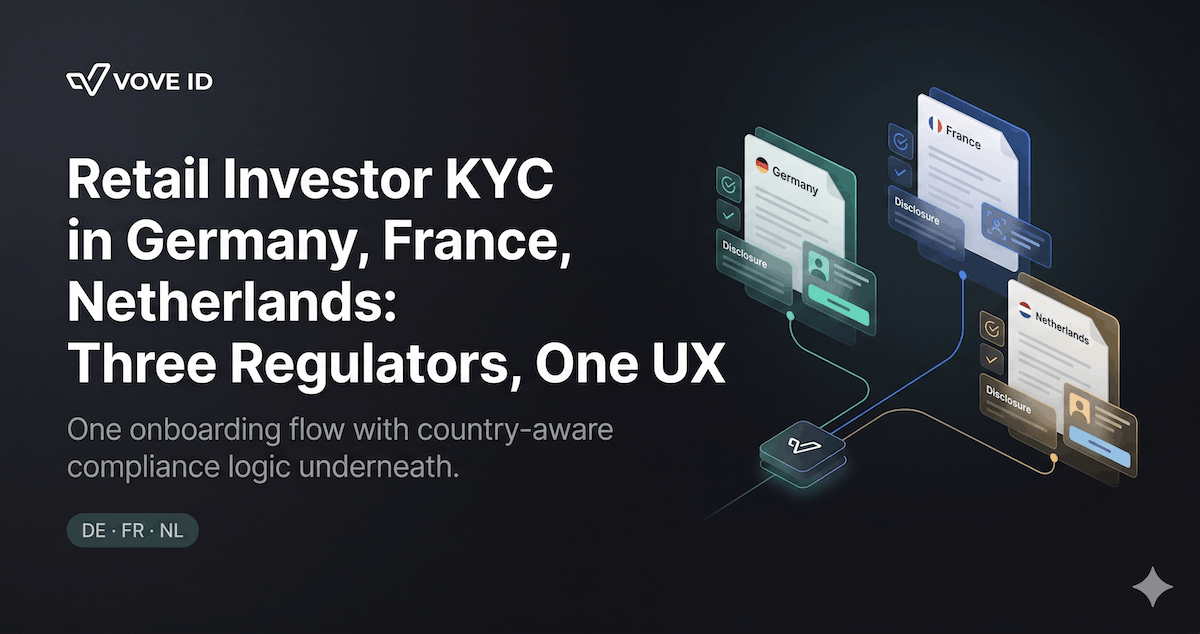
A better model is a common core with country-aware overlays. The common core can stay stable: identity verification, sanctions and PEP screening, fraud checks, and an auditable decision record. The overlays change by product, market, and risk trigger. A German investor in a simpler product may need a lighter disclosure path than a French investor entering a product structure that brings appropriateness questions forward. A Dutch investor may move through the same interface but generate different review artifacts in the back office.
The platform still looks unified. The compliance record does not pretend the three markets are identical.
A Realistic Failure: When a German File Fails a French Audit on Disclosure
A pan-EU investment platform launches with a clean KYC flow in Germany. The process is fast, conversion is healthy, and the internal compliance team is satisfied because identity, screening, and storage all work. Six months later the firm expands into France using the same onboarding path and the same acceptance wording.
Then a French review asks a simple question: where is the evidence that the relevant investor disclosures were presented in the right way, at the right point, and linked to the resulting decision?
The platform can show that users clicked through the journey. It cannot show a disclosure module tailored to the French context, a versioned record of what was shown, or a clean mapping from that step to the investor file.
That is how a file that looked complete in one market turns into a weak file in another. The identity evidence was fine. The operational sequencing was not.
For a full breakdown of AML and compliance requirements in France, see our AML Compliance in France 2025: Guide for Fintechs and Regulated Businesses.
How VOVE ID Hides the Differences Inside One UX
The best cross-border onboarding does not force investors to feel the regulatory complexity. It contains that complexity behind the scenes.
VOVE ID does this by separating the visible journey from the compliance logic beneath it. The investor sees one branded onboarding flow. Underneath, the platform can trigger different disclosure modules by jurisdiction and product type, request extra evidence only when thresholds or product risk require it, apply country-aware decision rules without rebuilding the front end, preserve a versioned audit record of every step, screen, and acceptance, and route higher-risk cases into review without slowing standard files.
That matters because retail expansion lives or dies on two numbers at the same time: conversion and audit resilience. If you optimize only for conversion, the regulatory file breaks later. If you optimize only for evidence gathering, the UX collapses immediately.
The correct design goal is one investor journey with invisible branching, not one static process applied everywhere.
What an Operationally Sound DE/FR/NL Setup Looks Like
For most retail investment platforms, the practical target state looks like this. Start with one baseline identity and screening flow. Layer in country-specific disclosure and product-governance modules. Trigger source-of-funds and enhanced due diligence only when risk, product, or value thresholds require it. Keep one decision record that links identity, disclosures, suitability outputs, and reviewer actions. Reuse the same customer-facing UX while letting compliance logic branch by jurisdiction.
This keeps the onboarding surface simple for investors while giving compliance and audit teams a file they can actually defend.
For a full breakdown of KYC compliance requirements in France, see our KYC Compliance in France 2025: Guide for Regulated Businesses.
Checklist
- Identity verification that works across DE, FR, and NL
- Country-aware disclosure logic behind one front-end journey
- Screening and escalation rules linked to each investor file
- Suitability or appropriateness evidence where the product requires it
- Versioned audit logs for every completed onboarding path
Q&A
Can one retail investor KYC flow work across Germany, France, and the Netherlands?
Yes, but only if the visible flow is supported by country-specific compliance logic underneath. One interface can work. One fixed evidence stack usually cannot.
What is the biggest cross-border mistake platforms make?
They assume that if identity verification is harmonized, the rest of the investor file is harmonized too. In practice, disclosure, audit evidence, and sequencing are where cross-border reviews often break.
Do platforms need separate onboarding products for each country?
Usually no. They need one UX with modular disclosures, configurable evidence triggers, and a single audit architecture that can reflect different supervisory expectations.
Conclusion
Germany, France, and the Netherlands do not require three separate retail onboarding products. They do require a compliance stack that understands where those markets diverge operationally. The firms that scale cleanly are the ones that keep the UX unified and the compliance logic flexible.
Running investor onboarding across DE, FR, and NL and not sure your audit trail holds up in all three markets? VOVE ID helps retail investment platforms keep one UX on the surface while the compliance logic branches correctly underneath — so the file looks clean to BaFin, AMF, and AFM, not just the one you launched in first.
This article is intended for general informational purposes only and does not constitute legal, financial, or regulatory advice. KYC/KYB/AML requirements may vary depending on jurisdiction, industry, and specific business circumstances. For up-to-date and binding compliance obligations, readers should refer to the relevant regulatory authorities or consult qualified professionals.