
Ongoing Monitoring for Alt-Investment Platforms: Beyond the Annual Review
Alt-investment platforms are no longer judged only on who they onboarded. In 2026, regulators want to know what changed after onboarding, how fast you noticed, and what you did next.
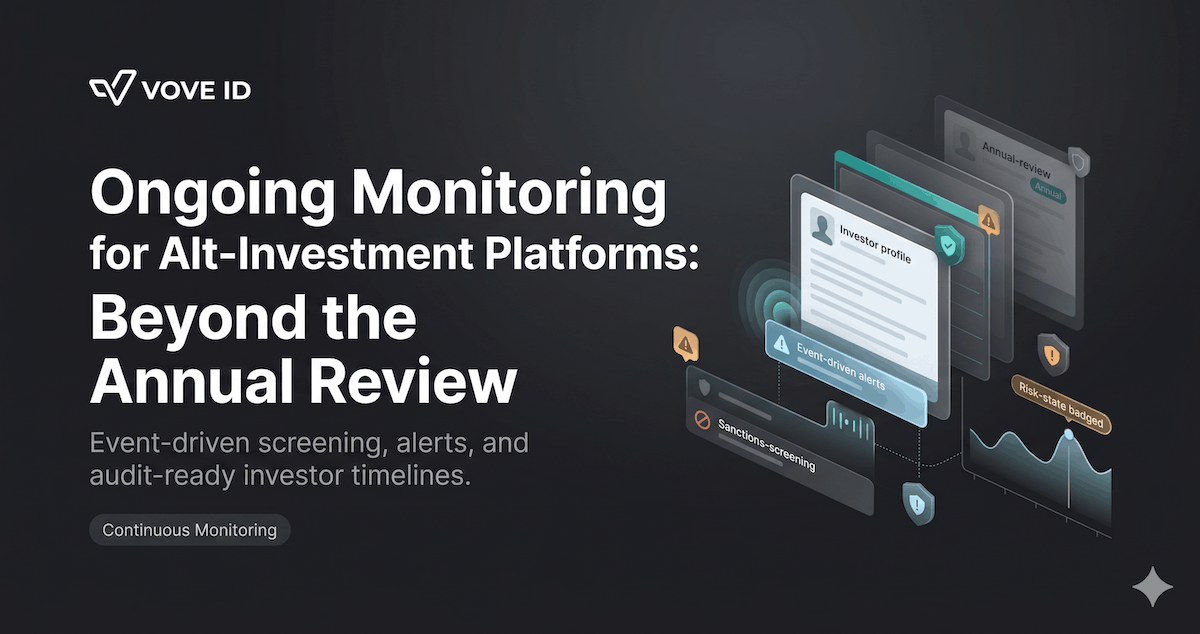
VOVE ID works with alternative investment platforms that need to move beyond annual KYC reviews toward monitoring that reacts when investor risk actually changes. This guide covers how event-driven monitoring works in practice and what a defensible ongoing monitoring setup looks like in 2026.
Direct Answer
Ongoing monitoring for alt-investment platforms in 2026 should be event-driven, not just annual. A defensible setup combines continuous screening, risk-based refresh triggers, adverse-media monitoring, and a review workflow that escalates real change without flooding operations with noise.
From Annual to Event-Driven Monitoring
The annual review used to be the default answer to ongoing monitoring. It was easy to schedule, easy to explain, and easy to build into operations. But it assumes investor risk changes slowly and predictably.
That assumption no longer holds.
Sanctions updates can hit overnight. PEP status can change immediately after an election or appointment. Adverse media can reveal beneficial ownership concerns or fraud indicators long before a scheduled refresh date. High-risk movement patterns can appear in transaction behavior well before the next periodic review.
For alt-investment platforms, this matters even more because investors may stay on the book for years. A file that was clean at onboarding can become stale long before the next annual checkpoint.
The regulator's question is no longer, "Did you review this investor eventually?" It is, "What system told you the risk profile changed, and how fast did you act?"
What Signals Actually Matter
Event-driven monitoring does not mean monitoring everything equally. That is how teams create alert fatigue and train themselves to ignore the system.
The useful signals are the ones that can materially change customer risk or the platform's obligations. For most alt-investment platforms, that means sanctions list changes, PEP status changes, adverse media tied to fraud, corruption, financial crime, or enforcement, source-of-funds inconsistencies for higher-value or higher-risk investors, ownership or control changes for legal entities, unusual transaction or subscription patterns relative to the investor profile, and threshold events such as larger tickets, unusual redemption behavior, or cross-border payment complexity.
A good monitoring design treats these as triggers, not as background noise. The platform should know which signals require a silent refresh, which require analyst review, and which require a temporary pause or enhanced due diligence.
For a full breakdown of how sanctions screening, transaction monitoring, and STR obligations fit into a compliant AML programme, see our AML Requirements Explained 2026: Compliance Operating System for Regulated Financial Institutions.
A Realistic Monitoring Failure: When a Sanctioned Investor Is Found via News, Not Screening
A fractional alt-investment platform has a top investor who passed onboarding cleanly. The file includes identity verification, screening at onboarding, and a calendar reminder for the annual refresh. Ninety days after onboarding, that investor becomes linked to a sanctions development reported in major financial press.
No screening refresh fires. No adverse-media trigger alerts the compliance team. The relationship manager finds the story first through general news coverage. By the time the team checks the file, the investor has remained active on the platform for weeks after the risk changed.
The problem is not only the missed screening event. The deeper problem is that the platform had no operating model for live change. It knew how to onboard. It did not know how to observe.
That is the gap regulators increasingly care about.
How VOVE ID Delivers Event-Driven Monitoring Without Alert Fatigue
The hard part of ongoing monitoring is not turning on more screening. The hard part is deciding what deserves action.
VOVE ID approaches this as a signal-routing problem. Low-value noise should not become analyst work. High-value changes should not wait for the next review cycle. The system runs continuous sanctions and PEP refreshes, captures adverse-media changes tied to real financial-crime risk, triggers source-of-funds refreshes when ticket size or investor behavior crosses thresholds, preserves a full timeline of what changed, when it changed, and who handled it, and escalates only the changes that alter customer risk, product eligibility, or reporting obligations.
That gives alt-investment platforms a way to replace the crude annual-review model with a risk-based operating rhythm. Standard investors keep moving. Material changes surface quickly. Reviewers work on real cases instead of drowning in low-value alerts.
Why Annual Reviews Alone Fail Fast-Growing Platforms
The annual model breaks hardest when the platform grows faster than the review calendar.
If you add thousands of investors, expand into more jurisdictions, or launch higher-value products, the review backlog starts to define your risk posture. Compliance becomes a race to the next batch instead of a response to actual change.
That creates three predictable problems. First, important cases wait too long because everything is grouped into the same review cycle. Second, review teams burn time on stable files while changed-risk files hide in the queue. Third, audit evidence shows process, but not responsiveness.
Event-driven monitoring fixes this by letting the monitoring workload follow risk instead of the calendar.
A Practical Monitoring Architecture for Alt-Investment Platforms
For most teams, the right target state is not a giant surveillance machine. It is a simple layered architecture. Keep periodic reviews for baseline hygiene and file completeness. Add continuous sanctions, PEP, and adverse-media refreshes. Define threshold triggers for ticket size, product exposure, and unusual behavior. Route triggered cases into a documented analyst workflow with clear outcomes. Preserve one investor timeline showing every alert, refresh, and decision.
This keeps ongoing monitoring proportional. It also gives the compliance team something much more valuable than a scheduled task list: a system that can explain why a case was reviewed now instead of later.
Checklist
- Continuous screening for sanctions and PEP changes
- Adverse-media monitoring tied to actual risk categories
- Threshold-based source-of-funds or EDD refreshes
- Clear case-routing rules for analysts and escalations
- A full audit timeline for every monitoring-triggered action
Q&A
Is an annual review still useful for alt-investment platforms?
Yes, but it should be the floor, not the full monitoring model. Annual reviews help maintain baseline file quality, but they are too slow to catch material changes on their own.
What is the main benefit of event-driven monitoring?
It lets platforms respond to changes when they happen instead of discovering them months later. That improves both regulatory defensibility and operational efficiency.
How can teams avoid alert fatigue?
By treating monitoring as a prioritization system. Not every signal should become a manual case. The useful model is continuous detection with risk-based escalation.
Conclusion
Alt-investment platforms can no longer treat ongoing monitoring as a yearly housekeeping task. In 2026, defensible monitoring means continuous signal, targeted escalation, and a decision trail that shows the platform reacts when investor risk changes. The platforms that make this shift early will scale with fewer surprises and far better audit resilience.
Running an alt-investment platform and still relying on annual reviews to catch risk changes? VOVE ID helps teams move from calendar-driven compliance to event-driven monitoring — so you know when an investor's risk profile changes, not just when the review cycle arrives.
This article is intended for general informational purposes only and does not constitute legal, financial, or regulatory advice. KYC/KYB/AML requirements may vary depending on jurisdiction, industry, and specific business circumstances. For up-to-date and binding compliance obligations, readers should refer to the relevant regulatory authorities or consult qualified professionals.