KYB Compliance in Botswana, A 2026 Guide for Regulated Businesses
CIPA now requires every Botswana company to declare nominee directors and shareholders, not just beneficial owners.
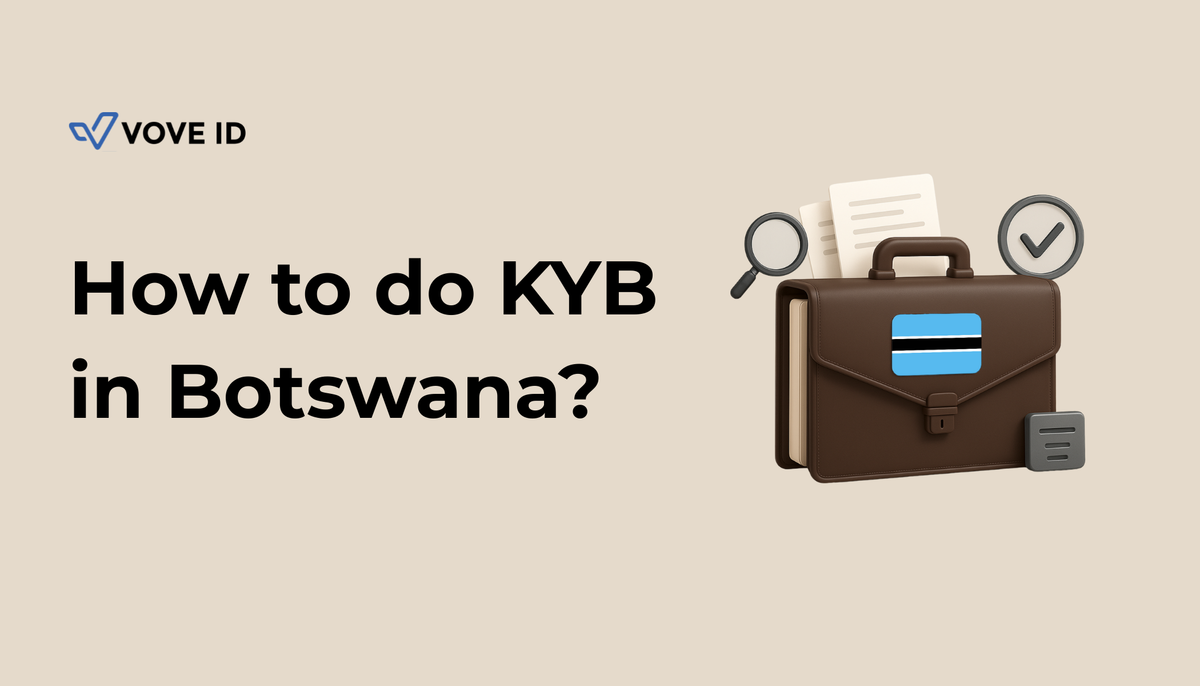
Botswana's reputation for stability and transparency makes it attractive for financial services and cross-border trade — and Know Your Business compliance is a real part of what sustains that reputation. For banks, fintechs, and other reporting entities, KYB goes well beyond confirming a company exists; it's about understanding who is actually behind it. VOVE ID helps regulated businesses build that verification properly.
This guide covers business verification requirements in Botswana. For the underlying KYB framework, see our KYB Requirements Explained 2026.
Regulatory Framework
- Financial Intelligence Act 2022, amended by the Financial Intelligence (Amendment) Act 2025.
- CIPA (Companies and Intellectual Property Authority): Botswana's company registry, requiring beneficial-owner declarations through its Online Business Registration System (OBRS).
- Companies (Amendment) Act 2025: updated company-law requirements, including nominee-arrangement disclosure.
For customer due diligence requirements for individual customers, see our KYC guide for Botswana.
Core KYB Requirements
1. Legal entity verification Registered name and number, legal form, certificate of incorporation, constitution, registered and operating addresses, tax/VAT numbers, trading license where applicable, and current CIPA status.
2. Beneficial ownership Identify natural persons who directly or indirectly hold more than 10% of shares, voting rights, or other ownership interest. Ownership percentage isn't the only test — also identify control through other means, and fall back to the senior managing official only if no natural person is identified after reasonable measures. Don't stop at a nominee, trust, or corporate shareholder in the chain.
3. CIPA beneficial-ownership declarations All new and existing companies must declare every natural person with ultimate ownership or control through CIPA's OBRS, including the nature of each interest. Resolve discrepancies before onboarding and refresh after any change.
4. Nominee and alternate arrangements CIPA's OBRS upgrade also requires disclosure of nominee or alternate directors and shareholders — identify the nominator and the ultimate natural person, and confirm the arrangement is declared to CIPA. This is a real gap in many onboarding checklists that only ask about direct shareholders.
5. Corporate authority Board resolutions authorizing the relationship, powers of attorney, mandates, and verification of directors, managers, and authorized signatories.
6. Trusts and partnerships For trusts: settlor, trustees, protector (if any), beneficiaries or class, and any natural person with ultimate effective control. For partnerships: every partner, including silent partners, plus authorized persons.
7. Business understanding Corroborate operating activity, licenses, expected transactions, and source of funds — with source of wealth evidence for elevated-risk cases.
Enhanced Due Diligence
Applies to companies with complex or opaque ownership structures, businesses in high-risk sectors, entities linked to prominent influential persons, and cross-border businesses with high-risk-jurisdiction exposure.
Record-Keeping
Botswana retains AML records for 20 years — transaction records from the transaction date, and CDD/relationship records from the end of the business relationship or occasional transaction. This is substantially longer than common international defaults and needs to be a deliberate part of system design, not an assumption inherited from other markets.
Common KYB Challenges
- Manual verification of company documents.
- Difficulty tracing beneficial owners through layered or nominee structures.
- Slow onboarding of corporate customers without automation.
- Inconsistent KYB processes across teams without a shared standard.
How VOVE ID Supports KYB in Botswana
VOVE ID helps regulated businesses:
- Verify company registration and CIPA status.
- Map ownership and control structures, including nominee arrangements.
- Screen directors and beneficial owners against sanctions and PEP lists.
- Maintain audit-ready records built for the 20-year retention horizon.
For the complete, sourced requirement-by-requirement checklist, see VOVE ID's Botswana compliance checklist.
Conclusion
KYB compliance in Botswana rewards businesses that go beyond a basic registry check — tracing real ownership through nominee arrangements, applying the correct beneficial-ownership test, and building for a long retention period. Businesses that get this right from the start avoid both onboarding friction and later compliance rework.
Nominee directors and shareholders are exactly where a basic KYB check misses the real owner. VOVE ID helps regulated businesses trace ownership all the way to the natural person behind it.
This article is intended for general informational purposes only and does not constitute legal, financial, or regulatory advice. KYC/KYB/AML requirements may vary depending on jurisdiction, industry, and specific business circumstances. For up-to-date and binding compliance obligations, readers should refer to the relevant regulatory authorities or consult qualified professionals.