KYC & AML Compliance in Guinea-Bissau: Same Rulebook, Different Reality
Guinea-Bissau shares its AML law with Togo and Côte d'Ivoire. Its enforcement track record looks nothing like theirs.
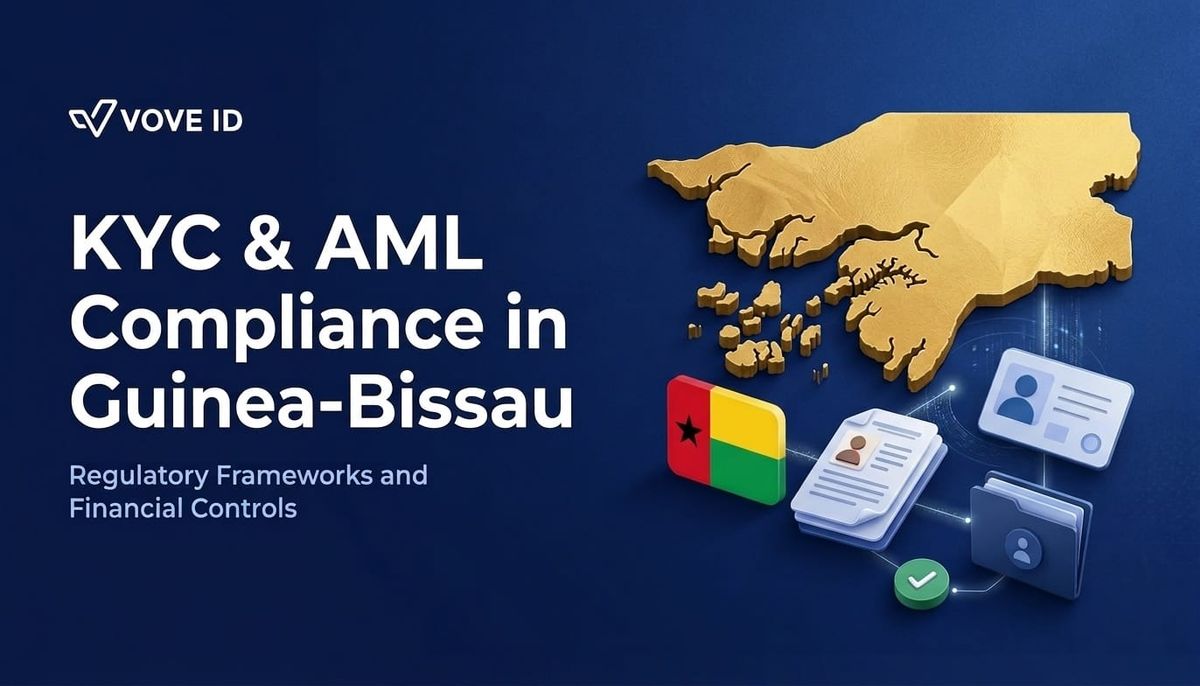
Guinea-Bissau belongs to the same monetary union as Togo, Côte d'Ivoire, and Senegal, and operates under the identical BCEAO-issued anti-money laundering law those countries do. On paper, that means a financial institution in Bissau faces the same customer due diligence, reporting, and supervisory framework as one in Lomé or Dakar. In practice, the two environments have almost nothing in common — and a compliance program built for the rulebook alone, without accounting for the reality it operates in, will miss the risk that actually matters here.
This article shares its legal framework with our brief on Togo's KYC and AML rules, since both countries apply the same UEMOA law — but Guinea-Bissau's enforcement track record and risk profile are distinct enough to need their own read, not a copy of that one with the country name changed.
The operating answer
A financial-services business in Guinea-Bissau needs risk-based AML/CFT controls built for a jurisdiction where the regional rulebook is solid on paper but effectiveness on the ground has scored close to zero in its own Mutual Evaluation. Digital onboarding works when identity evidence, source-of-funds context, and monitoring history stay connected in a case a reviewer can defend — not when it produces a fast approval that assumes the surrounding institutions will catch what the case itself misses.
VOVE ID keeps identity evidence, screening outcomes, and reviewer decisions attached to the same customer case, which matters most precisely where external institutional checks can't be relied on to catch what a case file doesn't already contain.
Establish the Guinea-Bissau perimeter
Guinea-Bissau is a member of the Union Économique et Monétaire Ouest Africaine (UEMOA) and applies the Loi uniforme relative à la lutte contre le blanchiment de capitaux, le financement du terrorisme et de la prolifération des armes de destruction massive, adopted by the UMOA Council of Ministers on 31 March 2023 and implemented through BCEAO instructions such as Instruction n°001-03-2025 on financial institutions' AML obligations. The national financial intelligence unit is the Cellule Nationale de Traitement des Informations Financières (CENTIF), the same institutional model used across UEMOA member states.
Where Guinea-Bissau diverges sharply from its neighbors is effectiveness. Its Mutual Evaluation Report, based on a GIABA on-site visit from 17 January to 5 February 2021, rated the country Compliant on 5 and Largely Compliant on 11 of the FATF's 40 Recommendations — but zero of its 11 effectiveness outcomes were rated Highly Effective or Substantially Effective. Guinea-Bissau also remains subject to United Nations sanctions under UNSCR 2048 (2012), imposed after that year's coup, including travel bans on designated individuals tied to threats against the country's stability; a UN sanctions list currently names 10 individuals. Guinea-Bissau is a member of GIABA and is not currently on the FATF list of jurisdictions under increased monitoring — but a clean grey-list status here reflects a narrower technical test, not a clean bill of health on the ground.
For a payment or financial license in Guinea-Bissau, the first operational task is treating the BCEAO rulebook as a floor, not a sufficient control on its own — the gap between technical compliance and actual effectiveness is precisely what the country's own evaluators have documented.
For the underlying identity-control model, see our KYC requirements framework.
Build a case around source of funds, not just source documents
Guinea-Bissau has been tracked by the UNODC as a cocaine-trafficking transit hub since 2008, sitting on a route between South American producers and European markets. What matters for a compliance program isn't the trafficking itself — it's where those proceeds end up: officials and researchers who track the country's illicit economy have consistently pointed to real estate and investment in ostensibly legitimate businesses as the most common channels for laundering the resulting cash. Layered onto an economy where cashew exports account for roughly 80% of the country's total exports, that creates two distinct risk patterns a financial institution needs to be able to tell apart: routine agricultural trade finance tied to the cashew season, and business or property investment that doesn't match any visible legitimate income source.
For a business customer, that means the KYB file needs to hold declared source of funds and business activity in a form a reviewer can actually test against — not just a completed registration document. A trading company or real estate purchaser whose paperwork is in order but whose funding source has no visible legitimate origin is exactly the profile the country's own risk environment predicts, and a case built only to clear document checks won't surface it.
For the broader entity- and beneficial-ownership model, see our KYB requirements framework.
Case note: a real estate purchase that cleared every document check
A Bissau-based financial institution processes a property purchase for a locally registered trading company. The company's registration is valid, the representative's identity clears verification, and the purchase price is within a plausible range for the property type. Every individual document check passes.
What the case doesn't capture is that the company's declared trading activity — a modest cashew export operation — doesn't generate anywhere near the cash flow the purchase implies, and no other funding source is on file. Because the onboarding process was built to confirm identity and registration status rather than to test source of funds against declared activity, nothing in the case flags the mismatch.
This isn't a document-verification failure. It's a case-design failure: in an environment where real estate is a documented laundering channel, a KYB process that stops at "is this company real" without asking "does this company's declared activity explain this transaction" is checking the wrong thing.
Connect monitoring to institutions that can't always be relied on
Reporting entities submit suspicious transaction reports to CENTIF. Given the effectiveness gaps GIABA's evaluation documented — and the broader institutional fragility that outside observers have tied to Guinea-Bissau's political instability — a firm's own internal escalation quality carries more weight here than in a jurisdiction with a stronger enforcement track record to lean on.
In practice, that means defining trigger events specifically around source-of-funds mismatches, transactions in cash-intensive sectors like real estate and import-export trade, and business relationships whose declared activity doesn't support their transaction volume — and making sure each trigger produces a case a reviewer can act on internally, rather than assuming a report to CENTIF closes the loop.
For the broader screening, case-management, and escalation model, see our AML requirements framework.
Design for a rulebook that outperforms its enforcement
The practical lesson from Guinea-Bissau's own Mutual Evaluation is that having the right law on the books — which it does, the same UEMOA law its neighbors apply — doesn't guarantee the surrounding system will catch what a weak onboarding process misses. A financial institution operating there needs to compensate for that gap directly, rather than assuming supervisory and law-enforcement backstops will function the way they might in a market with a stronger effectiveness record.
The operational test: if a customer's transaction volume or asset purchase doesn't match their declared source of funds, does the case surface that on its own — or does it depend on an external check that, per the country's own evaluators, may not be there?
Field checklist
Governance
- Confirm current obligations under the 2023 UEMOA uniform AML/CFT/PF law and applicable BCEAO instructions.
- Treat effectiveness gaps documented in the 2021 Mutual Evaluation as a design input, not background context.
- Assign accountable owners for risk assessment, exceptions, monitoring, and CENTIF reporting.
Onboarding
- Capture declared source of funds and business activity for every account or transaction above a defined threshold, especially for real estate and trade-related customers.
- Compare transaction size and asset purchases against declared activity at onboarding, not only after the fact.
- Screen against the UN sanctions list tied to UNSCR 2048 alongside standard sanctions and PEP screening.
Monitoring
- Define triggers for source-of-funds mismatches, cash-intensive-sector activity, and transaction volume inconsistent with declared business.
- Compare live activity against the original relationship profile at defined intervals.
- Maintain a tested internal escalation route into CENTIF, documented well enough to stand on its own.
Records
- Retain source evidence, risk ratings, and reviewer decisions together.
- Restrict access to sensitive identity and case data by role.
- Test whether a reviewer can identify a source-of-funds mismatch from the case file alone, without relying on external verification that may not be available.
Questions teams ask before launch
Which law governs AML/CFT in Guinea-Bissau right now?
The UEMOA uniform law on money laundering, terrorist financing, and proliferation financing, adopted 31 March 2023 and implemented through BCEAO instructions — the same regional framework applied in Togo, Côte d'Ivoire, and Senegal.
Is Guinea-Bissau on the FATF grey list?
No. Guinea-Bissau is not currently on the FATF list of jurisdictions under increased monitoring, though its 2021 Mutual Evaluation Report found significant effectiveness gaps across all 11 assessed outcomes.
Are there active international sanctions tied to Guinea-Bissau?
Yes. Guinea-Bissau remains subject to United Nations sanctions under UNSCR 2048, adopted after the 2012 coup, which currently designates 10 individuals for targeted measures including travel bans.
Where are suspicious transaction reports filed in Guinea-Bissau?
Reports go to CENTIF, the Cellule Nationale de Traitement des Informations Financières. Firms should follow their approved internal escalation procedures and current guidance for the applicable reporting decision.
The operating position
The regional law is solid; the effectiveness score next to it is close to zero. VOVE ID helps financial institutions keep source-of-funds evidence, screening outcomes, and reviewer decisions attached to a case that doesn't depend on external checks the country's own evaluators have flagged as weak.
This article is intended for general informational purposes only and does not constitute legal, financial, or regulatory advice. KYC/KYB/AML requirements may vary depending on jurisdiction, industry, and specific business circumstances. For up-to-date and binding compliance obligations, readers should refer to the relevant regulatory authorities or consult qualified professionals.