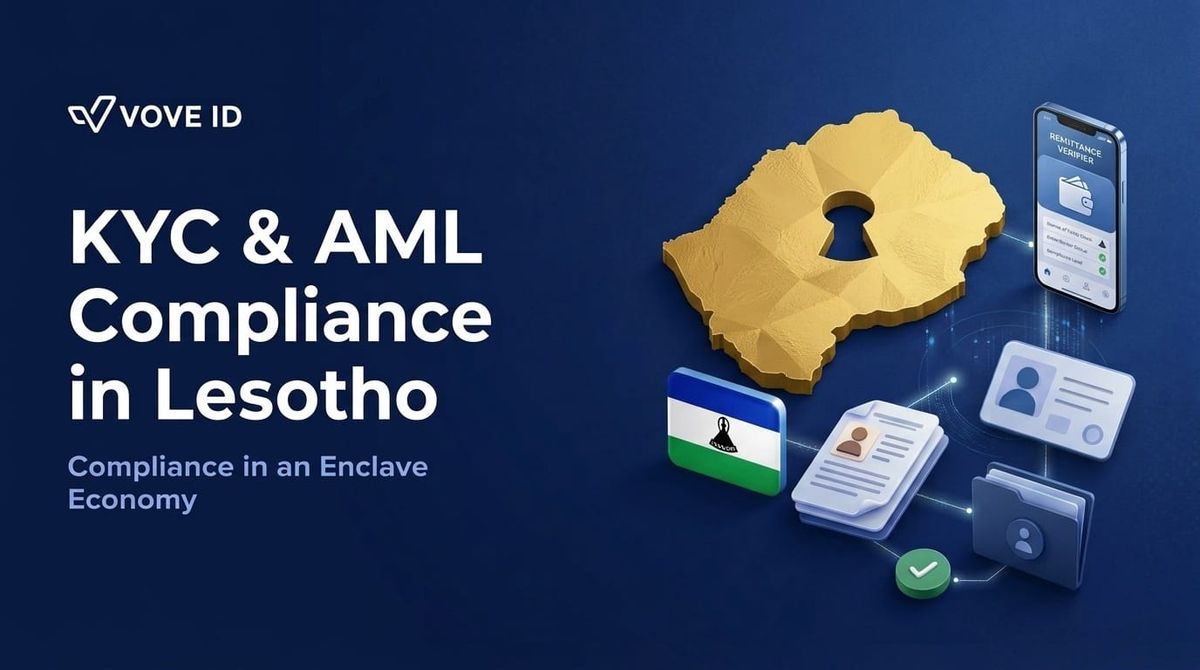
KYC & AML Compliance in Lesotho: Compliance in an Enclave Economy
Lesotho is the only country fully enclosed by another. Here is what that means for KYC and AML in a shared-currency economy.
LinkedIn summary: Lesotho is the only country in the world entirely enclosed by a single neighbor, and its financial system reflects that: the loti is pegged 1:1 to the South African rand and both currencies circulate freely, remittances from Basotho working in South African mines have made up roughly a quarter of GDP, and the country's diamond sector — anchored by the Letšeng mine — has produced some of the largest gem-quality stones ever found. For financial institutions supervised under the Money Laundering and Proceeds of Crime Act, that cross-border entanglement with South Africa is the defining compliance variable. Read the full guide → [link] Hashtags: #VOVEID #AML #KYC #ComplianceLesotho #ESAAMLG #SouthernAfrica #Remittances #DiamondCompliance
Lesotho is the only country in the world entirely surrounded by a single other nation. That geography isn't a curiosity — it's the central fact of the country's financial system. The loti is pegged one-to-one to the South African rand, and both currencies circulate side by side inside Lesotho. For a financial-services business operating there, the compliance question isn't just "what does Lesotho's law require" — it's "how much of this customer's real financial life actually happens across a border that, for currency purposes, barely functions as one."
The operating answer
A Lesotho-based financial-services business needs risk-based AML/CFT controls built around cross-border entanglement with South Africa as a default condition, not an edge case. Digital onboarding works when identity evidence, cross-border income context, and monitoring history stay connected in a case a reviewer can defend — not when it treats a customer's financial life as though it stops at Lesotho's border.
Establish the Lesotho perimeter
Lesotho's AML/CFT framework is anchored by the Money Laundering and Proceeds of Crime Act, 2008, substantially amended by the Money Laundering and Proceeds of Crime (Amendment) Act, 2016. The 2008 Act established both an Anti-Money Laundering Authority and the Financial Intelligence Unit (FIU), which began operating that year and now acts as secretariat across the country's AML/CFT institutional structure, with the Ministry of Finance responsible for overall policy. Schedule 1 of the Act sets out accountable institutions, amended over time by ministerial notice to add categories including bureaux de change, money or value transfer service providers, and motor vehicle dealerships — and explicitly includes mobile money and money transfer services alongside banks, insurers, and cooperatives.
Lesotho is a member of ESAAMLG, the FATF-style regional body for Eastern and Southern Africa, and underwent its most recent Mutual Evaluation with an on-site visit and a report adopted in 2023. The evaluation found Lesotho largely compliant across the core money-laundering and terrorist-financing offense Recommendations, but rated the country Non-Compliant on targeted financial sanctions related to proliferation financing (Recommendation 7) and only Partially Compliant on terrorism-related sanctions and non-profit-organization oversight — and separately noted that the FIU's financial and human resources are inadequate for the effective discharge of its mandate. Lesotho is not currently on the FATF list of jurisdictions under increased monitoring.
For a payment, remittance, or money-transfer license, the first operational task is confirming which accountable-institution category applies and building controls that account for the FIU's documented capacity constraints — a firm's own case quality carries more weight here than in a jurisdiction with a better-resourced financial intelligence function to lean on.
For the underlying identity-control model, see our KYC requirements framework.
Build a case around cross-border income, not just a Lesotho address
Lesotho's economy has historically run on labor migration: at its peak, around 100,000 Basotho worked in South African mines, and even with that number now much lower, remittances from South Africa have made up roughly a quarter of Lesotho's GDP in recent years, with the vast majority of migrant-sending households listing them as their primary income source. Because the loti and rand are interchangeable and both circulate freely inside Lesotho, a customer's income, savings, and spending can move across the South African border without ever generating the kind of paper trail a purely domestic transaction would.
That reality means a Lesotho KYC or KYB file that only captures a customer's declared Lesotho-based income tells a reviewer very little. For an individual customer, source-of-funds evidence needs to account for South African wage or business income as a routine case, not an exception. For a business customer — particularly one connected to the diamond sector, where Gem Diamonds' Letšeng mine has produced some of the largest gem-quality diamonds ever recorded, including a 164-carat stone valued at roughly £6 million — ownership, financing, and export-revenue flows often run through South African or other foreign corporate structures that a domestically-scoped KYB process won't surface on its own.
For the broader entity- and beneficial-ownership model, see our KYB requirements framework.
Case note: a remittance pattern that looked like income, until it didn't
A Maseru-based money transfer business onboards a customer whose primary declared income is wages from a South African employer, with regular inbound transfers consistent with that profile. The case clears standard due diligence: the employer is verifiable, the transfer amounts are plausible for the stated occupation, and the currency movement between rand and loti raises no immediate flag given how routine that flow is for Basotho customers.
Over time, the transfer amounts grow well beyond what the stated wage would support, and a portion begins arriving from parties unconnected to the original employer. Because the original onboarding didn't capture a baseline income range to compare against, and because cross-border rand transfers are treated as unremarkable by default, nothing in the case structure flags that this specific pattern has diverged from a normal remittance relationship.
This isn't a screening failure — no name involved ever appears on a sanctions or PEP list. It's a case-design failure: in an environment where nearly every customer has a legitimate reason to move money across the South African border, the case needs a baseline to measure drift against, not just a plausible story at onboarding.
Connect monitoring to sector-specific and sanctions gaps
Reporting entities submit suspicious transaction reports to the FIU. Given the FIU's documented resource constraints and the Non-Compliant rating on proliferation-related targeted financial sanctions, firms should treat sanctions-list screening — including proliferation-related designations, not just standard AML/terrorism lists — as an area where their own internal controls need to be more rigorous than the minimum a resource-constrained FIU can verify.
In practice, that means defining trigger events for income or transfer patterns that diverge from an established baseline, applying enhanced scrutiny to diamond-sector and other extractive-industry business relationships given their foreign-ownership and export-revenue structures, and ensuring proliferation-related sanctions screening is built into onboarding rather than treated as a subset of general AML screening.
For the broader screening, case-management, and escalation model, see our AML requirements framework.
Design onboarding for a market where "domestic" and "cross-border" blur
Because the loti and rand are interchangeable within Lesotho and the country's Common Monetary Area membership with South Africa, Namibia, and Eswatini formalizes that entanglement, a compliance program that treats cross-border and domestic transactions as fundamentally different categories will misclassify a large share of ordinary customer activity. The more useful distinction for a Lesotho-based financial institution is between transactions consistent with a customer's established income and occupation profile, and those that aren't — regardless of which side of the border the money technically originated on.
The operational test: does the case capture a customer's South African income or business ties clearly enough at onboarding to detect when activity later diverges from that baseline — or does it only notice a problem once a transfer is large enough to trip a generic threshold?
Field checklist
Governance
- Confirm accountable-institution category under Schedule 1 of the MLPCA, as amended.
- Build proliferation-related sanctions screening into standard onboarding, not as an afterthought, given ESAAMLG's Non-Compliant rating on Recommendation 7.
- Assign accountable owners for risk assessment, exceptions, monitoring, and FIU reporting.
Onboarding
- Capture South African (or other cross-border) income, employment, or business ties as a standard part of source-of-funds evidence, not an exception case.
- Apply enhanced diligence to diamond-sector and other extractive-industry business relationships given typical foreign-ownership structures.
- Record a baseline income or transaction range for every customer relationship in a retrievable form.
Monitoring
- Define triggers for transfer or income patterns that diverge from the customer's established baseline.
- Screen consistently against proliferation-related sanctions lists, not only standard AML and terrorism lists.
- Maintain a tested internal escalation route into the FIU, documented well enough to stand on its own given the FIU's resource constraints.
Records
- Retain source evidence, baseline profiles, and reviewer decisions together.
- Restrict access to sensitive identity and case data by role.
- Test whether a reviewer can identify drift from a customer's baseline without relying on a generic transaction-size threshold alone.
Questions teams ask before launch
Which law governs AML/CFT in Lesotho right now?
The Money Laundering and Proceeds of Crime Act, 2008, as amended by the 2016 Amendment Act, which established the Anti-Money Laundering Authority and the FIU.
Is Lesotho on the FATF grey list?
No. Lesotho is not currently on the FATF list of jurisdictions under increased monitoring, though its 2023 Mutual Evaluation found gaps, including a Non-Compliant rating on proliferation-related targeted financial sanctions.
Why does South Africa matter so much for AML compliance design in Lesotho?
Because the loti is pegged to and circulates alongside the South African rand, and a large share of household income in Lesotho has historically come from South African wages, a customer's real financial activity routinely crosses a border that functions more like an internal boundary than an international one for currency purposes.
Where are suspicious transaction reports filed in Lesotho?
Reports go to the Financial Intelligence Unit (FIU). Firms should follow their approved internal escalation procedures and current guidance for the applicable reporting decision.
The operating position
Lesotho's compliance challenge isn't a missing legal framework — the MLPCA and its 2016 amendment cover the basics, and the country isn't grey-listed. It's that the country's entire financial life runs through a border that, for currency and income purposes, barely behaves like one, on top of an under-resourced FIU and a documented gap in proliferation-sanctions controls. A case file built around a purely domestic customer picture will miss exactly where most Basotho financial activity actually happens.
Want to see how VOVE ID can fit into a case that tracks cross-border income against a real baseline instead of a generic threshold? Walk through the workflow with your team before you scale onboarding in Lesotho.
This article is intended for general informational purposes only and does not constitute legal, financial, or regulatory advice. KYC/KYB/AML requirements may vary depending on jurisdiction, industry, and specific business circumstances. For up-to-date and binding compliance obligations, readers should refer to the relevant regulatory authorities or consult qualified professionals.