KYC & AML Compliance in Somalia: Building Due Diligence for a Mobile-Money Economy
Somalia's own currency is barely usable. Here is what that means for KYC and AML when mobile money carries the economy instead.
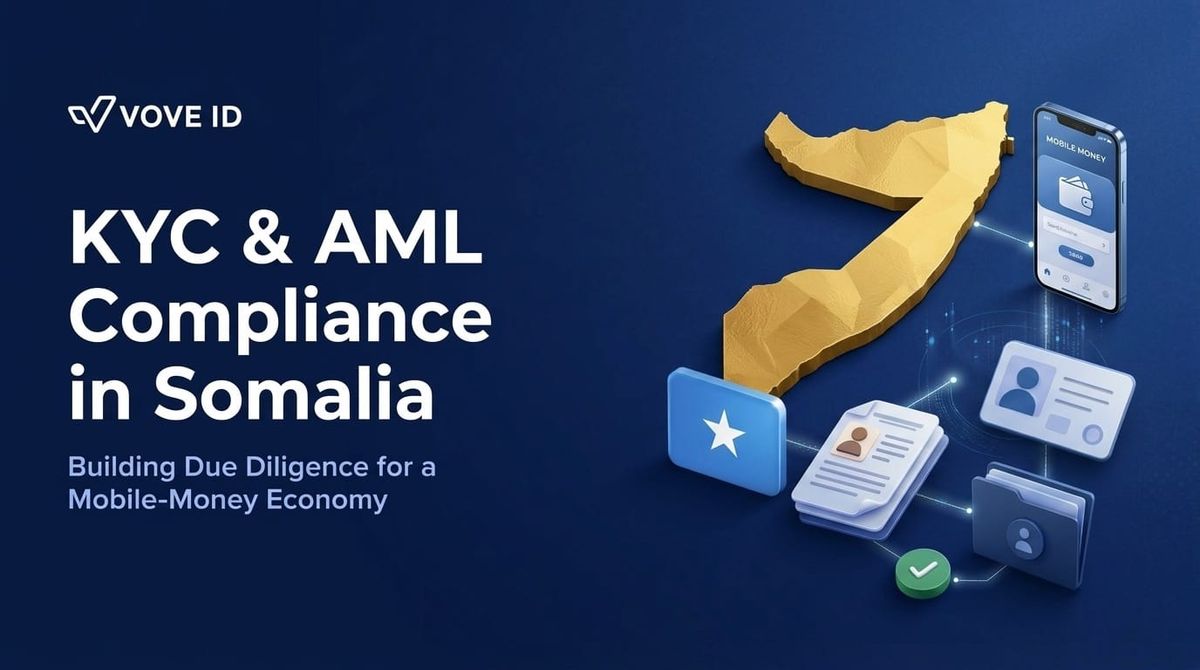
Somalia's own currency barely functions as money. The Somali shilling hasn't been printed since 1991, and by the U.S. State Department's own account, more than 98% of the shilling notes still in circulation are counterfeit. What actually moves the Somali economy is the U.S. dollar, hawala networks, and mobile money — and as of 2023, 89% of the population used mobile money services while only 8.8% had access to formal banking. For a financial-services business operating in Somalia, that inversion is the starting point for any onboarding or monitoring design, not a footnote to it.
The operating answer
A Somali financial-services business needs risk-based AML/CFT controls built for an economy where mobile money and hawala carry more transaction volume than banks do, and where the country's own currency isn't a reliable unit of account. Digital onboarding works when identity evidence, corridor and agent context, and monitoring history stay connected in a case a reviewer can defend — not when it assumes a banking-centric customer journey that most Somalis simply don't have.
Establish the Somali perimeter
Somalia's AML/CFT regime is anchored by the Anti-Money Laundering and Countering the Financing of Terrorism Act, 2016, which created the Financial Reporting Center (FRC) — Somalia's financial intelligence unit, headquartered in Mogadishu — and established the National Anti-Money Laundering and Countering the Financing of Terrorism Committee (NAMLC) as the multi-institutional body that sets AML/CFT policy, with the FRC serving as its secretariat. The 2016 Act was substantially amended by the Anti-Money Laundering and Countering the Financing of Terrorism Amendment Act, 2025. The Central Bank of Somalia (CBS) licenses and supervises banks, the ten hawalas, and the three mobile money service providers currently operating under its authority.
Somalia's federal structure adds a layer most compliance guides skip past: alongside the CBS, both Somaliland and Puntland operate their own central banks, and mobile money in practice runs along regional lines — Hormuud Telecom's EVC Plus dominates South Central Somalia, Telesom's Zaad leads in Somaliland, and Golis' Sahal serves Puntland. A national compliance program has to account for which regional authority and platform actually governs a given customer relationship, not just the federal rulebook.
Somalia is a member of MENAFATF (the Middle East and North Africa FATF-style regional body) and published its first National Risk Assessment in 2022 ahead of a mutual evaluation now underway, with an on-site visit expected around mid-2024 and Plenary discussion to follow. FATF's own country page for Somalia additionally notes that Somalia's FATF membership was suspended on 24 February 2023 — a status distinct from grey-listing, and one firms should track directly with FATF and MENAFATF rather than assume resolved. Somalia is not currently on the FATF list of jurisdictions under increased monitoring (the 22-jurisdiction grey list as of the June 2026 Plenary).
For the underlying identity-control model, see our KYC requirements framework.
Build a case around the agent and the corridor, not just the account
Remittances into Somalia total an estimated $2 billion a year, roughly 25% of GDP, according to the State Department's most recent assessment, and the large majority of that flow moves through hawalas and mobile money platforms rather than banks. The U.S. government has also been explicit that hawala and mobile operators face increased scrutiny over terrorist-financing risk, specifically citing efforts to disrupt al-Shabaab's financing networks through coordination between financial institutions, the FRC, and mobile money regulators.
That risk concentration changes what due diligence needs to look like for a Somali payments or remittance business. For a hawala agent, mobile money merchant, or business customer, the case needs to connect entity identity, licensing status with the CBS (or the relevant regional authority), the corridors and counterparties the business actually serves, and how its declared activity compares to its real transaction volume — not just a completed identity check. Given how much of the market runs through informal or semi-formal channels, KYB here is as much about establishing whether an agent relationship is licensed and traceable as it is about beneficial ownership in the traditional sense.
For the broader entity- and beneficial-ownership model, see our KYB requirements framework.
Case note: an agent whose volume outgrew its declared purpose
A Mogadishu-based money transfer business onboards a new hawala sub-agent operating in a border region, cleared at a standard risk tier based on declared remittance volume tied to a specific diaspora corridor. The sub-agent's actual transaction volume grows well beyond that declared figure over several months, and a portion of it begins routing through counterparties the original onboarding never identified.
Each individual transfer clears identity and sanctions screening — the counterparties aren't on any list, and the sub-agent's paperwork remains technically in order. But because the original risk assessment, the volume growth, and the new counterparties sit in separate records, no single reviewer sees that the agent's real activity has moved well outside the profile it was onboarded under — a pattern that, in a market where terrorist-financing risk is explicitly flagged by regulators, carries more weight than it would elsewhere.
This isn't a screening failure. It's a case-management failure: nothing connected the original onboarding decision to the drift that followed it, in an environment where that drift is exactly what supervisors are watching for.
Connect monitoring to a reporting system still being built out
Reporting entities submit suspicious transaction reports to the FRC. With NAMLC and the FRC actively developing new compliance measures under the 2025 amendment, and Somalia's institutional capacity to enforce AML/CFT still developing more broadly, a firm's own internal case quality — clear evidence, a documented rationale, a traceable decision — carries real weight rather than being a formality on top of a stronger external system.
In practice, that means defining trigger events for agent volume growth, new corridors or counterparties, and declared-activity mismatches, and ensuring each trigger produces a case that retains the original relationship profile alongside the new evidence — rather than assuming a downstream review will catch what the case itself didn't flag.
For the broader screening, case-management, and escalation model, see our AML requirements framework.
Design onboarding for where the money actually moves
Somalia's 2025 launch of its first nationwide instant payment system, alongside continued growth in mobile wallet adoption, signals that digital rails — not branch banking — are where the next wave of Somali financial inclusion is happening. For a financial-services business, that means onboarding needs to work for a mobile-first, largely unbanked customer base from the outset, with identity evidence standards calibrated to what's actually available (national ID, mobile-operator KYC data, hawala referral networks) rather than assuming bank-grade documentation most customers won't have.
The operational test: can a compliance reviewer reconstruct why a specific hawala agent, mobile money merchant, or remittance corridor was rated the way it was, without assuming a banking relationship that, for most Somali customers, doesn't exist?
Field checklist
Governance
- Confirm CBS licensing category and current obligations under the 2016 AML/CFT Act as amended in 2025.
- Identify whether the business operates under CBS, Somaliland, or Puntland regulatory authority, or across more than one.
- Assign accountable owners for risk assessment, exceptions, monitoring, and FRC reporting.
Onboarding
- Capture licensing status, corridor, and counterparty context for hawala and mobile-money agent relationships, not just individual customers.
- Calibrate identity evidence standards to what's realistically available in a largely unbanked, mobile-first market.
- Record the original risk rationale for every business relationship in a retrievable form.
Monitoring
- Define triggers for agent volume growth, new corridors, and counterparties outside the original onboarding profile.
- Apply heightened attention to patterns consistent with terrorist-financing typologies regulators have publicly flagged.
- Maintain a tested internal escalation route into the FRC.
Records
- Retain source evidence, risk ratings, and reviewer decisions together.
- Restrict access to sensitive identity and case data by role.
- Test whether a reviewer can reconstruct an agent's case history without cross-referencing multiple systems.
Questions teams ask before launch
Which law governs AML/CFT in Somalia right now?
The Anti-Money Laundering and Countering the Financing of Terrorism Act, 2016, as amended by the 2025 Act, alongside CBS regulations for banks, hawalas, and mobile money providers.
Is Somalia on the FATF grey list?
No. Somalia is not currently on the FATF list of jurisdictions under increased monitoring, though FATF's own records note its FATF membership was suspended in February 2023, and the country is undergoing a mutual evaluation through MENAFATF.
Why does mobile money matter so much for compliance design in Somalia?
Because 89% of the population uses mobile money against just 8.8% with formal banking access, most customer relationships and transaction risk in Somalia run through mobile wallets and hawala agents rather than bank accounts — a program built around branch banking will miss where the actual activity is.
Where are suspicious transaction reports filed in Somalia?
Reports go to the Financial Reporting Center (FRC). Firms should follow their approved internal escalation procedures and current CBS guidance for the applicable reporting decision.
The operating position
Somalia's compliance challenge isn't fitting a banking-style due-diligence program into a smaller market — it's building one for an economy that never ran on banks in the first place, where mobile wallets and hawala agents carry the transaction volume, and where a currency, a central bank, and even a FATF status all reflect a country still assembling its financial infrastructure in real time. A case file built around bank-account assumptions will miss where the risk, and the customers, actually are.
Want to see how VOVE ID can fit into a case that tracks agents, corridors, and volume drift instead of just accounts? Walk through the workflow with your team before you scale onboarding in a mobile-first market like Somalia.
This article is intended for general informational purposes only and does not constitute legal, financial, or regulatory advice. KYC/KYB/AML requirements may vary depending on jurisdiction, industry, and specific business circumstances. For up-to-date and binding compliance obligations, readers should refer to the relevant regulatory authorities or consult qualified professionals.