KYB Compliance in Cabo Verde: 2026 Guide for Regulated Businesses
How business verification works in Cabo Verde — from the commercial registry and entity types to UBO disclosure, CENTIF obligations, and what breaks when onboarding foreign-owned entities.
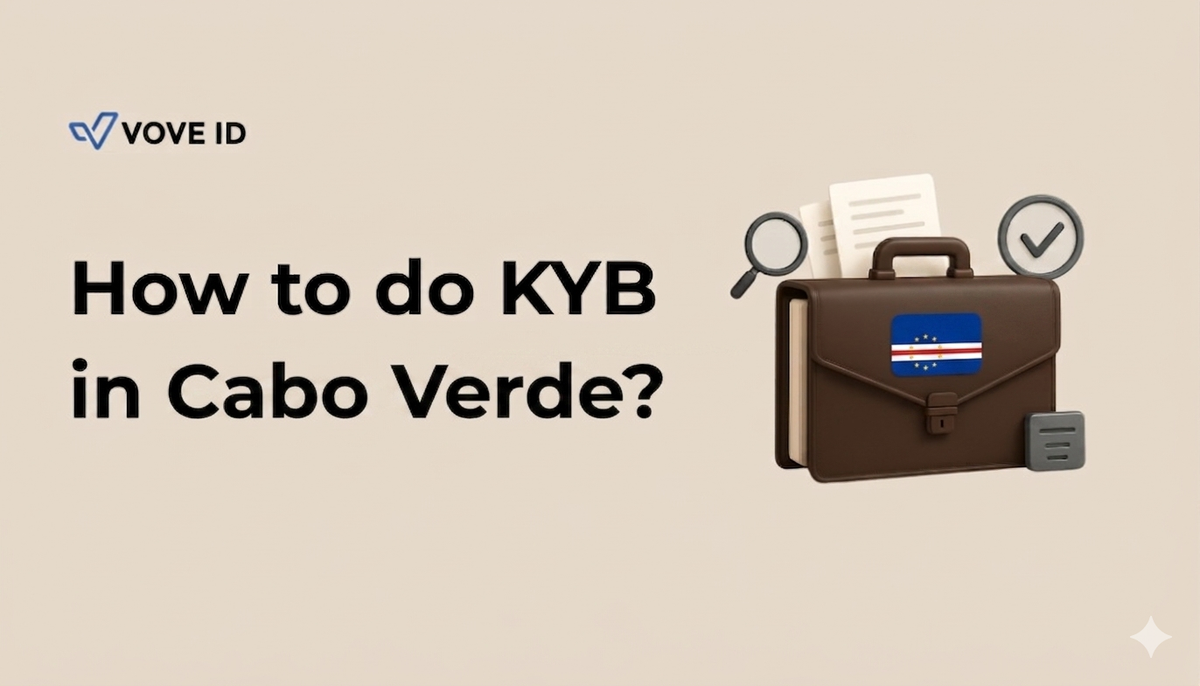
Business verification in Cabo Verde takes place against a legal backdrop that combines Portuguese commercial law traditions with an island economy defined by tourism, diaspora remittances, and a growing offshore financial sector. For regulated entities onboarding corporate customers incorporated in the archipelago — or foreign companies seeking to establish a local presence — the verification requirements are defined by a combination of the Commercial Companies Code, AML legislation, and BCV regulatory notices. VOVE ID supports teams operating in markets like this with biometric identity verification for UBO layers that lack public registry coverage.
This guide covers the current KYB framework in Cabo Verde, including entity structures, the commercial registry, UBO disclosure requirements, required documentation, and the practical friction points in corporate onboarding. For the underlying KYB framework and workflows, see our KYB Requirements Explained: 2026.
Legal Framework for Business Verification
The primary legislation governing KYB obligations in Cabo Verde sits across three instruments:
Law No. 57/VIII/2013 — the main AML/CFT statute — establishes the core CDD obligations for legal entity customers, including identification of the entity, its directors, and its beneficial owners. Obliged entities must verify information using reliable and independent sources and apply ongoing monitoring to corporate relationships.
Law No. 58/VIII/2013 — the beneficial ownership statute — defines a beneficial owner as any natural person who ultimately owns or controls more than 25% of a company's shares or voting rights. This 25% threshold aligns with the standard FATF/EU approach and applies across the spectrum of corporate structures.
The Commercial Companies Code (Código das Sociedades Comerciais, 2019) — which replaced the earlier Commercial Companies Code — governs incorporation, governance structures, share transfer restrictions, and the obligations around maintaining ownership records. The 2019 update is the current operative framework for corporate law.
Entity Structures
Two corporate structures account for the overwhelming majority of commercial entities in Cabo Verde:
Sociedade por Quotas (LDA) — the limited liability company, equivalent to a Portuguese Lda. or a UK private limited company. This is the most common vehicle for small and medium businesses and foreign investor subsidiaries. Liability is limited to the value of subscribed quotas. A minimum share capital of CVE 100,000 applies in practice (at least 50% paid up at incorporation). Single-member formation is permitted. Management is carried out by one or more managers who may be partners or third parties, and no resident director requirement exists under the Companies Code. Quota transfers require the consent of members representing the majority of the capital.
Sociedade Anónima (SA) — the joint-stock company, equivalent to a public limited company. Required for larger businesses seeking external capital or public listing. The board of directors must comprise at least three members (odd number required). Shares are generally more freely transferable than quotas.
Branch offices of foreign companies are also permitted, registered under the local commercial registry.
The 2019 Commercial Companies Code governs both structures and defines the governance, ownership transfer, and record-keeping obligations. For KYB purposes, the key difference is transferability: quota transfers in an LDA require registry notification, while SA share transfers can occur without the same level of visibility — which creates a lag in public ownership information.
Registration: Conservatória do Registo Comercial and Casa do Cidadão
Company registration in Cabo Verde is administered through the Conservatória do Registo Comercial (commercial registry) via the Casa do Cidadão's one-stop-shop, operated by the Instituto do Registo e do Notariado (IRN). This is the central filing point for:
- Articles of association (escritura de constituição or statutes)
- Director appointments and shareholder details
- Registered office address
- Share capital structure and quota distribution
- UBO declarations (submitted as part of the AML-compliance layer at formation)
Changes to registered information — including ownership transfers and director changes — must be filed with the Conservatória. However, the registry is not structured as a real-time searchable database accessible via public API in the way that, for instance, Companies House in the UK operates. Obtaining up-to-date registry extracts (certidão de registo comercial) requires formal requests and may have processing delays.
For KYB purposes, this means that commercial registry data provides a baseline but may not reflect the most recent ownership changes. Ongoing monitoring of corporate customers requires a process for periodic re-verification, particularly when the underlying beneficial ownership structure is complex or involves quota transfers.
UBO Disclosure and the 25% Threshold
Under Law No. 58/VIII/2013, beneficial ownership disclosure is mandatory at incorporation and whenever ownership changes occur. The applicable threshold is 25% of shares or voting rights — consistent with the FATF standard and the approach taken in most ECOWAS and GIABA member states.
The UBO declaration is submitted to the relevant notary or the Conservatória do Registo Comercial as part of the formation documentation. CENTIF oversees compliance with these obligations.
There is, however, no publicly accessible centralised UBO register in Cabo Verde. Unlike post-4th Directive EU jurisdictions where beneficial ownership registries are available to the public or to institutions with legitimate access rights, Cabo Verde's UBO information is maintained at the entity level and submitted to the registry and/or notary — but is not aggregated in a searchable national database accessible to financial institutions performing ongoing due diligence.
This creates a practical gap: a bank or fintech onboarding a corporate customer cannot query a government system to verify the UBO declaration independently. The verification layer must be constructed from registry extracts, articles of association, UBO declarations provided by the customer, and — where the UBO is a natural person — biometric identity verification of that individual.
Required Documentation for KYB
The standard documentation set for onboarding a Cabo Verdean corporate entity includes:
Entity documents:
- Certidão permanente do registo comercial (commercial registry extract) — must be recent (typically within 3 months)
- Estatutos (articles of association / statutes)
- Proof of registered office address
- Tax identification number (NISS or equivalent)
- Business licence or sector-specific operating permit, where applicable
Director and shareholder documents:
- Government-issued identity document (CNI or passport) for each director and shareholder
- Proof of residential address (within 3 months)
- Signed KYC declaration form where required by the notary or registry
Beneficial ownership documents:
- UBO declaration identifying all natural persons above the 25% threshold
- Identity documents for each UBO (CNI, passport, or foreign-issued equivalent)
- Source of funds documentation for higher-risk relationships or transactions
For corporate shareholders: When the direct shareholder is itself a legal entity, the KYB chain must extend through the corporate layers to identify the ultimate natural persons. This requires obtaining equivalent registry documents and articles of association for each intermediate holding company. Where corporate shareholders are registered outside Cabo Verde, documents must generally be apostilled and, for non-Portuguese documents, accompanied by a certified translation.
Notarisation and Apostille
Cabo Verde acceded to the Hague Apostille Convention, meaning that foreign-issued public documents (company certificates, UBO declarations, director passports certified by foreign notaries) can be apostilled rather than subjected to full consular legalisation. This significantly simplifies the authentication chain for corporate documents originating in EU member states, the US, and other Apostille Convention signatories.
For corporate documents originating in ECOWAS states that are not Apostille Convention members, full legalisation through the relevant Cabo Verdean diplomatic mission may be required. This adds time and cost to the onboarding process for West African corporate customers.
The Offshore Sector: IFIs
Cabo Verde maintains a dedicated licensing regime for International Financial Institutions (IFIs) — entities licensed to operate in the offshore segment, primarily in tax-advantaged structures serving international investors. The 2009 IMF/ROSC assessment and subsequent GIABA evaluations have consistently noted that the regulatory treatment of IFIs differs materially from the onshore banking sector.
For KYB purposes, entities structured through or affiliated with IFIs require enhanced due diligence. The corporate structures in this sector often involve multiple jurisdictions, offshore holding companies, and layers of nominee arrangements that make UBO mapping more complex. BCV's supervisory reach over IFIs has developed since the early assessments, but the sector remains one where compliance teams should apply heightened scrutiny.
Sector-Specific Risk Considerations
Tourism and real estate: Tourism accounts for a substantial share of GDP, and foreign direct investment in the sector reached €376 million in 2023. Real estate transactions linked to tourism development on islands like Sal and Boa Vista involve significant capital flows. The DNFBP supervision gap — real estate agents are obliged entities under AML law but enforcement has been limited — makes property-linked corporate structures a higher-risk area for KYB.
Blue economy: Cabo Verde's Blue-X initiative, which raised €14 million in late 2025 to fund SMEs in fisheries and maritime logistics, signals growing activity in a sector that has historically operated with limited formal verification infrastructure. Companies entering this space through structured investment vehicles will require careful KYB treatment.
Informal sector: The informal economy in Cabo Verde represents a meaningful share of activity, though it has been declining as a proportion of GDP. Corporate entities that generate significant revenue from informal-sector supply chains may present higher source-of-funds complexity.
What Breaks in KYB Practice
Several friction points characterise corporate onboarding in Cabo Verde:
The absence of a public UBO register means that every KYB exercise requires manual construction of the ownership chain from primary documents. This is slower, more expensive, and less reliable than registry-based verification.
Quota transfer lag: When ownership of an LDA changes through quota transfer, the update to the Conservatória may not be immediate. A registry extract obtained at onboarding may already be stale by the time the relationship becomes active.
DNFBP coverage gaps: Lawyers, notaries, and accountants who serve as intermediaries in company formation are themselves obliged entities under AML law, but supervisory capacity outside BCV's direct remit is limited. The entities incorporated through these channels may have received variable levels of CDD at the formation stage.
Foreign corporate shareholders: Where a Cabo Verdean entity has a foreign corporate shareholder — which is common in tourism and FDI-intensive sectors — the supporting documentation chain can extend across multiple jurisdictions with different registry formats, document standards, and apostille requirements.
For the UBO layer specifically, biometric identity verification of the natural persons at the apex of the ownership structure is the most reliable check when public registry data is unavailable or insufficiently current.
VOVE ID's face matching against document photos and liveness detection allows compliance teams to verify UBOs without requiring in-person branch visits — which is particularly relevant for foreign investors who are not physically present in Cabo Verde.
This article is intended for general informational purposes only and does not constitute legal, financial, or regulatory advice. KYC/KYB/AML requirements may vary depending on jurisdiction, industry, and specific business circumstances. For up-to-date and binding compliance obligations, readers should refer to the relevant regulatory authorities or consult qualified professionals.