KYC & AML Compliance in Greece (2026): Practical Requirements for Payments and Fintechs
Fast onboarding in Greece only holds up if the evidence behind it is explainable — here's what Bank of Greece and the Hellenic FIU expect from payment and fintech teams in 2026.
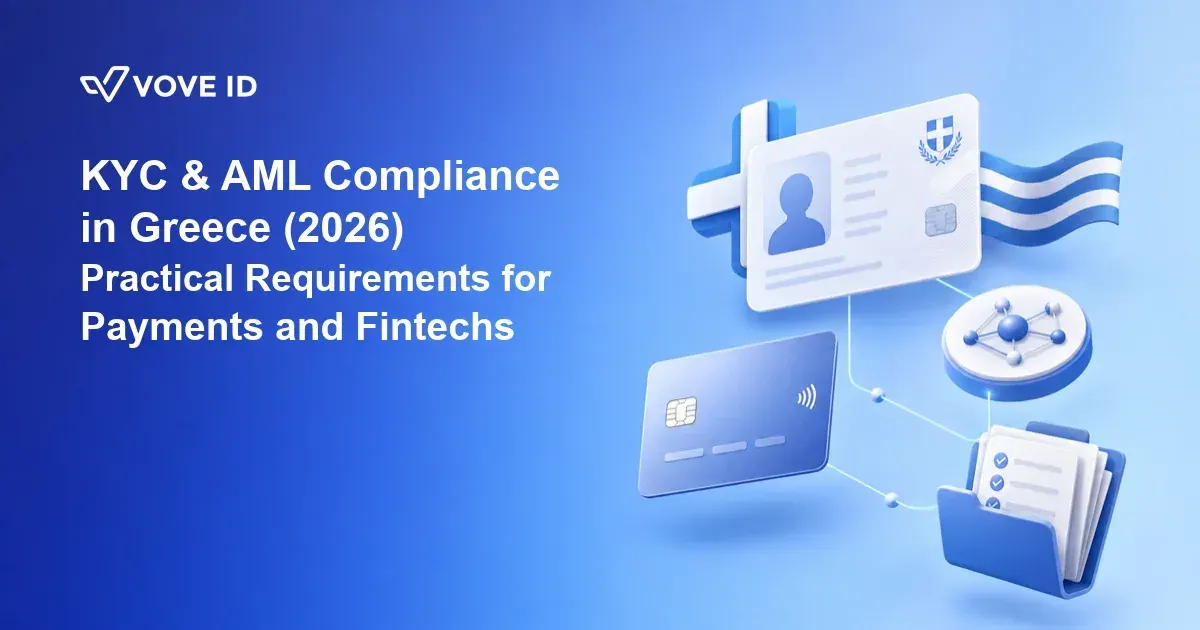
Greece's payments and fintech market needs fast digital onboarding, but speed only works when identity evidence, risk review, and reporting decisions remain explainable.
Direct answer: A Greece-based payment or fintech business within AML/CFT obligations needs risk-based customer due diligence, monitoring, documented escalation, and a clear reporting path to the competent authority. A remote journey can make evidence collection faster; it does not remove the need to understand the customer, investigate anomalies, and preserve the rationale for the final decision.
As of 22 July 2026. This guide is an operational overview, not legal advice.
VOVE ID helps payments and fintech teams connect identity evidence with risk review, exception handling, and an auditable case record. The operational gap often appears after onboarding: information has been collected, but the team cannot show how it assessed a mismatch, a higher-risk relationship, or an unusual payment pattern.
This guide covers what Bank of Greece and the Hellenic FIU actually expect in practice — customer due diligence, ownership evidence, and reporting. For the underlying framework, see our KYC Requirements Explained 2026.
This is exactly where a smooth onboarding flow stops being a controlled compliance workflow.
Regulatory map: start with the firm, its license, and the supervisory perimeter
Greece's AML/CFT framework is anchored in Law 4557/2018 for the prevention and suppression of money laundering and terrorist financing. The Hellenic Financial Intelligence Unit identifies reporting entities as the persons subject to the obligations of that law. The FIU's Unit A page is an official starting point for the reporting and FIU context.
For institutions under its supervision, the Bank of Greece is responsible for supervising compliance with the AML/CFT legal and regulatory framework. It assesses the adequacy and effectiveness of AML/CFT procedures and publishes materials relevant to supervised institutions. The Bank of Greece AML overview explains this role.
The scope question matters. A payment institution, e-money issuer, credit institution, investment business, or service provider working through an authorized partner can have a different license position, supervisory relationship, and allocation of compliance responsibilities. Teams should resolve those facts before documenting an onboarding workflow.
Customer due diligence: collect evidence that a reviewer can explain later
Customer due diligence should do more than confirm that a customer completed a flow. It should establish enough evidence to identify and verify the customer as required, understand the relationship, assess the risk, and route exceptions to an accountable decision maker.
For a business customer, the file should connect the entity, its ownership and control information, authorized representatives, expected use of the service, and any screening or follow-up evidence. For an individual, it should connect the identity record to the relationship risk basis and the conditions that would require reassessment.
This means one thing: do not let a fast front-end journey produce a thin back-office file.
For a full breakdown of entity verification and beneficial ownership mapping, see our KYB Requirements Explained 2026.
Remote onboarding: test the tool and the exception path together
The EBA's remote customer-onboarding guidelines set common expectations for safe, effective, and risk-sensitive remote initial CDD. They focus on the policies and processes around the tool, including how a firm chooses and assesses the adequacy and reliability of a remote solution. The EBA guidelines have applied since October 2023.

That is particularly relevant when a payment product must balance conversion with control. The team should test what happens when a document is inconsistent, an identity signal cannot be resolved automatically, the expected payment activity is unclear, or the case needs enhanced review. The exception path is part of the product, not a manual afterthought.
AML, PEP, and sanctions: make escalation a designed operational route
The Bank of Greece notes that its AML materials include guidance on risk methodology by customer and transaction category, with particular attention to areas including customers not physically present. It also describes the role of a competent executive appointed by each supervised entity to report suspicious or unusual transactions to the AML Authority. The Bank of Greece's AML page is the source to use when translating this framework into the firm's specific obligations.
Teams should define the route from a potential match or unusual activity to a reviewed decision. That route needs ownership, due dates, evidence standards, and access controls. It also needs a clear record of who considered the facts and why the case was cleared, escalated, restricted, or reported.
For fintechs onboarding merchants or businesses, the same principle applies to ownership and control. A declaration is not a completed case file if the team cannot show what it checked, which information was incomplete, and who accepted the resulting risk.
A realistic failure: a merchant is approved while the important decision remains in email
A Greek payment platform onboards a small marketplace seller that expects cross-border card payments.
- An identity document and liveness result for the authorized representative
- Company information and an ownership declaration
- An explanation of expected transaction volumes
- A screening result requiring a follow-up question
The initial reviewer asks for clarification by email. The seller replies with a document that changes the ownership picture. A second reviewer approves the account, but the revised evidence stays in the mailbox and the risk rationale is saved only in a ticket comment.
Later, the merchant's payments depart from the stated pattern. A compliance reviewer cannot reconstruct whether the ownership change was assessed, what question was resolved, or who accepted the risk.
This is not a screening failure. It is a fragmented case-management failure.
Reporting and monitoring: preserve the case before it becomes a filing question
The Hellenic FIU's Unit A collects, examines, and evaluates information about suspicious or unusual transactions submitted by liable persons. Its official FIU page sets out that role. A firm should turn that reporting obligation into an internal operating path before it needs to use it.
The path should link monitoring alerts to the customer profile, the facts gathered, the investigation record, the decision maker, and the final escalation. It should also control access so that sensitive cases are available to the right people without becoming informal team knowledge.
The next EU milestone matters as well. Regulation (EU) 2024/1624 will apply from 10 July 2027 to most obliged entities, creating a more harmonised EU AML rulebook. Article 90 of the Regulation gives Greek fintech teams a concrete reason to test their evidence and case-management model now.
For a full breakdown of sanctions screening and reporting obligations, see our AML Requirements Explained 2026.
Records and privacy: the useful file is the file a team can reconstruct
Identity and payment evidence is sensitive, so teams need a practical policy for access, audit logging, retention, deletion, and legal holds. The policy should connect legal and compliance requirements to real roles in product, operations, support, and financial-crime teams.
The strongest test is a realistic review: can the team show the original evidence, risk reasoning, exception steps, monitoring context, and final decision without searching across an inbox, a CRM, and a vendor portal? If not, the workflow needs more structure.
How VOVE ID fits: connecting evidence to controlled decisions
VOVE ID supports identity verification, biometric liveness, face matching, AML screening, KYB, and transaction monitoring. It supports 2,000+ document types across 200+ countries and helps detect document-template inconsistencies, invalid MRZ checksums, barcode or QR inconsistencies, and image manipulation. AML screening is customer-configurable and its data is refreshed daily; manual review may be used where the compliance team has sufficient evidence to approve a verification.
VOVE ID does not make a Greek firm's legal judgment or decide whether a case must be reported. It helps teams collect evidence, route exceptions, and maintain an operational record that is useful when a payment or customer relationship needs review.
Practical Greece KYC and AML checklist
Governance
- Confirm the firm's license position, AML perimeter, and accountable compliance owner.
- Define risk categories and the approval rights for exceptions and high-risk relationships.
- Test procedures against the current Bank of Greece and FIU materials for the firm's activity.
Onboarding and KYB
- Connect identity evidence, entity and ownership information, and risk rationale in one case.
- Test remote flows for document mismatches, uncertain ownership, and incomplete expected-activity information.
- Record the reviewer, evidence, and decision whenever an exception is accepted or escalated.
Monitoring and reporting
- Set documented triggers for unusual transactions and risk-profile changes.
- Preserve investigation facts and decision rationale before a potential FIU report.
- Maintain role-based access to sensitive case material and reporting workflows.
Records and privacy
- Keep evidence retrievable without relying on inboxes or chat tools.
- Define retention, deletion, and legal-hold controls before volume increases.
- Test a completed merchant or customer file from onboarding through monitoring.
FAQ
Which authority supervises AML/CFT compliance for Bank of Greece-supervised institutions? The Bank of Greece states that it is responsible for supervising compliance with the AML/CFT framework by the institutions under its supervision. The exact supervisory perimeter depends on the business and license.
Where do liable persons report suspicious or unusual transactions in Greece? The Hellenic Financial Intelligence Unit's Unit A collects, examines, and evaluates information submitted by liable persons under Law 4557/2018.
Does remote onboarding remove the need for customer due diligence? No. Remote tools can support evidence collection, but a firm still needs risk-sensitive CDD, exception handling, ongoing monitoring, and a decision record.
What should a payment fintech keep in a compliance case file? The file should make it possible to reconstruct evidence, risk rationale, reviewer actions, exceptions, monitoring context, and the final decision in line with applicable requirements.
Conclusion
KYC and AML compliance in Greece is not a question of how quickly a payment product collects an ID. It is whether the collected evidence becomes a controlled, explainable case.
Payments and fintech teams need identity, risk, escalation, monitoring, and records to work as one system. That is what keeps a fast onboarding flow from becoming an unreviewable operational gap.
Want to see how VOVE ID supports a country-aware identity and compliance workflow?
This article is intended for general informational purposes only and does not constitute legal, financial, or regulatory advice. KYC/KYB/AML requirements may vary depending on jurisdiction, industry, and specific business circumstances. For up-to-date and binding compliance obligations, readers should refer to the relevant regulatory authorities or consult qualified professionals.