KYC & AML Compliance in Finland (2026): Remote Onboarding for Regulated Fintechs
Finland's digital onboarding can cut friction, but a defensible AML file still depends on connected evidence and rationale — here's what FIN-FSA expects fintechs to build in 2026.
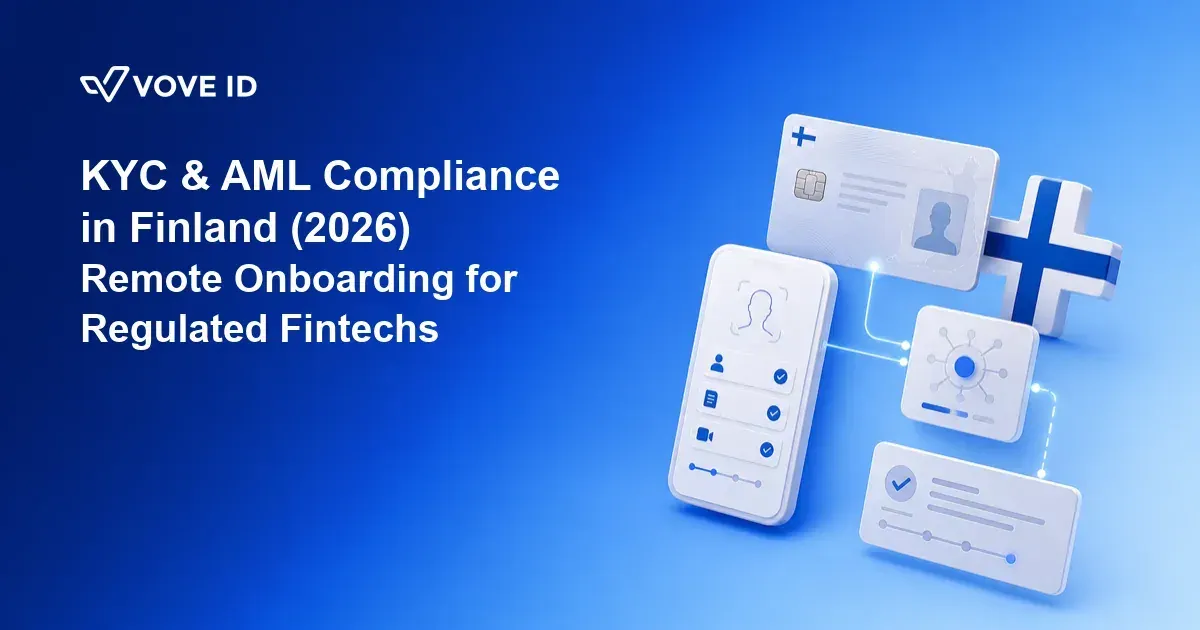
Finland's digital onboarding environment can reduce collection friction, but regulated fintechs still need a risk-based file that explains each customer decision.
Direct answer: A Finnish fintech within AML obligations needs a documented risk assessment, customer due diligence, ongoing monitoring, escalation, and a route for reporting suspicion. Remote onboarding can improve collection and review; it does not replace the evidence, risk rationale, or accountable decision required for a defensible customer file.
As of 22 July 2026. This guide is an operational overview, not legal advice.
VOVE ID helps Finnish payments and fintech teams connect identity evidence with risk review, exception handling, and an auditable decision record. The failure is rarely that a customer cannot complete a digital step. It is that the evidence, risk assessment, and reviewer action live in separate systems.
This guide covers what FIN-FSA actually expects in practice — risk assessment, remote onboarding, and FIU reporting. For the underlying framework, see our KYC Requirements Explained 2026.
This is exactly where remote onboarding becomes hard to defend.
Regulatory map: establish the Finnish perimeter before building the flow
Finland's core AML/CFT statute is the Act on Preventing Money Laundering and Terrorist Financing (444/2017). The official English translation is a useful working reference, but product teams should validate the current Finnish text and their own regulatory perimeter before implementation. Finlex's statute record identifies the Act and the amendments reflected in the translation.
For financial entities under its remit, the Financial Supervisory Authority (FIN-FSA) supervises compliance with the Money Laundering Act. Its published supervisory material makes the operating expectation clear: policies, procedures, internal controls, customer due diligence, and risk management must work together. FIN-FSA's sanctions-risk assessment summary describes this supervisory context.
Not every digital business has the same obligations or supervisor. A payment institution, e-money issuer, lender, virtual-currency provider, or outsourced program arrangement can have different permissions, roles, and controls. Teams need to resolve those facts before they turn a product journey into a compliance specification.
Remote onboarding: make digital convenience part of controlled CDD
Remote onboarding should start with a design question: what evidence must be collected, how will it be assessed, and where does a case go when the evidence does not fit? A completed selfie, document upload, or bank transfer is an input to a customer due-diligence decision. It is not the decision itself.

The EBA's remote customer-onboarding guidelines apply to credit and financial institutions within the AMLD scope. They set common standards for risk-sensitive initial CDD policies and for choosing and assessing the adequacy and reliability of remote tools. The EBA guidance has applied since October 2023.
In practice, the remote flow should preserve the submitted identity evidence, the verification outcome, the relationship risk assessment, the decision maker, and any exception or follow-up request. This means one thing: digital collection should make a case easier to review, not easier to lose.
Risk, PEP, and sanctions: classify the relationship before volume obscures it
FIN-FSA guidance for money-remittance providers highlights written risk assessments, customer risk categories, ongoing monitoring, and documented treatment of political exposure. The point is not to turn every case into a high-risk case. It is to ensure a team can show what factors it considered and why a relationship receives its level of review. The FIN-FSA guidance is a practical example of the expectation.
Teams should map standard, elevated, and exception cases before launch. The map should state what additional evidence is required, who can approve it, what a reviewer records, and when a relationship must be refreshed or escalated.
Sanctions and PEP checks also need a human decision route. A potential match, a complex ownership chain, or inconsistent identity information should create an explainable review task rather than an informal conversation in an inbox.
A realistic failure: a remote payment account is approved without a recoverable rationale
A Finnish payment fintech receives a routine remote application from a customer opening an account for cross-border freelance income.
- A residence document and identity document
- A liveness result and face match
- A stated occupation and expected payment pattern
- A screening result requiring manual review
Then the file fragments. Identity outputs sit in the onboarding provider, the explanation of expected activity sits in CRM notes, and the reviewer records the clearance in a chat message. The account is approved.
Weeks later, payment activity differs from the expected profile. The team cannot tell which evidence it relied on, whether the original screening result was resolved, or who accepted the risk basis.
This is not a remote-onboarding failure. It is a decision-record failure.
Monitoring and reporting: build the escalation route before suspicion arrives
Finland's National Bureau of Investigation hosts the Financial Intelligence Unit. The police state that parties with a reporting obligation must file an electronic report with the FIU for suspicious business transactions, and that the FIU receives, processes, and analyzes those reports. The Finnish Police AML guidance is the operational starting point for a team's reporting process.
That route must be designed before a monitoring alert occurs. A team needs clear ownership for triage, investigation, escalation, reporting, and access control. It should retain the facts that informed the decision, including what was observed, what was requested, the review performed, and whether activity was executed, paused, or refused where applicable.
The EU's AML Regulation, Regulation (EU) 2024/1624, applies from 10 July 2027 to most obliged entities. Article 90 of the Regulation makes 2026 the right time to test whether current controls can support a more harmonised EU rulebook.
For a full breakdown of sanctions screening and reporting obligations, see our AML Requirements Explained 2026.
Records and privacy: keep evidence retrievable and access controlled
Remote KYC creates more sensitive evidence, not less. Teams need a defined policy for access, audit logging, retention, deletion, and legal holds. They also need to test that policy against a real question from compliance, a banking partner, or a regulator.
The practical standard is simple: a reviewer should be able to reconstruct the customer decision without assembling screenshots from multiple tools. If the decision cannot be reconstructed, the organization has collected data without creating a reliable case record.
How VOVE ID fits: from evidence to controlled review
VOVE ID supports identity verification, biometric liveness, face matching, AML screening, KYB, and transaction monitoring. It supports 2,000+ document types across 200+ countries and helps detect document-template inconsistencies, invalid MRZ checksums, barcode or QR inconsistencies, and image manipulation. AML screening is customer-configurable and its data is refreshed daily; manual review may be used where the compliance team has sufficient evidence to approve a verification.
VOVE ID does not determine a Finnish firm's risk appetite, reporting decision, or legal obligations. It helps teams collect evidence, route exceptions, and maintain a case record that is useful in operations and review.
Practical Finland KYC and AML checklist
Governance
- Confirm the product's AML perimeter, supervisor, and accountable owner.
- Maintain a written risk assessment and a clear customer-risk methodology.
- Define decision rights for exceptions, high-risk cases, and escalation.
Remote onboarding
- Link identity evidence, verification outputs, and risk rationale in one case.
- Test remote tools and exception paths against the EBA onboarding guidance.
- Record who reviewed a mismatch and why the final decision was made.
Monitoring and reporting
- Set documented triggers for unusual activity and customer-profile changes.
- Preserve investigation facts and reviewer rationale before a reporting decision.
- Maintain a tested electronic-reporting route to the Finnish FIU.
Records and privacy
- Restrict access to identity and case evidence by role.
- Define retention, deletion, and legal-hold controls before scaling.
- Test whether a completed file can be reconstructed without manual hunting.
FAQ
Can a Finnish fintech onboard customers entirely remotely? Remote onboarding can be part of a compliant process when the firm applies risk-sensitive CDD, assesses its tools, manages exceptions, and keeps an accountable decision record. The exact design depends on the firm's regulated activity and risk profile.
Who receives suspicious-transaction reports in Finland? The Financial Intelligence Unit within Finland's National Bureau of Investigation receives electronic reports from parties with a reporting obligation.
What should be retained from a remote KYC case? Keep the evidence collected, assessment outputs, risk basis, exception history, reviewer actions, and final decision in a controlled record consistent with applicable requirements.
Does identity verification decide AML risk? No. Identity verification helps establish evidence. AML risk assessment, monitoring, escalation, and reporting require a broader operational process.
Conclusion
KYC and AML compliance in Finland is not a question of whether onboarding is digital. It is whether the digital journey produces a controlled, explainable customer file.
Fintech teams need to connect evidence, risk, monitoring, and records before scale turns small exceptions into recurring control gaps. Collection, verification, review, and case management are one workflow.
Want to see how VOVE ID supports a country-aware identity and compliance workflow?
This article is intended for general informational purposes only and does not constitute legal, financial, or regulatory advice. KYC/KYB/AML requirements may vary depending on jurisdiction, industry, and specific business circumstances. For up-to-date and binding compliance obligations, readers should refer to the relevant regulatory authorities or consult qualified professionals.