KYB Compliance in Uganda: 2026 Guide for Regulated Businesses
Uganda set its beneficial-ownership bar lower than most — 10%, not the usual 25%. Here's what that changes for business verification.
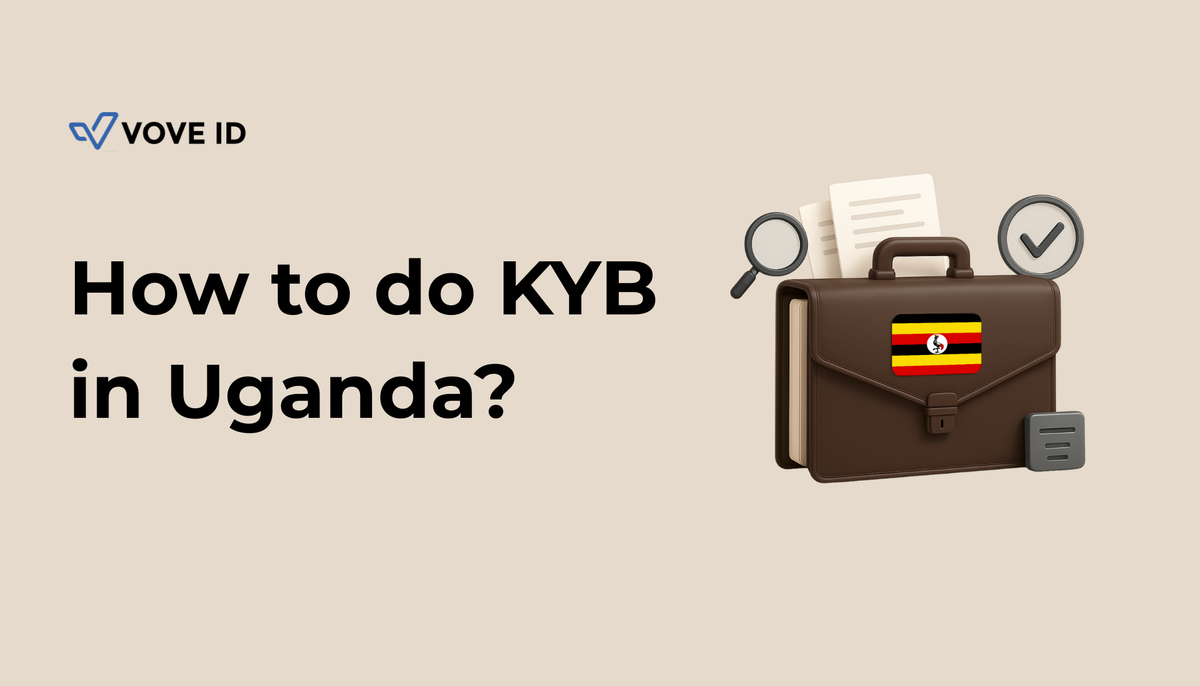
Uganda's fintech and digital economy continue to expand, driven by mobile money, e-commerce, and foreign direct investment. As financial services digitize, regulators are placing more weight on Know Your Business (KYB) — verifying and monitoring business customers to prevent money laundering, fraud, and shell-company risk. VOVE ID helps fintechs and digital wallets build that verification layer for Uganda specifically.
This guide covers business verification requirements in Uganda. For the underlying KYB framework, see our KYB Requirements Explained 2026.
Regulatory Framework for KYB in Uganda
- Bank of Uganda (BoU): supervises financial institutions and enforces AML/CDD requirements under the Financial Institutions Act.
- Financial Intelligence Authority (FIA): established under the Anti-Money Laundering Act 2013 (Cap. 118), as amended; oversees compliance programs and STR enforcement.
- Uganda Registration Services Bureau (URSB): maintains the national company registry and the beneficial-ownership register, now governed by the Companies (Beneficial Owners) Regulations 2023, as amended by the 2024 regulations (S.I. 35/2024) — an update from the earlier 2016 framework.
- Capital Markets Authority (CMA) and Insurance Regulatory Authority (IRA): require licensed entities to run CDD and KYB checks on their clients and partners.
These bodies align Uganda's AML and KYB regime with FATF and ESAAMLG standards.
For customer due diligence requirements for individual customers, see our KYC guide for Uganda.
The KYB Process in Uganda
- Business registration verification: confirm incorporation details via the URSB database, and obtain the Certificate of Incorporation, Memorandum and Articles of Association, and Tax Identification Number.
- Beneficial ownership identification: Uganda sets its UBO threshold at natural persons holding 10% or more of ownership or control — notably lower than the 25% used in many other jurisdictions. Collect national ID or passport copies and address details for each UBO, and check that the company maintains its own BO register and files an updated consolidated register annually with URSB.
- Directors and signatories verification: validate the identities of directors, shareholders, and authorized representatives.
- Operational and risk assessment: review the business's activity, source of funds, and geographic exposure, with ongoing due diligence for higher-risk entities.
Challenges and Opportunities
- Informality: a large share of Ugandan businesses still operate informally, which complicates KYB and raises fraud exposure for institutions onboarding them.
- Manual onboarding: many institutions still rely on paper-based checks, slowing onboarding and raising cost.
- Cross-border complexity: within the East African Community, differing enforcement standards and registry maturity levels complicate regional due diligence, even where ownership thresholds are similar.
Uganda's move to a 10% UBO threshold — ahead of several regional peers still finalizing their own disclosure regimes — has been part of its case for stronger transparency credentials with international partners.
Best Practices for Regulated Businesses
- Prioritize Enhanced Due Diligence for high-risk entities, including politically exposed businesses or those with complex ownership structures.
- Automate verification where possible, using trusted KYB and eKYC providers to reduce error and delay.
- Monitor continuously, not just at onboarding, to catch ownership or activity changes.
- Apply a risk-based approach, matching compliance depth to customer risk profile.
How VOVE ID Supports KYB Compliance in Uganda
VOVE ID helps Ugandan fintechs, financial institutions, and digital platforms automate KYB and KYC workflows:
- Document verification: extracts and validates data from business registration, incorporation, and tax documents submitted at onboarding.
- Sanctions and PEP screening: cross-checked against global watchlists.
- UBO identification: workflows built around the 10% threshold, with risk-based scoring for complex ownership structures.
- Ongoing monitoring: flags for ownership or activity changes.
For the complete, sourced requirement-by-requirement checklist, see VOVE ID's Uganda compliance checklist.
Conclusion
Uganda's lower UBO threshold makes KYB here structurally stricter than in many peer markets — which is a genuine transparency advantage, provided the businesses applying it actually get the threshold right. Automated, well-sourced verification is what turns that stricter standard into a real compliance edge rather than just extra paperwork.
This article is intended for general informational purposes only and does not constitute legal, financial, or regulatory advice. KYC/KYB/AML requirements may vary depending on jurisdiction, industry, and specific business circumstances. For up-to-date and binding compliance obligations, readers should refer to the relevant regulatory authorities or consult qualified professionals.