Malawi KYC in 2026
A biometric ID rollout finished in 180 days now decides how Malawi verifies customers. Here's what that means for onboarding.
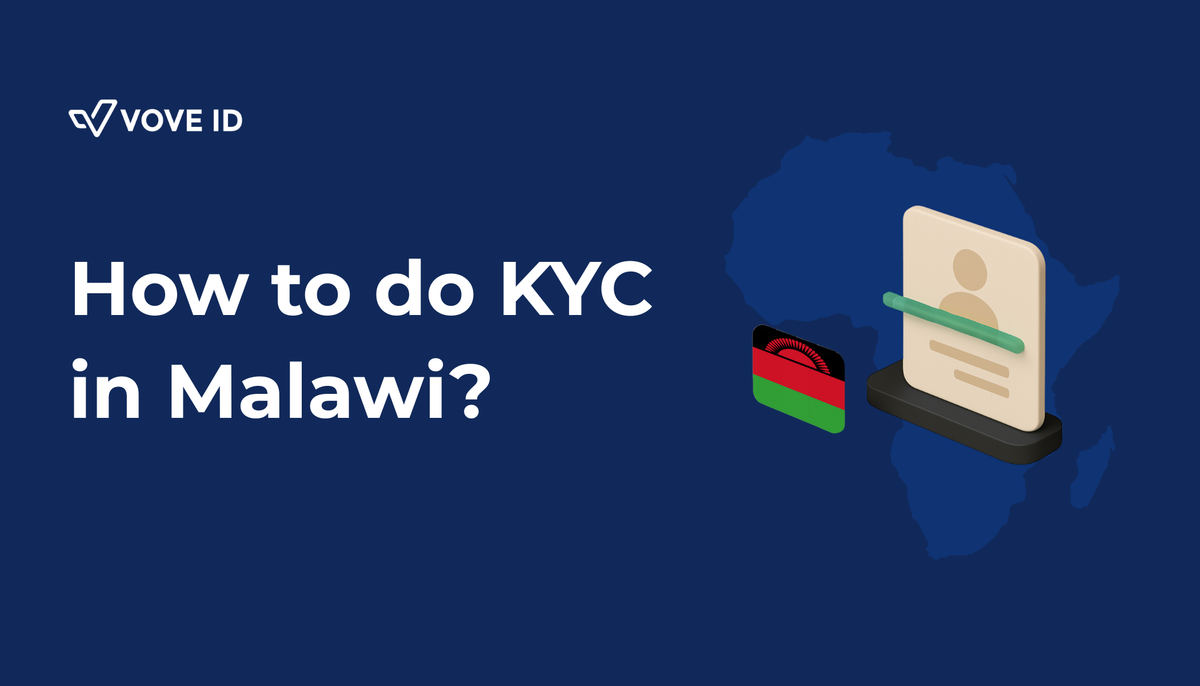
VOVE ID works with fintechs and regulated platforms operating across Africa and MENA, including corridors that touch Malawi. This guide covers what individual identity verification requires in Malawi specifically — country-level documents, thresholds, and friction points, building on the underlying identity verification framework covered separately.
The Regulatory Starting Point
Customer identification obligations in Malawi sit with the Reserve Bank of Malawi (RBM) for banks and financial institutions, and trace back to a 2005 RBM directive on customer due diligence that predates the country's modern AML law. That directive required banks to establish "the true identity" of customers using reliable, independent source documents — but it left real gaps in what counted as acceptable proof, particularly for customers without formal paperwork.
The bigger shift came later, and it wasn't primarily legislative. It was infrastructural.
The National ID Became the Default KYC Document
Before 2017, Malawi had no functioning national identity registry. Fewer than 60,000 adults out of a population of roughly 9 million held any form of legal ID. A government project backed by UNDP and the EU changed that in a single push: between May and November 2017, the National Registration Bureau (NRB) biometrically registered 9.1 million citizens, reaching close to 90% of the eligible adult population.
The RBM followed with a 2018 directive making the NRB's National ID the primary identification tool for opening a bank account. Banks were required to complete integration with the NRB database by September 2019, with mandatory use taking effect on October 1, 2019. FDH Bank was the first to go live, checking KYC details submitted at account opening directly against the National Registration and Identification System (NRIS).
For fintechs, this changes what "acceptable identity document" means in practice. A National ID card issued by the NRB is now the default, not one option among several — and verification increasingly means checking a document against the issuing registry, not just inspecting it.
For a full breakdown of identity verification requirements, see our KYC Requirements Explained 2026 guide.
Where the Coverage Story Gets More Complicated
The registration numbers are strong, but they don't map cleanly onto financial access. Only around a quarter of Malawi's adult population uses formal banking services, according to the Institute of Bankers in Malawi — a gap that mobile money, not bank branches, has mostly filled.
There's also a legal gap sitting underneath all of this: Malawi does not yet have a comprehensive data protection law. A Data Protection and Privacy Bill was introduced in 2021 and has stalled since. For fintechs handling National ID data, biometric captures, or cross-border verification flows, that's a live compliance question rather than a settled one — there's no single statute yet defining how identity data collected for KYC has to be stored, retained, or shared.
Foreign nationals and resident non-citizens follow a separate NRB process for their own identity cards, and businesses onboarding customers without a Malawi National ID — visiting workers, cross-border traders, diaspora remittance senders — need a fallback verification path that doesn't assume NRB coverage.
Mobile Money Runs on a Different Onboarding Model
Malawi's mobile money market is a duopoly between Airtel Money and TNM Mpamba, both built on dense agent networks rather than branch infrastructure. In lakeshore and rural districts where trust in formal banks is low, the agent — someone customers know by name — is often the actual point of identity verification, not a back-office compliance team.
That model works for reach, but it puts real weight on agent-level CDD consistency. It's also becoming more tightly coupled to the National ID system: the Malawi Communications Regulatory Authority (MACRA) began mandatory biometric SIM registration on July 1, 2025, tying every SIM card — and by extension every mobile money wallet linked to it — to a verified NRB identity. Non-compliance carries daily fines running into tens of thousands of kwacha for individuals and well above that for corporate SIM holders.
For a mobile money-first onboarding flow, that means identity verification increasingly needs to succeed at the SIM registration stage, not just the wallet-opening stage.
Banks in Malawi are also integrated through National Switch Limited (NSL), the interoperability platform jointly owned by banks and the two mobile network operators, which supports wallet-to-bank and bank-to-wallet transfers across providers — another reason a customer's identity needs to check out consistently across channels, not just within one.
Onboarding without a strong national eID equivalent for every customer segment — foreign workers, occasional traders, undocumented rural residents — is where VOVE ID fits into the picture: OCR and biometric liveness detection built to work across document types and 190+ country formats give fintechs a verification path that doesn't fully depend on one national registry being reachable or complete.
When Individual Onboarding Turns Into Business Onboarding
Individual KYC covers the person opening the account. It doesn't cover what happens when that person is opening the account on behalf of a company, or when a business customer needs its own owners identified. Malawi's Companies (Beneficial Ownership) Regulations, 2022 set a materially different bar for that — a 5% ownership threshold, well below the 25% used in many comparable jurisdictions — and require a separate verification layer entirely.
Verifying a National ID against a registry is one thing. Confirming the person behind a mobile wallet or a company filing is who they claim to be is another. VOVE ID helps fintechs and regulated platforms run both checks — individual and business — through one workflow, without depending on a single registry being available or complete.
This article is intended for general informational purposes only and does not constitute legal, financial, or regulatory advice. KYC/KYB/AML requirements may vary depending on jurisdiction, industry, and specific business circumstances. For up-to-date and binding compliance obligations, readers should refer to the relevant regulatory authorities or consult qualified professionals.