KYC Requirements: What Fintechs Need in 2026
KYC in modern fintech is no longer a single onboarding step but a continuous identity verification system that connects user data, risk scoring, and compliance decisions across the entire lifecycle.
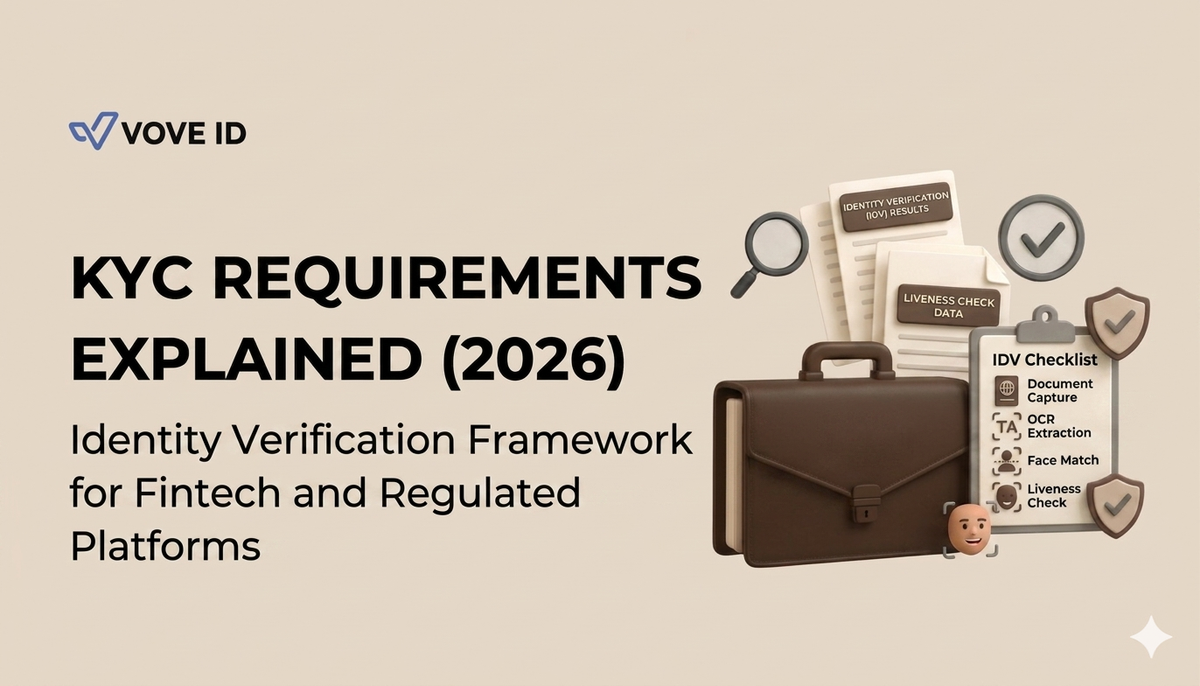
Know Your Customer (KYC) is often reduced to a simple onboarding requirement, but in modern fintech systems it operates as a continuous identity verification framework that supports risk management, fraud prevention, and regulatory compliance. Platforms like VOVE ID approach KYC not as a one-time check, but as an integrated process that connects onboarding, monitoring, and transaction level decisioning.
Modern KYC systems function as identity infrastructure rather than isolated verification steps. They continuously connect user identity with risk decisions across the entire lifecycle.
As digital financial services expand across jurisdictions, KYC must handle more than identity collection. It must ensure that user data is accurate, consistent, and reusable across the entire lifecycle. This defines an effective KYC compliance process today.
What KYC Actually Means in Practice
At its core, KYC is the process of verifying that a customer is who they claim to be. In operational terms, this includes several distinct layers:
- collection of personal identity data
- validation of official documents
- biometric verification
- screening against risk databases
The goal is identification and risk contextualization, which helps determine whether a user can safely access financial services.
Core Components of a Modern KYC System
Identity Data Collection
The process begins with structured data capture:
- full legal name
- date of birth
- residential address
- nationality
Accuracy at this stage is critical because all downstream checks depend on it.
Document Verification
Users are required to submit government issued identification such as:
- passports
- national ID cards
- driver’s licenses
Modern systems apply OCR and authenticity checks to validate:
- document structure
- expiration status
- tampering indicators
Biometric Verification
To ensure the person submitting the document is its rightful owner, biometric checks are applied:
- selfie capture
- liveness detection
- face matching against the ID
This reduces impersonation and supports reliable digital identity verification.
Database Screening
Once identity is established, users are screened against external databases:
- sanctions lists
- politically exposed persons (PEP)
- watchlists
This connects customer identity verification to broader compliance obligations.
The KYC Workflow (End to End)
A functional KYC system is a structured workflow:
- User onboarding begins
- Identity data is captured
- Documents are submitted and verified
- Biometric validation is performed
- Screening checks are executed
- Risk scoring is applied
- Decision is made: approve, reject, or manual review
- Ongoing monitoring is initiated
KYC does not end at approval. It continues as ongoing risk assessment.
From Identity to Transactions
KYC data becomes most valuable when reused beyond onboarding. In mature systems, verified identity attributes are linked to:
- transaction monitoring systems
- payment authorization logic
- risk scoring engines
This enables platforms to:
- detect anomalies based on known identity behavior
- reduce repeated verification requests
- apply consistent risk logic across products
- reconstruct user activity during audits
Without this continuity, KYC remains isolated and loses most of its operational value.
KYC Data Lifecycle
KYC is not limited to a single verification moment. Identity data continues to evolve throughout the customer relationship.
A typical lifecycle includes:
- initial data capture during onboarding
- verification and validation of identity attributes
- continuous enrichment through user activity signals
- periodic review and updates based on regulatory requirements
- re verification triggered by risk changes or unusual behavior
This lifecycle approach ensures that identity data remains accurate, relevant, and usable across multiple compliance systems.
What a Mature KYC System Looks Like
In production-grade fintech environments, KYC operates as a connected identity layer rather than a set of separate checks.
A mature system typically includes:
- a single persistent identity profile per user
- reusable verification results across products and flows
- shared risk logic between onboarding and monitoring
- event driven re verification instead of static periodic checks
This structure reduces duplication, improves audit readiness, and increases consistency across compliance systems.
Real World KYC Architecture in Fintech Systems
In operational fintech environments, KYC is typically implemented as a layered architecture rather than a single linear process.
Most systems include:
Identity layer
Responsible for collecting and maintaining verified user identity data.
Verification layer
Handles document checks, biometric validation, and screening in real time.
Risk layer
Aggregates signals from identity checks, user behavior, and external data sources.
Decision layer
Applies rule based or model based logic to approve, reject, or escalate users.
This separation allows systems to scale efficiently while maintaining consistent compliance decisions across different products and jurisdictions.
KYC in Modern Product Stacks
In modern fintech architectures, KYC is deeply integrated into the broader product ecosystem rather than existing as an isolated step.
It typically connects with:
- onboarding systems
- identity verification providers
- risk engines
- transaction monitoring systems
- customer data platforms (CRM)
This integration allows identity data to move across systems without duplication, creating a unified compliance infrastructure.
Operational Impact of KYC Systems
The structure of a KYC system has a direct impact on key business and risk metrics:
- onboarding conversion rates
- fraud detection accuracy
- manual review workload
- customer drop off rates
- operational compliance costs
Poorly designed systems increase friction and operational overhead. Well structured systems balance regulatory requirements with user experience and scalability.
Common Use Cases of KYC in Financial Systems
KYC is applied across multiple regulated environments, including:
- digital banking onboarding
- crypto exchange account verification
- fintech lending platforms
- payment service providers
- cross border remittance systems
While implementation differs by sector, the underlying identity verification principles remain consistent.
Where KYC Breaks in Real Systems
Many compliance setups fail not because of missing checks, but because of poor system design.
Fragmented Tooling
Using separate vendors for document verification, biometrics, and screening creates data silos, which leads to:
- inconsistent user profiles
- duplicated checks
- audit complexity
Re Verification Friction
Without persistent identity records, users are forced to repeat KYC across flows:
- onboarding
- withdrawals
- new product access
This increases drop off and reduces conversion.
False Positives
Overly aggressive screening without context leads to:
- unnecessary manual reviews
- delayed onboarding
- operational inefficiency
Disconnect Between Onboarding and Monitoring
KYC data is often not reused in transaction monitoring systems, resulting in:
- incomplete risk profiles
- duplicated compliance logic
- weak audit trails
Lack of Data Portability
KYC data is often locked within a single provider or workflow, which makes it difficult to:
- reuse verification results
- migrate between systems
- maintain consistent identity across platforms
This creates vendor dependency and limits scalability.
KYC vs KYB vs AML
Clear separation between compliance layers is essential:
| Layer | Scope | Function |
|---|---|---|
| KYC | Individuals | Customer identity verification |
| KYB | Businesses | Business and ownership verification |
| AML | Transactions | Monitoring and suspicious activity detection |
For business verification frameworks, see the KYB compliance guide.
Regulatory Landscape
KYC requirements are shaped by global standards rather than a single unified regulation.
Key frameworks include:
- FATF recommendations (risk based approach)
- EU Anti Money Laundering Directives (AMLD)
- regional financial authority guidelines
Regulators increasingly apply a risk based approach, where verification depth depends on customer risk rather than applying identical checks to all users.
This affects:
- simplified due diligence for low risk users
- standard due diligence
- enhanced due diligence for high risk users
Across jurisdictions, the expectation remains consistent: reliable customer identity verification combined with ongoing risk assessment.
Ongoing KYC and Re Verification
KYC does not end after onboarding. Depending on jurisdiction and risk level, businesses must periodically:
- refresh customer data
- re run sanctions and PEP screening
- reassess risk profiles
Re verification may be triggered by:
- large or unusual transactions
- changes in customer behavior
- regulatory updates
This ensures identity data remains accurate over time and aligned with current risk exposure.
The Future of KYC Systems
KYC systems are evolving toward more adaptive and continuous models.
Key trends include:
- shift from static verification to continuous identity validation
- increased use of behavioral signals in risk scoring
- deeper integration between onboarding and transaction monitoring systems
- reuse of identity data across multiple services to reduce friction
- movement toward identity centric financial infrastructure
KYC Compliance Checklist
A practical KYC system should include:
- structured identity data collection
- document authenticity verification
- biometric liveness detection
- sanctions and PEP screening
- risk scoring logic
- audit trail and secure data storage
- ongoing monitoring and re verification processes
If any of these elements are missing or disconnected, compliance gaps appear.
Conclusion
KYC has evolved from a simple onboarding requirement into a lifecycle identity system that supports continuous risk decisioning across fintech operations.
The most effective implementations:
- treat identity as a reusable infrastructure layer
- connect onboarding, monitoring, and transactions
- apply risk based verification logic instead of uniform checks
- integrate KYC deeply into product and risk systems
- reduce friction while maintaining compliance integrity
This shift is essential for fintechs operating across multiple jurisdictions, where regulatory expectations and operational complexity continue to increase.
See how identity verification fits into a complete KYC and compliance workflow with VOVE ID.