Why Vendor Fragmentation Is the Real Compliance Bottleneck for Emerging-Market Fintechs
Adding a new corridor shouldn't mean adding a new vendor. Here's why fragmented compliance stacks break down as fintechs scale across markets.
A fintech launching in one market can get away with almost anything. A local KYC vendor, a manually checked sanctions list, a spreadsheet for flagging suspicious transactions — none of it is elegant, but it works when there's one regulator, one set of document types, and one team that knows the process by heart.
The trouble starts at market two.
VOVE ID works with fintechs and financial institutions expanding across multiple emerging-market corridors, and the same story comes up repeatedly: compliance was never designed as infrastructure. It was assembled, market by market, vendor by vendor, until the stack itself became the constraint on growth.
Compliance procurement follows market entry, not strategy
Most fintechs don't choose their compliance stack — they inherit it, one decision at a time. The first market sets the pattern: pick a KYC vendor that covers the local ID document types, add a sanctions screening tool because a partner bank requires it, build a basic rules engine for transaction monitoring because the regulator's onsite inspection is coming up.
Each of these decisions makes sense in isolation. None of them are made with market five or market ten in mind, because at the time, there is no market five.
Then the second market opens. The original KYC vendor doesn't cover the new market's ID types well, so a second vendor gets added, for that corridor only. The sanctions screening tool turns out to miss a regional list the new regulator cares about, so a supplementary check gets layered on. The transaction monitoring rules, written for the first market's typology, don't map cleanly onto the second market's risk patterns, so a parallel rule set gets built.
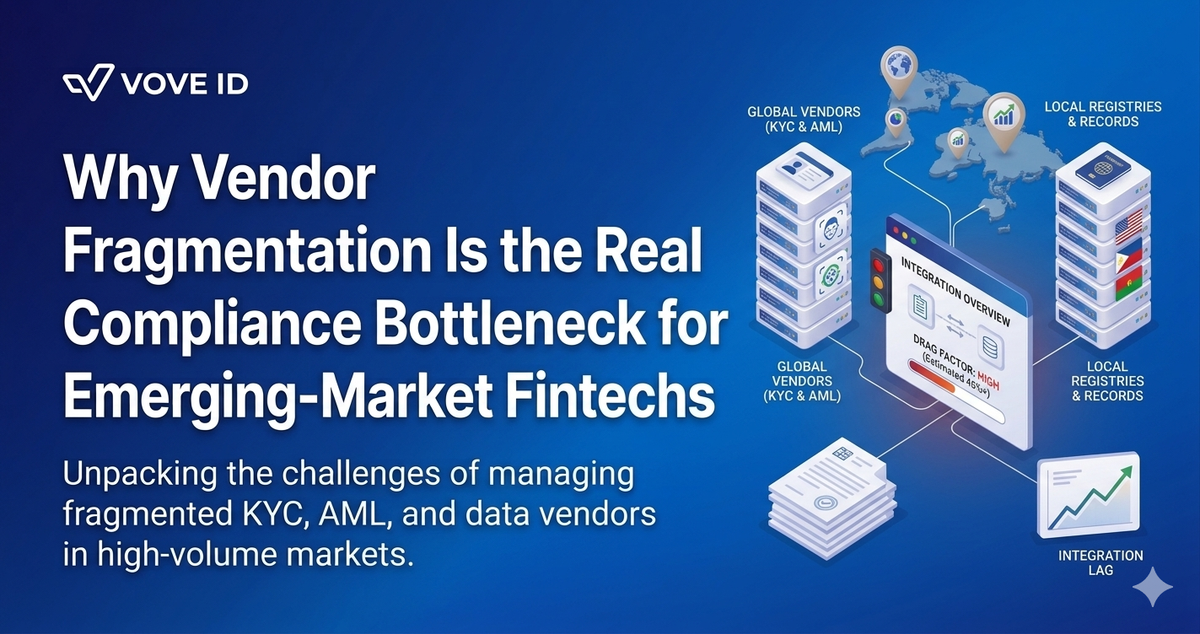
Multiply this by five or six markets and the result isn't a compliance stack. It's an archive of decisions made under different pressures at different times, with no shared logic connecting them.
What fragmentation actually costs
The direct cost is the easiest to see: more vendor contracts, more integrations to maintain, more APIs that can each fail independently. Engineering time that should go toward product ends up going toward keeping six different verification providers talking to six different internal systems.
The harder cost is what happens to risk visibility. When KYC for individuals runs through one vendor, KYB for business customers through another, and transaction monitoring through a third, a customer's risk profile gets split across systems that don't share data. A business onboarded with a clean KYB check in one market can show transaction patterns three months later that would have changed the onboarding decision — but the monitoring system has no way to feed that back, because it was never connected to the onboarding system in the first place.
This is also where fragmentation turns into a regulatory problem, not just an operational one. Examiners are starting to ask whether KYC, KYB, and AML controls function as a connected program, not just whether each one exists on its own: does a flag raised in one process actually change what happens in another? A fragmented stack can pass a checklist audit and still fail this test, because the connections a regulator is looking for don't exist between separately procured tools.
For a full breakdown of what a connected AML program is expected to cover, see our AML Requirements Explained 2026 guide.
Why "best of breed" doesn't survive corridor expansion
There's a reasonable-sounding argument for fragmentation: pick the best tool for each job. Best KYC vendor for West African ID documents, best sanctions screening provider for OFAC and EU lists, best transaction monitoring engine for the typologies that matter in mobile-money-heavy markets.
The problem isn't that any individual choice is wrong. It's that "best of breed" optimizes for each market in isolation, and emerging-market fintechs rarely operate in isolation for long. A remittance startup that launches in Nigeria and Kenya is, within a year or two, often also operating corridors into the UK, the EU, or the Gulf — each with its own document standards, sanctions regimes, and reporting obligations.
Every new corridor under a best-of-breed model means evaluating vendors again, negotiating contracts again, building integrations again, and training compliance staff on yet another interface. The fintechs that built their stack this way often find that compliance overhead grows roughly in line with the number of corridors, while revenue growth depends on adding corridors as cheaply as possible. The two curves point in opposite directions.
Business verification is where this shows up earliest. UBO ownership thresholds, registry data formats, and the documents that count as proof of beneficial ownership differ from one jurisdiction to the next, and a KYB process built around one market's registry structure often can't be lifted as-is into the next. A fintech that fragments KYC and AML across vendors usually fragments KYB the same way, market by market, without anyone deciding to.
For a full breakdown of what entity verification and UBO mapping should cover, see our KYB Requirements Explained 2026 guide.
The onboarding cost nobody budgets for
Fragmentation shows up to customers, too, even if they never see the backend. Multiple verification steps from different providers — sometimes asking for the same document twice because two systems can't share what they've already collected — translate directly into onboarding drop-off.
For fintechs targeting underbanked or first-time formal-finance users, which describes a large share of the emerging-market customer base, onboarding friction isn't a UX nuisance. It's a conversion problem with a direct revenue impact. A customer who abandons onboarding because the process felt repetitive or slow doesn't come back to try again later in most cases — they use whichever competitor's process felt faster.
VOVE ID supports document verification across 190+ countries through a single integration, which matters specifically in this context: a fintech doesn't need to add a new identity verification vendor every time it enters a market with different ID document standards. The verification layer that worked for the first corridor keeps working for the fifth.
What changes when compliance runs as infrastructure
The alternative to fragmentation isn't a single monolithic tool that tries to do everything equally well in every market — that's its own kind of trap. It's infrastructure that's built to be configured per market rather than replaced per market.
In practice, that means a few specific things. Identity and business verification share a data layer, so a flag on an individual during KYC is visible during KYB checks on a business they're connected to, and vice versa. Sanctions and watchlist screening runs against the same engine across all corridors, with jurisdiction-specific lists layered in rather than swapped out. Transaction monitoring rules can be tuned per market, since risk typologies genuinely differ between mobile-money-heavy markets and card-heavy ones, without requiring a separate monitoring system per market.
Expansion into a new corridor then becomes a configuration exercise: new document types added to the verification layer, new sanctions lists added to the screening engine, new monitoring rules tuned for local typologies. The underlying system doesn't change. What changes is its configuration for that market.
This is also where continuous monitoring becomes practical rather than aspirational. For more on what re-verification and ongoing monitoring should look like at the individual level, see our KYC Requirements Explained 2026 guide.
The window for fixing this is widest before it's a crisis
Fintechs rarely decide to fix a fragmented compliance stack proactively. It usually happens after a regulator flags the disconnect during an examination, or after a near-miss where a risk signal from one system should have triggered action in another and didn't.
By that point, the fix is harder. Untangling years of separately procured tools, each with its own data format and its own institutional knowledge among the staff who manage it, takes longer and costs more than building on connected infrastructure from the start would have.
For fintechs still early in their multi-corridor expansion — two or three markets in, with more planned — this is close to the cheapest point at which to make this decision. The cost of consolidating compliance infrastructure now is the cost of choosing a different vendor for the next market. The cost of doing it later is the cost of replacing several vendors at once, while also explaining to a regulator why it took this long.
The fastest-growing fintechs in emerging markets aren't necessarily the ones with the most compliance tools. They're the ones whose compliance infrastructure didn't need to grow every time the business did.
VOVE ID helps fintechs and financial institutions run KYC, KYB, AML screening, and transaction monitoring on shared infrastructure that's configured per market rather than rebuilt per market — so the next corridor is a configuration change, not a procurement cycle.
This article is intended for general informational purposes only and does not constitute legal, financial, or regulatory advice. KYC/KYB/AML requirements may vary depending on jurisdiction, industry, and specific business circumstances. For up-to-date and binding compliance obligations, readers should refer to the relevant regulatory authorities or consult qualified professionals.