AML Compliance in 2026: The Essential Concepts and Reading List
Reading about AML standards isn't the hard part — connecting each one to a control, a case owner, and a piece of evidence is. Here's where a compliance team should start.
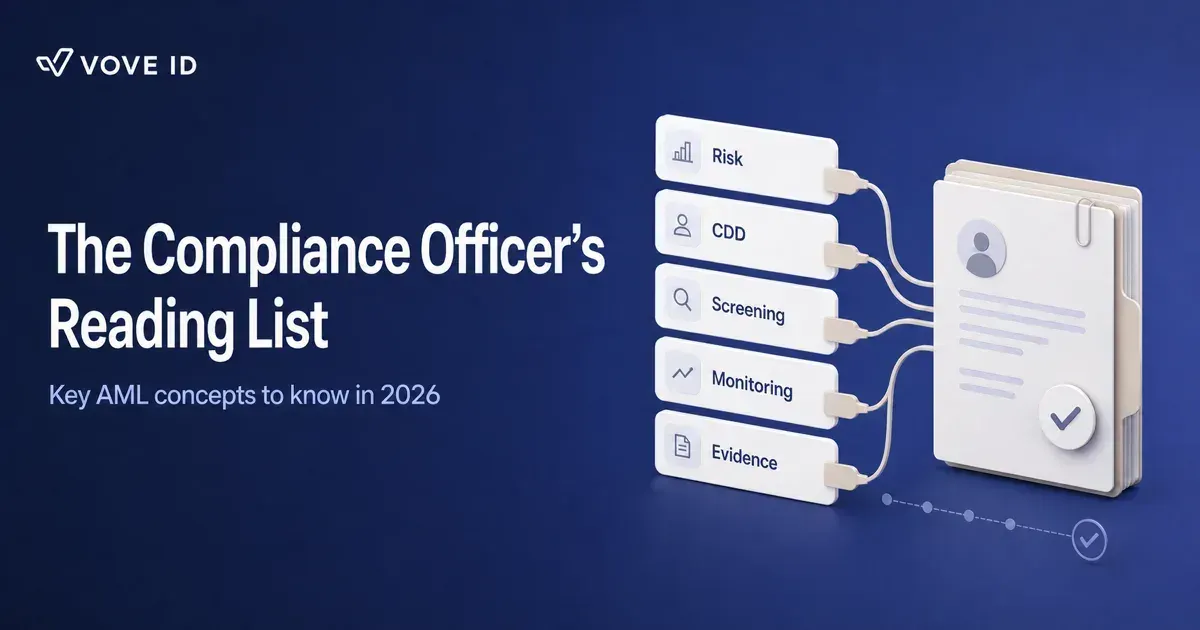
A practical AML compliance reading list for turning standards into controls, customer due diligence, case decisions, and audit-ready evidence.
VOVE ID Editorial Team
5 August 2026 · 5 min read
Direct answer: AML compliance is the risk-based system a financial business uses to prevent, detect, investigate, and report suspected money laundering. The essential concepts in 2026 are customer due diligence, enhanced due diligence, beneficial ownership, sanctions and PEP screening, transaction monitoring, suspicious-activity reporting, record keeping, and governance. Start with the FATF standards, then apply the rules and guidance for the team’s product, market, and risk profile.
VOVE ID helps compliance teams turn identity and AML requirements into a repeatable operating workflow. The hard part is rarely finding another document to read; it is connecting a requirement to the control, case owner, evidence, and escalation path that make it real.
This is exactly where AML knowledge becomes operationally useful or stays theoretical.
Start with the standard: understand the control system
The FATF Recommendations, last updated in October 2025, are the best starting point for a shared vocabulary. They frame AML, counter-terrorist financing, and proliferation-financing controls as a risk-based system rather than a box-ticking exercise.
This means one thing: a team should be able to explain why a control exists, what risk it addresses, and what happens when it produces an alert or a gap. A policy that names the standard but cannot answer those questions does not give reviewers a working control.
For the underlying framework, see our AML requirements explained: the compliance operating system for regulated institutions.
Risk-based approach: make prioritisation explicit
Risk-based AML starts with identifying, assessing, and understanding exposure. FATF treats that as central to applying proportionate measures, but the standard does not hand a fintech its risk model.
The reading task is to turn market, product, customer, channel, and geography signals into documented decisions. Teams should know which risk signals increase review, which permit simplification where law allows, and who approves a change to the model.
Read the FATF material on ML/TF risks, then compare it with the local national risk assessment and supervisory guidance. Do not copy a global risk category into a local policy without explaining its relevance.
Customer due diligence: identity is the beginning of the case
Customer due diligence, or CDD, establishes who is entering the relationship and whether the information is reliable enough for the risk level. The practical concepts are identification, verification, beneficial ownership, purpose and intended nature of the relationship, and ongoing review.
On paper, CDD can look like a document upload. In practice, the team needs a decision record: which evidence it accepted, which inconsistency it found, what it requested next, and why the case was approved, declined, or escalated.
VOVE ID supports identity verification, biometric liveness, face matching, KYB, and checks across 2,000+ document types in 200+ countries. It can surface document-template inconsistencies, invalid MRZ checksums, barcode or QR inconsistencies, and signs of image manipulation. Those signals should feed a human decision process; they are not a substitute for a team’s risk policy.
When enhanced due diligence is required
Enhanced due diligence, or EDD, is the deeper review applied when standard customer due diligence does not provide enough confidence for the level of risk. Depending on the applicable framework and the case, triggers may include a politically exposed person, an opaque ownership chain, a high-risk jurisdiction, an unusual source of funds, or activity that conflicts with the expected relationship.
EDD is not simply "more documents." The team should identify the risk that requires additional evidence, decide what would resolve it, record who approved the outcome, and set any monitoring or review conditions that follow. This makes enhanced due diligence a controlled escalation from CDD rather than an improvised request for information.
Beneficial ownership: separate legal form from control
Business onboarding requires a second reading track: legal entity information and the people who ultimately own or control the entity. Beneficial ownership is not solved by collecting an ownership chart once.
The relevant concepts are ownership, control, verification of natural persons, discrepancies, and change monitoring. A strong file shows how the team reached its conclusion when registry information, customer-supplied records, and director evidence do not line up.
Screening and monitoring: distinguish list matching from risk judgment
Sanctions and PEP screening identify potential matches that need resolution. Transaction monitoring identifies activity patterns that warrant review. Neither task ends when a system produces a hit.
Reviewers need entity-resolution evidence, a disposition reason, and an escalation route for uncertain or higher-risk cases. VOVE ID provides customer-configurable AML screening refreshed daily; the compliance team still owns list scope, match handling, approvals, and reporting decisions.
The 2026 reading habit is to study both the standards and the team’s own closed cases. A policy explains the expected control. Case evidence reveals where the control actually breaks down.
[Insert anchor visual here: The reading-to-control loop from standard to case evidence and policy improvement.]
Caption: AML knowledge becomes useful when each source changes a concrete control, reviewer decision, or audit record.
Prompt file: blog-151-the-compliance-officers-reading-list-key-aml-concepts-to-know-in-2026-anchor-visual-prompt.md
A realistic case: a source list without an operating loop
A payments fintech assigns its new compliance officer a folder of policies and regulatory links.
The folder contains:
- The FATF Recommendations
- A local AML law and regulator circulars
- A customer onboarding policy
- A screening procedure
- Previous alert exports
Then the inconsistency appears. The policy says that high-risk cases require enhanced review, but the alert queue has no field for the reviewer to record the risk rationale. A PEP-like name is cleared because a birth date differs, yet the file does not show which source established the date.
The team cannot prove how the control operated. The problem is not a lack of reading. It is a missing link between requirement, workflow, and evidence.
How VOVE ID approaches this: inputs that support a case file
VOVE ID gives teams identity and screening inputs they can place inside a defined workflow. A case can begin with document and biometric checks, continue through AML screening, and collect the evidence a reviewer uses to make a decision.
Where the customer’s compliance team has sufficient evidence to approve a verification, manual review may be used. That separation matters: automation provides signals and consistency; accountable reviewers apply the policy and document the judgment.
Practical AML reading-to-controls checklist
Source map
- Read the current FATF Recommendations before interpreting secondary summaries.
- Record the local law, rule, circular, and supervisor guidance that apply to the product.
- Date-stamp each source and assign an owner for checking changes.
Controls
- Map each requirement to a control, system step, case owner, and evidence field.
- Define escalation triggers for unresolved matches and higher-risk relationships.
- Test whether a completed case shows the reason for its outcome.
Governance
- Review closed cases alongside policy updates.
- Track control changes through approval and deployment.
- Keep an audit trail of exceptions and remediation.
Q&A
What is AML compliance?
AML compliance is the set of risk assessments, customer checks, screening, monitoring, investigation, reporting, record-keeping, and governance controls used to prevent and detect money laundering under the applicable legal framework.
What are the core AML concepts a compliance officer should know?
Risk assessment, CDD, beneficial ownership, screening, monitoring, suspicious-activity reporting, record keeping, and governance are the core concepts. The local legal framework determines how each one applies.
Is FATF guidance legally binding on a fintech?
FATF standards are international standards, not a substitute for local law. Use them to understand the control model, then apply the laws and supervisory instructions that govern the team.
Does screening clear an AML obligation by itself?
No. A screening result needs review, disposition, and evidence. Monitoring and reporting obligations also continue according to the applicable framework.
What should be kept in an AML case file?
Keep the relevant customer evidence, system signals, reviewer rationale, escalation records, approvals, and actions taken. Retention requirements depend on the applicable jurisdiction.
What is the difference between CDD and enhanced due diligence?
CDD establishes and reviews the customer relationship at the required baseline. Enhanced due diligence adds deeper evidence, approval, and monitoring when higher-risk facts make the baseline insufficient.
FAQ
Where should a new compliance officer begin?
Begin with the applicable local framework and the current FATF Recommendations, then map each requirement to the team’s live controls and evidence fields.
How often should an AML source register be reviewed?
Set a named owner and a regular review cadence, then review sooner when a regulator publishes a relevant change or the product enters a new market.
Conclusion
AML reading is not a library exercise. It is a way to make the next customer decision more controlled, more consistent, and easier to explain.
Teams should connect each source to a workflow step and an evidence requirement. Collection, verification, screening, and case management are one operating system.
Want to see how VOVE ID supports the identity and AML inputs behind an auditable workflow? Talk to the team.
This article is intended for general informational purposes only and does not constitute legal, financial, or regulatory advice. KYC/KYB/AML requirements may vary depending on jurisdiction, industry, and specific business circumstances. For up-to-date and binding compliance obligations, readers should refer to the relevant regulatory authorities or consult qualified professionals.