AML Compliance in Qatar and Kuwait (2026): Gulf Fintech Licensing Realities
Qatar and Kuwait sit next to each other on a map but run on separate AML/CFT laws and regulators. Here's how fintechs keep both markets controlled without merging them into one risky shortcut.
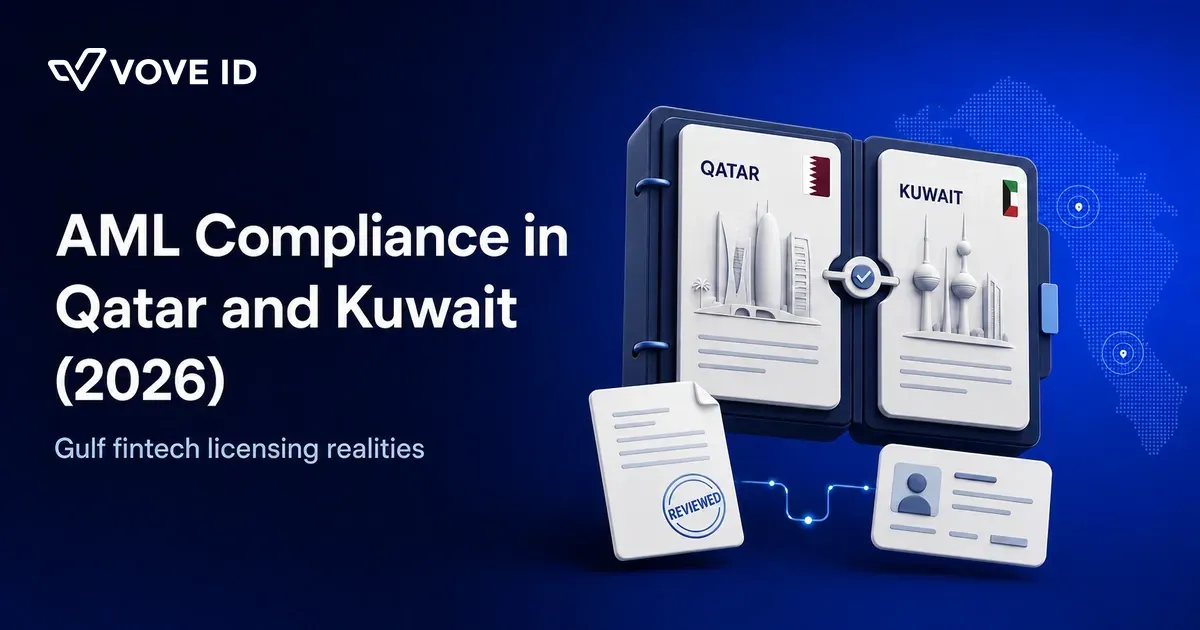
A practical way to turn two separate Gulf AML/CFT rulebooks into a controlled onboarding, review, and evidence workflow.
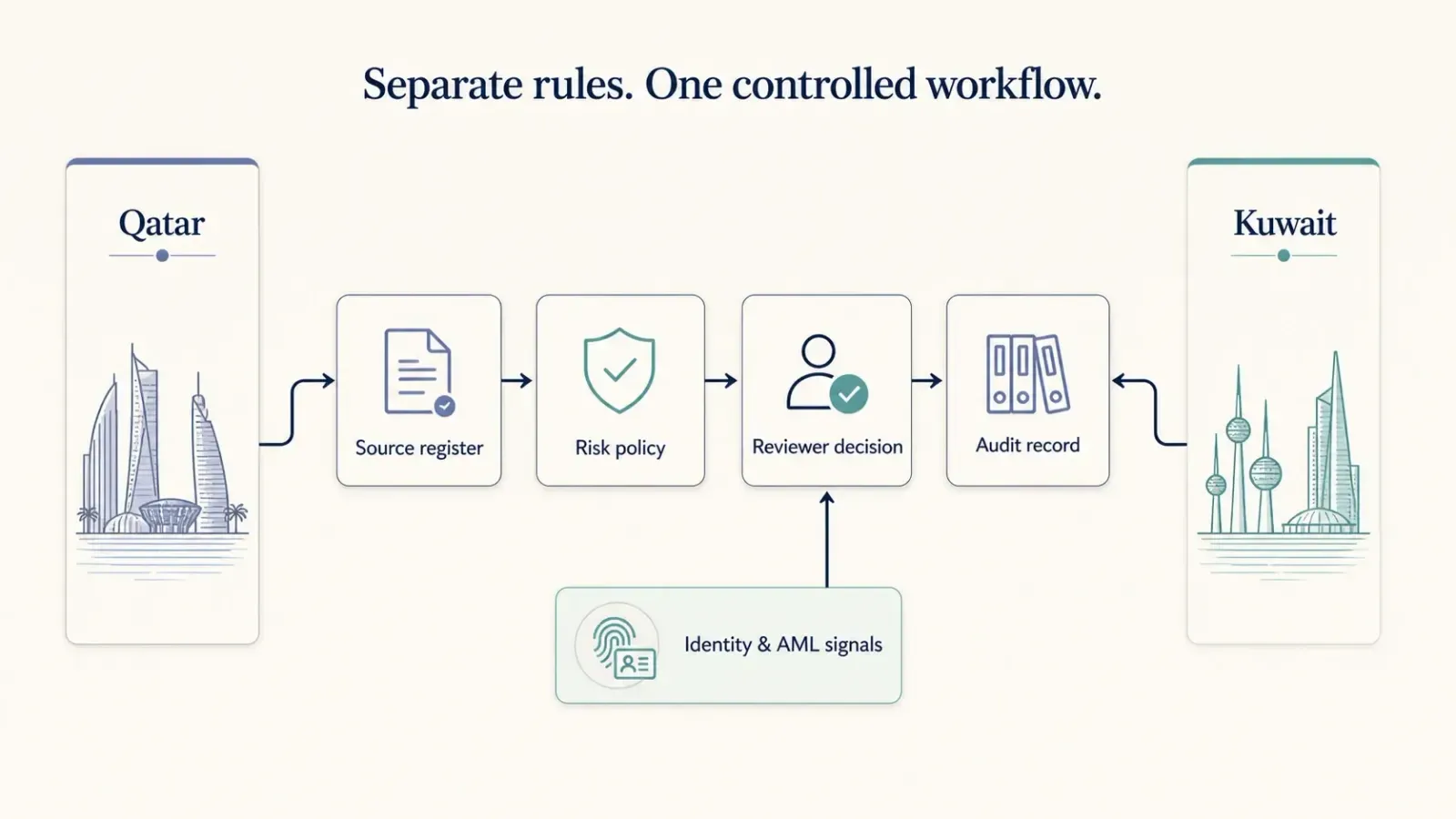
Direct answer: A fintech serving Qatar and Kuwait should maintain separate legal-source registers and escalation rules, then run one traceable workflow for customer evidence, risk decisions, screening, and case records.
VOVE ID helps payment and fintech teams organize identity and AML evidence where reviewer decisions have to stay connected.
This guide is current as of 6 August 2026 and is informational, not legal advice. Teams should check the authoritative local-language text, current circulars, license conditions, and qualified local advice before relying on a control design.
A country selector that turns Kuwait "on" is not a compliance program — it just moves the point where the gap gets found.
Regulatory context: close markets, separate supervisory records
In Qatar, the Qatar Central Bank's legislation page lists Law No. 20 of 2019 on combating money laundering and terrorist financing, amended by Decree Law No. 19 of 2021. Its Financial Crimes Enforcement Management describes risk-based AML/CFT supervision. Teams must still confirm whether another local regulator, zone, or license framework applies.
In Kuwait, the Central Bank of Kuwait states that its remit includes implementation of Law No. 106 of 2013. Published AML/CFT instructions for exchange companies cover controls and suspicious-transaction reporting to the Kuwait Financial Intelligence Unit.
This means one thing: a regional policy is not a substitute for a jurisdiction register. Name an owner, source, version checked, affected product, and control change for each market.
For a full breakdown of the underlying framework, see our AML requirements explained: the compliance operating system for regulated institutions.
Licensing reality: map the product before copying the controls
"Fintech" is not a license category. Start with the service, entity, customer relationship, and funds flow, then map the local license, supervisor, reporting path, and recordkeeping obligations.
On paper, a group policy can say "conduct KYC and screen customers." In practice, reviewers need a country-specific answer to who is checked, what triggers enhanced work, who approves an exception, and where a suspicious concern goes.
Customer due diligence: make the decision reconstructible
For each workflow, keep the customer evidence, verification result, risk classification, reviewer action, and disposition in one case record. A document image alone does not explain an acceptance, escalation, or decline.
Separate natural-person, business, and beneficial-owner journeys. Do not silently inherit either from a generic "GCC customer" template.
VOVE ID supports identity verification, biometric liveness, face matching, AML screening, KYB, and transaction monitoring. Teams should apply these inputs under approved local policy and escalation rules.
For the underlying identity-verification framework, see our KYC requirements explained: identity verification framework for fintech and regulated platforms.
Screening and reporting: keep alerts inside accountable casework
Screening produces potential matches, not an automatic clearance or report. The control is the documented review: what matched, what was compared, why it was resolved or escalated, and who made the decision.
VOVE ID offers customer-configurable AML screening. The regulated team remains responsible for scope, review, escalation, and local reporting.
The same applies to monitoring. When an alert appears, a later reviewer should be able to see the customer context, underlying event, risk logic, evidence requested, decision, and handoff. Onboarding and monitoring records that live in unrelated systems are where teams actually lose the thread.
A realistic Gulf expansion failure: one policy, two unanswered questions
A payment startup enables Kuwait through a country selector. The reviewer cannot identify the applicable instruction or escalation owner, and a potential match is closed in a shared inbox with no rationale.
This is not an identity-verification failure. It is a source-and-case-control failure.
How VOVE ID supports the workflow: signals before a decision
VOVE ID can provide identity, liveness, face-matching, KYB, AML-screening, and transaction-monitoring inputs inside a designed workflow. Manual review may be used where the customer's compliance team has sufficient evidence to approve a verification.
Practical AML checklist for Qatar and Kuwait fintech teams
Regulatory ownership
- Maintain separate Qatar and Kuwait source registers, including current instructions and circulars.
- Map the product, entity, license, supervisor, and reporting route before launch.
Onboarding and risk
- Link each risk category to a defined due-diligence, approval, and review action.
- Record the jurisdiction and policy version used for each material decision.
Screening and records
- Review potential matches with an attributed rationale rather than a checkbox.
- Keep alert context, actions, and handoffs in one retrievable case record.
- Test that a second reviewer can reconstruct a completed case without using an inbox.
Q&A
Can a Qatar AML policy cover Kuwait onboarding?
No. The two markets have separate legal and supervisory sources, so their source registers and control mappings must remain separate.
Which regulator should a fintech follow in Qatar?
It depends on the activity, entity, and license perimeter. Confirm the applicable local framework before treating one source as complete.
Is an AML-screening result a final compliance decision?
No. Screening surfaces a potential issue. The accountable compliance function needs a documented review, disposition, and escalation path.
What should change first when a Gulf fintech enters a second market?
Build the second market's source register, product-perimeter map, and decision ownership before reusing the onboarding flow. Then test the full case record from evidence through escalation.
What makes a case audit-ready?
The record should show the evidence, checks, risk result, reviewer rationale, action, and governing policy version.
Conclusion
Qatar and Kuwait share a region, not a rulebook — treating them as one market is where Gulf expansion plans tend to come apart.
Keep legal ownership, workflow logic, and case evidence together across both, and let one operating model carry two separate source registers without merging them.
Two markets, two rulebooks, one workflow that has to hold both together — that's what VOVE ID supports for Gulf expansion.
This article is intended for general informational purposes only and does not constitute legal, financial, or regulatory advice. KYC/KYB/AML requirements may vary depending on jurisdiction, industry, and specific business circumstances. For up-to-date and binding compliance obligations, readers should refer to the relevant regulatory authorities or consult qualified professionals.