Crowdfunding Platforms: KYC for Backers and KYB for Campaign Owners
A verified backer and an unverified recipient are two different problems. Here's how crowdfunding platforms build separate KYC and KYB paths that meet in one accountable case record.
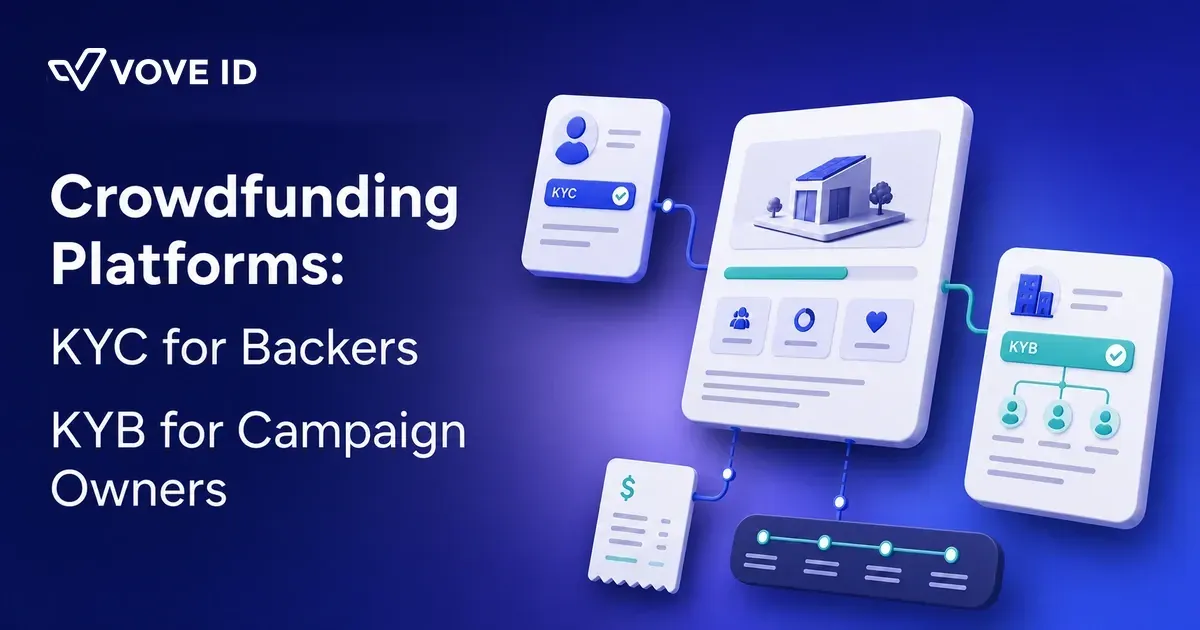
How a platform can separate contributor identity from campaign-owner ownership while keeping both decisions in one accountable workflow.
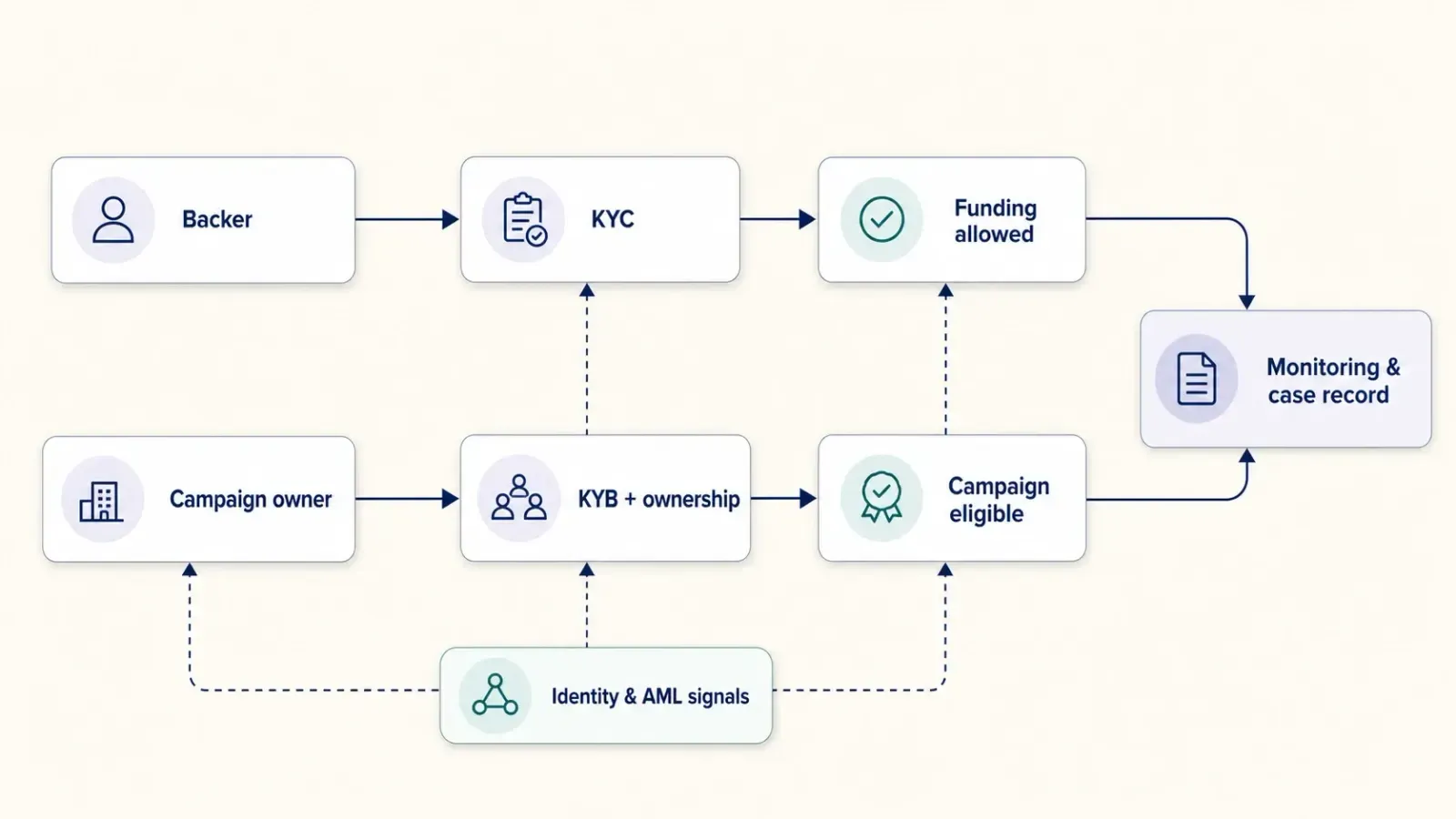
Direct answer: Backers need an individual KYC path where applicable; campaign owners need a KYB and ownership path. Both should meet in a monitored case record.
VOVE ID helps crowdfunding teams organize identity and business-verification evidence where trust depends on both sides of a transaction.
This guide is current as of 6 August 2026 and is informational, not legal advice. The applicable obligations depend on the platform's jurisdiction, business model, payment flow, license, and customer relationship.
A platform can pass every backer check and still fail at the one question that decides whether a campaign is legitimate: who actually receives the money.
Regulatory context: crowdfunding is a three-party operating model
Crowdfunding connects a project owner, contributors, and an intermediary platform. The EU Crowdfunding Regulation describes that structure for in-scope European services and requires minimum project-owner due diligence. It does not erase national AML/CFT law or turn every global model into an EU service; FINRA's funding-portal materials illustrate a different framework.
The FATF's crowdfunding report notes that most activity is legitimate but identifies risks involving opaque campaigns and efforts to obscure funding sources.
This means one thing: the platform must understand both the participant and the recipient. A policy that checks one side leaves the case incomplete.
For a full breakdown of the underlying framework, see our KYC requirements explained: the identity-verification framework for fintech and regulated platforms.
Backer KYC: identify the individual behind the contribution
The backer flow asks who is attempting to fund, invest, donate, or receive a repayment. The exact control depth depends on the product and local rules, but the workflow should collect identity evidence, result, risk outcome, and any exception reason.
Do not confuse a logged-in account with an identity decision. Distinguish submitted evidence, verification, review, and permitted action.
VOVE ID supports identity verification, biometric liveness, face matching, AML screening, KYB, and transaction monitoring. Teams decide how these inputs apply under approved policy.
Campaign-owner KYB: prove who is asking the public to fund a project
The campaign-owner flow asks what person or organization receives the funds, who controls it, and who can represent it. For a business, verify the entity, ownership, relevant directors or authorized representatives, and campaign purpose.
On paper, a campaign profile and bank account can look complete. In practice, the reviewer needs the ownership trail, authority trail, declared use of funds, and the decision that connects them.
For a full breakdown of business entity verification and beneficial ownership, see our KYB requirements explained: complete fintech compliance framework.
Monitoring: connect funding behavior to the onboarding record
Crowdfunding risk does not end at approval. A changed purpose, unusual contribution concentration, or early payout can prompt review. It is not an automatic conclusion.
VOVE ID offers customer-configurable AML screening. The accountable team must set the scope, assess potential matches, retain rationale, and follow the applicable route.
The useful design is one case record that links the backer or investor event, campaign-owner evidence, funding activity, alert context, and reviewer outcome. Teams tend to lose the thread exactly where KYC, KYB, payments, and support queues stop sharing an identifier.
A realistic platform failure: a verified backer, an unverified recipient
A crowdfunding platform accepts contributions to a campaign. The payout-account name does not match the project owner, the manager cannot show authority, and ownership information sits in support rather than the case file.
The team can see the money coming in but cannot explain who is entitled to receive it. This is not a backer-KYC failure. It is a recipient-KYB failure.
How VOVE ID supports the workflow: two evidence paths, one decision record
VOVE ID can provide identity, liveness, face-matching, business-verification, and AML-screening inputs within a platform workflow. Manual review may be used where the customer's compliance team has sufficient evidence to approve a verification.
Practical crowdfunding KYC and KYB checklist
Platform perimeter
- Map the platform's jurisdiction, license, payment role, and applicable reporting route.
- Define which party is the platform's customer at every stage.
Backers and campaign owners
- Separate individual backer KYC from campaign-owner KYB and authority checks.
- Link the campaign purpose and expected activity to the risk and review decision.
Monitoring and evidence
- Route unusual contribution or payout patterns into a defined review process.
- Preserve the relevant identity, ownership, alert, and reviewer evidence in one case record.
- Test that the platform can explain both the funder and the recipient of a completed campaign.
Q&A
Does every crowdfunding backer need the same KYC process?
No. The process depends on the platform model, jurisdiction, risk, and legal perimeter.
Why is KYB needed for campaign owners?
KYB helps the platform understand the entity or person receiving funds, the ownership and authority behind it, and whether the campaign evidence supports the intended activity.
Can KYC and KYB be handled in separate tools?
They can, but the platform still needs one retrievable case record linking contributor, campaign, recipient, screening, and reviewer evidence.
What should trigger enhanced review of a campaign?
The risk policy should define triggers such as inconsistent ownership or payout evidence. A trigger prompts review; it is not a conclusion.
What is the core control a crowdfunding platform should test?
Ask whether a reviewer can reconstruct the funder, recipient, acceptance decision, and response to a risk signal.
Conclusion
Backer identity and campaign-owner ownership answer different questions, and a platform needs both answered before it can stand behind a payout.
Separate the KYC and KYB journeys, then reconnect them in a monitored case record so a reviewer can trace either side without switching tools.
Backer identity solves half the problem — recipient ownership is the other half. VOVE ID brings both into one workflow.
This article is intended for general informational purposes only and does not constitute legal, financial, or regulatory advice. KYC/KYB/AML requirements may vary depending on jurisdiction, industry, and specific business circumstances. For up-to-date and binding compliance obligations, readers should refer to the relevant regulatory authorities or consult qualified professionals.