AML Compliance in Angola (2026): Guide for Fintechs and Regulated Businesses
Navigate AML compliance in Angola 2025. Explore fintech rules, digital identity, CDD, and FDI opportunities
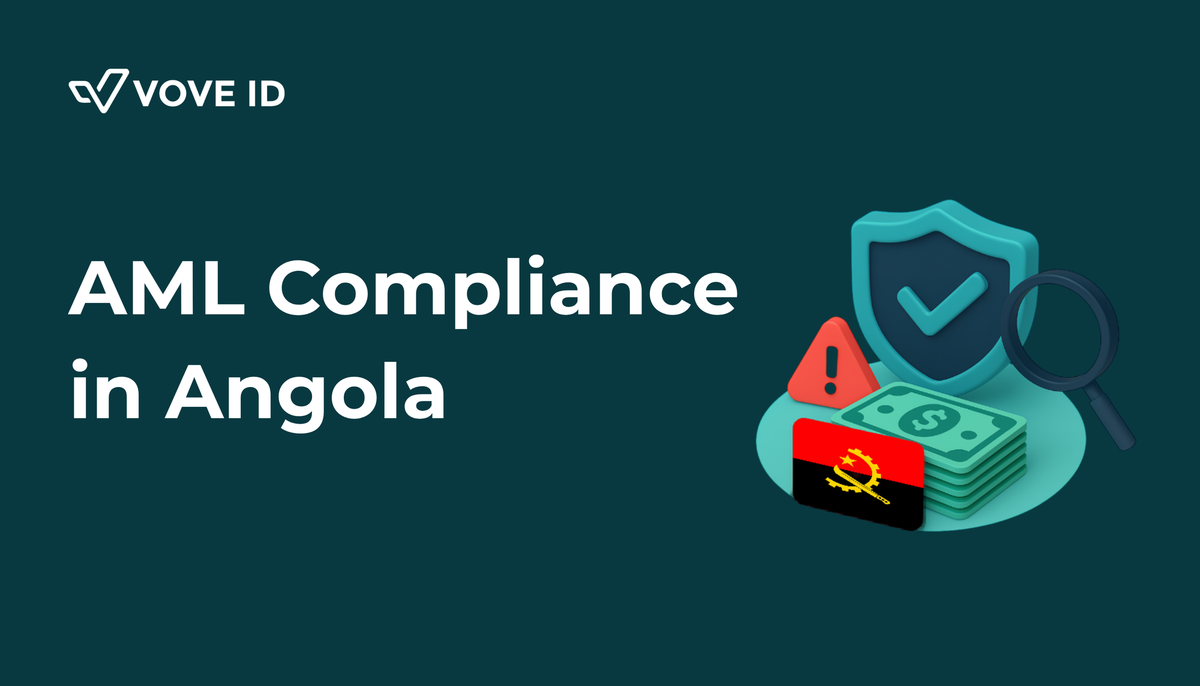
Angola remains on the FATF grey list — and has been since 2023. That status shapes the entire compliance environment: regulators are under international pressure to demonstrate enforcement, foreign banking partners apply additional scrutiny to Angolan counterparties, and fintechs operating in the market face higher due diligence expectations from investors and correspondent banks alike.
At the same time, Angola's economy is genuinely growing. Oil revenues, a expanding mobile money sector, and increasing foreign direct investment mean the market is worth operating in — but the compliance infrastructure needs to match the risk profile.
This guide covers the Angola-specific AML layer: the legal framework, regulatory authorities, reporting obligations, sector risks, and what compliance looks like in practice. For the underlying AML system architecture, see our AML Requirements guide.
The Legal Framework
Angola's AML regime is built on three core laws:
Law No. 34/11 (2011) established the foundational AML/CFT obligations — customer due diligence, record-keeping, and suspicious transaction reporting. This is the baseline that all regulated entities operate under.
Law No. 3/14 (2014) expanded the list of predicate offences to include corruption and influence peddling — directly relevant in a market where political exposure and state-connected business structures are common.
Law No. 5/20 (2020) is the most significant update. It introduced mandatory risk-based approaches to customer due diligence, strengthened UBO transparency requirements, and aligned Angola's framework more closely with FATF recommendations. This is the operative law for compliance teams building or reviewing AML programs today.
BNA Directives 01/2025 and 02/2025 — issued in early 2025 — establish updated standards for risk-based onboarding, enhanced due diligence triggers, and internal AML control requirements. These are the most current operational reference documents for FATF-supervised entities in Angola.
Regulatory Authorities
Banco Nacional de Angola (BNA) is the primary AML supervisor for banks, payment institutions, fintechs, and other financial service providers. It issues operational directives, conducts inspections, and monitors compliance with AML/CFT obligations. BNA's 2025 directives represent a material tightening of expectations — firms that have not reviewed their CDD and EDD frameworks against these directives are operating on outdated assumptions.
UIF (Unidade de Informação Financeira) is Angola's Financial Intelligence Unit. It receives and analyses Suspicious Transaction Reports (STRs), coordinates with law enforcement, and participates in the Egmont Group for cross-border intelligence sharing. UIF's analytical capacity has been a focus of FATF's grey list concerns — international cooperation is improving but remains an area under scrutiny.
CMC (Comissão do Mercado de Capitais) supervises capital markets participants. ARSEG supervises the insurance sector. Both apply AML/CFT requirements under the same Law 5/20 framework.
FATF Grey List: What It Means Operationally
Angola was placed on the FATF grey list in 2023, meaning it is subject to increased monitoring due to identified strategic deficiencies in its AML/CFT regime. As of 2026, key areas under scrutiny include:
- Effectiveness of suspicious transaction reporting and UIF analysis
- Beneficial ownership transparency and registry quality
- Supervision of DNFBPs — real estate, lawyers, accountants
- International cooperation and cross-border information sharing
For fintechs and regulated businesses, grey list status has direct operational consequences:
- Correspondent banking relationships require additional due diligence documentation
- Foreign investors and banking partners apply elevated scrutiny to Angola-linked transactions
- Regulatory tolerance for compliance gaps is lower — enforcement is more active under international pressure
Angola is working through an action plan with FATF. Progress has been made on legal reforms, but effectiveness ratings — how well the system actually works in practice — remain the sticking point.
Key AML Obligations
Suspicious Transaction Reporting
STRs must be filed with the UIF promptly — without tipping off the client. The obligation is not threshold-based: any transaction or behaviour where suspicion exists must be reported regardless of amount.
Large cash transactions above 15 million kwanzas (~$16,000 at current rates) trigger mandatory monitoring and reporting obligations under BNA guidelines.
Record-keeping obligations: all customer and transaction data must be retained for a minimum of 10 years — notably longer than EU standards and a common gap for internationally-oriented compliance teams.
Risk-Based CDD and EDD
Law 5/20 and BNA Directives 01/2025 and 02/2025 require risk-based customer due diligence — not a uniform checklist. Businesses must:
- Classify customers by risk at onboarding and update that classification throughout the relationship
- Apply standard CDD for typical low-to-medium risk clients
- Apply EDD for PEPs, high-risk geographies, complex ownership structures, and large cash transactions
- Document the rationale for risk decisions in a way that survives BNA inspection
For EDD cases, senior management approval is required before activation — this is an explicit BNA requirement, not just best practice.
For business clients, CDD extends into full KYB: ownership verification, UBO identification, and business model assessment.
Ongoing Monitoring
AML obligations in Angola do not end at onboarding. BNA expects:
- Transaction monitoring for patterns inconsistent with the declared purpose of the relationship
- Periodic re-verification of higher-risk clients
- Re-screening against sanctions and PEP lists when risk profile changes
- Immediate reporting to UIF when suspicious patterns emerge
Sector-Specific AML Risks
Oil, Gas, and Mining
Angola's economy is heavily concentrated in extractive industries — oil accounts for the majority of government revenues and a significant share of FDI. This creates specific AML risk vectors:
- State-owned enterprise relationships with complex ownership and government connections
- Sector-specific licences (ANPG for oil and gas, ANRM for mining) that require verification as part of KYB
- PEP exposure through government-connected business structures — particularly common in joint ventures and concession arrangements
- Large transaction volumes that require robust monitoring baselines
For fintechs and payment platforms serving businesses in these sectors, EDD is not an edge case — it is a baseline expectation.
Mobile Money and Digital Payments
Approximately 60% of Angola's population remains unbanked. Mobile money has expanded rapidly to serve this gap, with platforms like Multicaixa Express processing significant transaction volumes. This creates AML risk vectors specific to digital channels:
- Cash-to-digital conversion points where transaction origins are difficult to verify
- High transaction velocity among lower-value accounts
- Informal economy flows that are hard to distinguish from legitimate small-business activity
BNA has increased oversight of mobile money operators specifically, and digital platform operators should expect continued scrutiny of their monitoring frameworks.
Real Estate
Real estate is a priority AML risk sector in Angola, flagged specifically in FATF assessments. Property transactions — particularly in Luanda — involve significant cash flows, foreign investment, and politically connected buyers. Ministry of Finance oversight of real estate agents under AML obligations has expanded, but enforcement capacity in this sector remains uneven.
Where AML Breaks in Practice
PEP exposure is pervasive. Angola's political economy means a high proportion of business relationships involve PEP-adjacent structures — family connections to government officials, state enterprise ownership, or concession arrangements tied to political relationships. Proximity screening is essential, not optional.
UBO data is limited. Angola has no public beneficial ownership register. Customer-provided UBO declarations are the primary input, which must be verified against whatever other data sources are available. This creates a documentation burden that many compliance teams underestimate. The full KYB workflow for corporate clients is covered in our KYB Compliance in Angola guide.
Portuguese-language documentation. All official documents — corporate registries, identity documents, regulatory correspondence — are in Portuguese. Compliance systems and review workflows must accommodate this.
Grey list scrutiny compounds normal compliance gaps. In most jurisdictions, a documentation gap is a finding. In a grey list jurisdiction, the same gap can become a relationship termination trigger for correspondent banks or a licensing issue with BNA.
Getting AML Right in Angola
Angola's AML environment in 2026 requires firms to treat compliance as an active operational system — not a periodic review exercise. FATF grey list pressure, BNA's 2025 directive updates, and active UIF enforcement mean that documentation quality and monitoring coverage matter more than in many comparable African markets.
VOVE ID supports fintechs and regulated businesses operating in Angola with identity verification, KYB workflows, and sanctions screening built for low-infrastructure environments — Arabic-language documentation support, biometric verification for populations with limited formal ID coverage, and audit-ready logging aligned with BNA standards.
If you're building or reviewing AML infrastructure for Angola, we can walk you through how it works in practice.
This article is intended for general informational purposes only and does not constitute legal, financial, or regulatory advice. AML requirements may vary depending on jurisdiction, industry, and specific business circumstances. For up-to-date and binding compliance obligations, readers should refer to the relevant regulatory authorities or consult qualified professionals.