AML Compliance in Gabon: 2026 Guide for Fintechs and Regulated Businesses
Gabon has been on the FATF grey list since February 2023. For regulated businesses, that means heightened EDD requirements, ANIF reporting obligations, and a compliance bar that's moving upward.
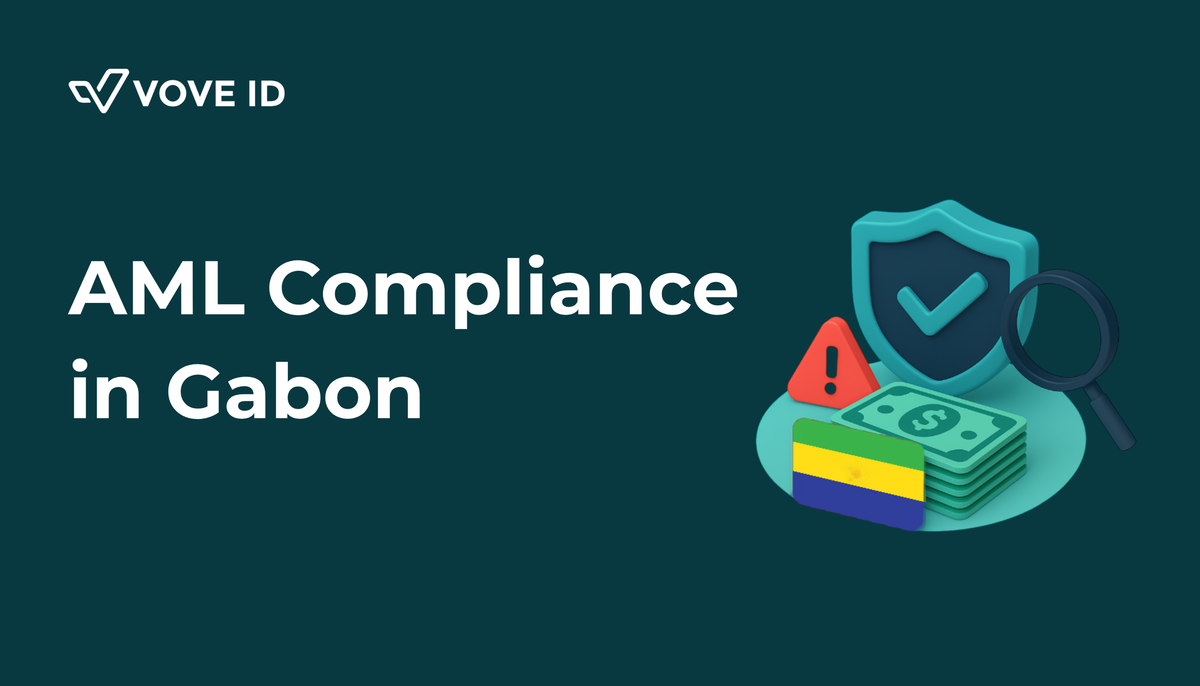
Gabon's placement on the FATF grey list in February 2023 was not a surprise to anyone tracking the GABAC mutual evaluation process, but it changed the operational calculus for businesses onboarding Gabonese clients or routing transactions through Gabonese financial institutions. Enhanced due diligence now applies by default from most international counterparty perspectives, domestic supervisors are under pressure to demonstrate measurable improvement, and ANIF's enforcement posture has shifted.
VOVE ID supports AML compliance workflows for businesses operating in high-scrutiny jurisdictions — including FATF grey list markets like Gabon — with sanctions screening, document verification, and audit-ready logging.
This guide covers Gabon's AML framework as it stands in 2026 — regulators, reporting obligations, sector risks, and the grey list reform agenda. For the underlying AML compliance framework, see our AML Requirements Explained: 2026.
The Regulatory Architecture
Gabon's AML/CFT framework sits at the intersection of three layers:
FATF/GABAC: Gabon is a member of GABAC (Groupe d'Action contre le Blanchiment d'Argent en Afrique Centrale), the FATF-style regional body for Central Africa. GABAC conducts mutual evaluations and monitors member state compliance with FATF recommendations. The 2023 grey listing followed Gabon's last full mutual evaluation, which identified gaps in beneficial ownership transparency, STR reporting rates, and enforcement outcomes.
CEMAC/COBAC: At the monetary union level, COBAC (Commission Bancaire de l'Afrique Centrale) supervises financial institutions across the CEMAC zone and issues binding AML regulations applicable in Gabon. COBAC has broad supervisory authority including the power to impose sanctions, revoke licenses, and require remediation plans.
National level — ANIF: The Agence Nationale d'Investigation Financière is Gabon's Financial Intelligence Unit, established under Law No. 35/2004 on the prevention and repression of money laundering. ANIF receives and analyzes suspicious transaction reports (STRs), disseminates financial intelligence to law enforcement, and coordinates with GABAC and international FIUs through the Egmont Group.
Primary Legislation
The foundational AML law is Law No. 35/2004 on the prevention, detection, and repression of money laundering in Gabon. This has been supplemented by subsequent regulatory instruments, including COBAC circulars implementing FATF-aligned CDD standards and CEMAC's broader AML regulation.
Terrorist financing is addressed separately under Ordinance No. 6/2010 and subsequent provisions implementing UN Security Council resolutions on proliferation financing. Gabon is a signatory to the UN Convention Against Corruption (Mérida Convention) and the UN Convention Against Transnational Organized Crime (Palermo Convention).
Practically, the regulatory instruments that matter most for day-to-day compliance are the COBAC circulars, which translate the higher-level laws into specific operational requirements for supervised institutions.
Obliged Entities
AML obligations under Gabonese law apply to:
- Banks and credit institutions licensed by COBAC
- Microfinance institutions
- Insurance companies and intermediaries
- Notaries, in real estate and company formation transactions
- Accountants and statutory auditors
- Lawyers in transactional contexts
- Real estate agents and developers
- Money transfer operators and mobile money providers
- Casinos and gaming establishments
- Dealers in high-value goods (jewels, art, luxury vehicles)
The scope expansion to Designated Non-Financial Businesses and Professions (DNFBPs) has been one of the reform commitments Gabon made in connection with its grey list action plan. Implementation across the DNFBP sector remains uneven, with notaries and real estate agents among the areas GABAC has specifically flagged.
STR Reporting: The Obligation and the Reality
Supervised institutions must file a Déclaration de Soupçon (suspicious transaction report) with ANIF when they have reasonable grounds to suspect that a transaction relates to the proceeds of a crime, money laundering, or terrorist financing. Reporting is mandatory — there is no threshold below which a suspicious transaction may be ignored.
Reports must be submitted to ANIF promptly. The law does not specify an exact hour-based deadline for standard STRs (unlike some jurisdictions with 24-hour requirements), but delay without documented justification is itself a compliance failure. Institutions must also file cash transaction reports above XAF 5 million (approximately USD 8,000 at current rates) for cash transactions at financial institutions.
The STR filing rate in Gabon has historically been low relative to the size of the financial sector. One of FATF's specific criticisms in the grey list action plan was the gap between declared AML programs and actual reporting outputs. ANIF has been working to address this through guidance, training, and in some cases enforcement — but the gap remains a known weakness.
Tipping off — disclosing to a customer or third party that a STR has been filed — is a criminal offense.
Sanctions Screening
Gabon implements UN Security Council sanctions through national legislation and COBAC regulatory requirements. Supervised institutions are required to screen customers and transactions against:
- UN consolidated sanctions list
- COBAC-directed lists (which incorporate EU and other major jurisdictions' designations for CEMAC-zone supervisory purposes)
There is no single national sanctions list managed by ANIF. In practice, institutions operating in Gabon that have international correspondent banking relationships apply OFAC, EU, and UK sanctions lists in addition to UN sanctions — partly because their correspondent banks require it as a condition of maintaining the relationship.
Correspondent banking de-risking is a real operational concern in Gabon. Several Gabonese banks have lost or seen reduced access to USD correspondent banking over the past decade, driven by the compliance costs of maintaining relationships with grey list jurisdictions. This affects cross-border payments infrastructure and is relevant context for any fintech looking to move money through Gabonese financial rails.
The FATF Grey List: What It Means in Practice
Gabon was placed on the FATF grey list in February 2023 under the "Jurisdictions Under Increased Monitoring" designation. The grey list does not represent a sanctions designation or a legal prohibition — but it has operational consequences:
From counterparty institutions: International banks and payment processors apply enhanced due diligence as standard when dealing with Gabonese counterparties. This increases onboarding friction and transaction monitoring requirements for Gabonese entities operating cross-border.
From regulators: COBAC and ANIF are under explicit pressure to demonstrate progress on the FATF action plan. This translates to more frequent on-site examinations, tighter documentation requirements, and lower tolerance for program gaps.
FATF action plan commitments for Gabon include:
- Improving beneficial ownership transparency and enforcement
- Increasing STR filing rates and ANIF analytical capacity
- Demonstrating prosecutorial outcomes in money laundering cases
- Extending AML obligations meaningfully to DNFBPs
Progress reviews occur at FATF plenary meetings. Gabon's exit from the grey list depends on demonstrating "significant progress" across these areas — a process that typically takes 2–4 years from listing. As of mid-2026, Gabon remains under monitoring.
Sector-Specific ML/TF Risk
Oil and Gas: Gabon derives roughly 40-45% of government revenue from hydrocarbons. The sector is a known concentration point for financial crime risk: over-invoicing of services, profit repatriation through related-party structures, and the complexity of production sharing agreements create multiple vectors. Foreign companies operating in Gabon's offshore blocks face AML scrutiny from both COBAC and their home jurisdiction supervisors.
Forestry and Timber: Gabon holds one of the largest remaining tropical forest areas in Central Africa. The timber sector has been identified by international monitoring bodies as vulnerable to proceeds laundering through logging concession payments, export permit manipulation, and undervaluation of timber consignments. The Gabonese government introduced export restrictions on raw logs in 2010 to drive domestic processing — but the regulatory gap between declared and actual transactions remains.
Artisanal Mining: Gabon has gold, manganese, and iron ore resources. Artisanal and small-scale mining (ASM) operates largely outside the formal financial system, with cash as the dominant settlement medium. ML risk from ASM is concentrated in cash aggregation and conversion.
Real Estate in Libreville: Political instability — culminating in the August 2023 military coup — did not suppress Libreville property values. High-value real estate continues to serve as a store of value for politically connected wealth. ANIF has flagged the sector, but notary and real estate agent compliance with AML obligations remains limited.
Mobile Money: Airtel Money and Moov Money dominate retail payments. Cash-in transactions at agents are difficult to monitor at scale. Structuring risk — multiple small deposits across agent networks to avoid reporting thresholds — is a documented vulnerability.
The August 2023 Coup and Its Compliance Implications
The military coup of August 30, 2023, which removed President Ali Bongo Ondimba after over a decade in power, created a specific compliance consideration: the emergence of a new military-led transitional government and the reshuffling of politically exposed person classifications.
Individuals who held senior positions under the Bongo administration may now face adverse sanction scrutiny, while new figures within the transitional government (Comité pour la Transition et la Restauration des Institutions — CTRI) represent an emerging PEP category. For institutions maintaining Gabonese customer relationships from before the coup, a PEP re-screening cycle was appropriate within weeks of the transition.
The transitional government has maintained Gabon's stated commitment to the FATF reform agenda, but institutional continuity at ANIF and COBAC supervision has required monitoring. As of 2026, both bodies continue to function, but reform momentum is tied to the transitional government's broader stabilization agenda.
Record-Keeping
Under COBAC rules applicable in Gabon, records related to customer due diligence, transactions, and STR reporting must be retained for 10 years. This covers:
- KYC and CDD documentation
- Transaction records with enough detail to reconstruct each transaction
- STR filings and ANIF correspondence
- Internal risk assessments and escalation records
Records must be accessible on demand during regulatory inspections. The audit-readiness of those records — not just their existence — is what COBAC examiners check.
Operationalizing AML in Gabon
The combination of grey list status, sector-specific risks, and post-coup institutional uncertainty means Gabon requires an explicitly documented, risk-based AML program — not a template lifted from a lower-risk jurisdiction.
For businesses building or reviewing that program, the specific pressure points are: sanctions screening that covers UN plus major list coverage; STR workflows that produce actual reports rather than internal escalations that stop short of ANIF; and KYC documentation that satisfies what an examiner will actually ask for.
VOVE ID covers sanctions screening across the major lists and document verification for the identity records that anchor your CDD files. Teams onboarding Gabonese clients or counterparties can run verification flows that produce audit-ready records aligned with what COBAC expects.
Gabon is under active FATF monitoring, and COBAC examiners are checking programs — not just policies. If yours was built for a lower-scrutiny environment, now is the right time to review it.
This article is intended for general informational purposes only and does not constitute legal, financial, or regulatory advice. KYC/KYB/AML requirements may vary depending on jurisdiction, industry, and specific business circumstances. For up-to-date and binding compliance obligations, readers should refer to the relevant regulatory authorities or consult qualified professionals.