
AMLR and the New EU KYB Standard: What Startups Need to Build Now
AMLR applies from 10 July 2027. For EU fintech startups, 2026 is the build window — and the decisions that matter aren't the policy documents, they're the workflow architecture being built right now.
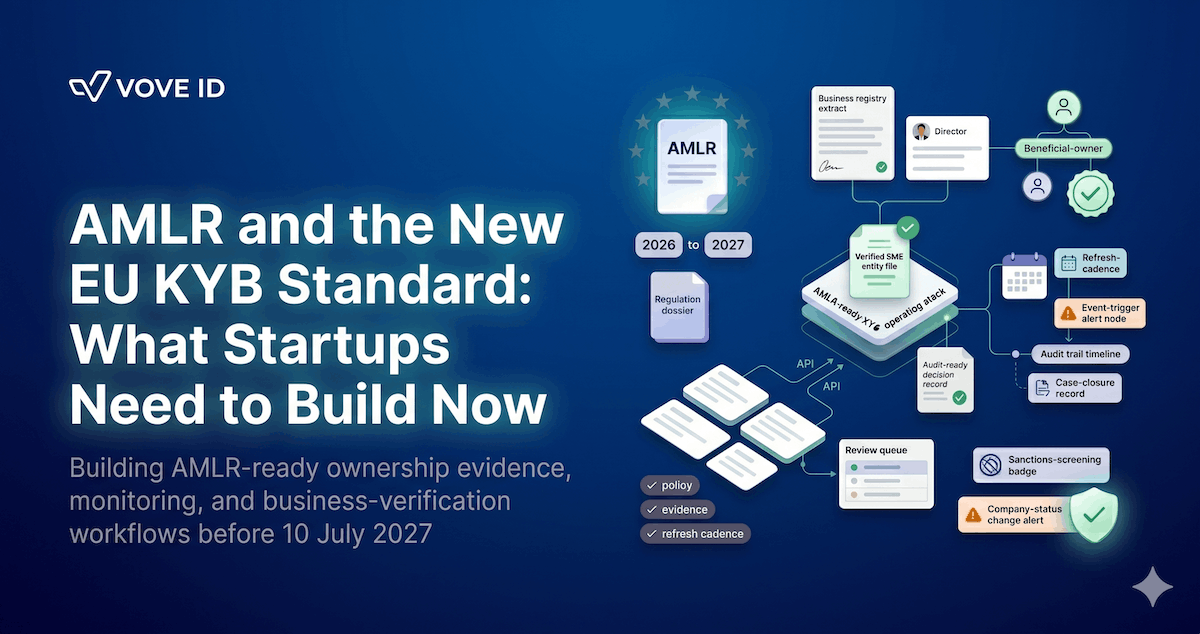
For EU fintech startups, AMLR is not a distant policy headline anymore. On 14 May 2026, the real question is whether the business-verification stack being built today will still look defensible when Regulation (EU) 2024/1624 starts applying on 10 July 2027. Teams that still rely on an AMLD 5-era KYB workflow are not just slightly behind. In many cases, they are building evidence models, refresh logic, and ownership controls that will need to be rebuilt under deadline pressure.
What should startups build now for the new EU KYB standard under AMLR? Startups should build a KYB workflow that treats entity verification, beneficial-owner resolution, screening, ongoing monitoring, and evidence capture as one connected control system. AMLR raises the floor by making the rulebook more uniform across the EU and by increasing the pressure on firms to prove that business-customer files stay accurate, current, and reviewable over time.
Many founders still talk about AMLR as if it belongs to a later phase of the company.
That is the wrong timeline.
AMLR entered into force on 9 July 2024, twenty days after publication in the Official Journal. For most obliged entities, it applies from 10 July 2027. That may sound far enough away to postpone architecture decisions.
It is not.
For startups, 2026 is the build window.
By the time a regulator, banking partner, auditor, or licensing adviser asks whether the firm's business-verification controls are AMLR-ready, the work that matters will not be the policy document drafted that month. It will be the workflow decisions made much earlier:
- what data the team collects
- how beneficial ownership is resolved
- how evidence is stored
- how refreshes are triggered
- how reviewers close edge cases
- how the file stays current after onboarding
That is what the new KYB standard actually changes.
Why AMLR changes the KYB conversation
Under AMLD 5, many firms got used to an EU framework that still left meaningful room for national interpretation and uneven implementation.
That often produced a familiar startup pattern:
- one country-specific onboarding workflow
- one registry check
- one UBO capture step
- one screening pass
- one manual review note
Then the file was considered "done."
AMLR pushes the market away from that mindset.
Because it is a directly applicable regulation, it is designed to reduce fragmentation in how core AML/CFT obligations are read across the Union. That matters for startups because the difference between "our local interpretation is fine" and "our file is actually defensible" gets narrower.
For KYB, the practical implication is simple:
the business-customer file has to behave more like an operating record and less like a one-time onboarding packet.
That means stronger expectations around:
- identifying the legal entity correctly
- understanding ownership and control properly
- documenting the purpose and nature of the relationship
- screening relevant parties, not only the company
- monitoring the relationship on an ongoing basis
- keeping information current when risk or circumstances change
Most startups already know these ideas in principle.
What AMLR changes is the cost of doing them weakly.
First, fix the date confusion
This is the first thing many teams still get wrong.
The key dates are:
- 19 June 2024: Regulation (EU) 2024/1624 was published in the Official Journal
- 9 July 2024: AMLR entered into force
- 10 July 2027: AMLR begins applying for most obliged entities
- 10 July 2029: later application date for certain sector-specific entities listed in the Regulation
So when people say in 2026 that AMLR is "still years away," that is only half true.
Legally, the main application date is 10 July 2027.
Operationally, the redesign work belongs in 2026, not in the quarter before application.
That is especially true for startups because business verification is deeply structural. You cannot patch ownership logic, audit trails, or ongoing monitoring into a weak onboarding architecture at the last minute.
What AMLR adds to KYB obligations in practice
The headline is not that business verification suddenly becomes mandatory for the first time.
The headline is that the floor becomes more explicit, more harmonized, and harder to treat as a documentation exercise.
1. The entity file has to explain the relationship, not just name it
Too many startup KYB flows still stop at:
- company name
- registration number
- incorporation document
- one or two declared owners
That is not enough for serious risk management.
A defensible KYB file needs to explain:
- what the business is
- who controls it
- why it is using the product
- what activity is expected
- which jurisdictions matter
- what would count as a meaningful change later
This is the difference between verifying a company exists and understanding whether it fits the relationship you are approving.
2. Beneficial ownership has to become a real workflow
This is where many AMLD 5-built stacks are weakest.
They technically collect ownership information but do not operationalize it well. The result is often:
- incomplete UBO mapping
- no confidence level on ownership evidence
- unclear treatment of layered holding structures
- no refresh cadence
- no clean linkage between ownership data and screening
Under the new EU standard, beneficial ownership cannot stay a checkbox.
It has to become a maintained part of the file.
3. Ongoing monitoring matters more for business customers than teams admit
One-time KYB is easy to build.
The harder question is whether the startup can tell six months later:
- whether the company is still active
- whether the directors changed
- whether ownership changed
- whether a new controller became sanctioned or higher risk
- whether the actual usage still fits the original profile
This is where old KYB stacks usually fail.
They store a static business file and assume the customer remains the same.
AMLR pushes in the opposite direction. The relationship has to be monitored, and the information has to stay current on a risk-sensitive basis.
4. The decision trail matters almost as much as the underlying data
A startup can have most of the right information and still fail an audit-style review if the reasoning is missing.
The file should make it easy to answer:
- what matched
- what was reviewed
- what evidence was accepted
- which risk factors were identified
- who approved the case
- when the next refresh is due
Without that, the workflow produces data but not defensible decisions.
The new evidence requirements startups underestimate
When founders hear "evidence," they often think of documents.
Documents matter. But the evidence problem is broader than that.
For modern KYB, the startup needs evidence in at least five layers.
1. Entity evidence
The file should show:
- legal existence
- registration status
- jurisdiction
- company identifiers
- business purpose or activity
2. Ownership and control evidence
The startup should be able to show:
- who the declared UBOs are
- how that was determined
- whether the structure involved intermediate entities
- whether any ownership ambiguity remained
- what the team did with that ambiguity
3. Screening evidence
This should cover:
- the entity
- directors
- beneficial owners
- other relevant controllers or signatories
And it should be clear whether the results were:
- clean
- matched and cleared
- escalated
- deferred pending more information
4. Refresh and monitoring evidence
This is where the AMLR gap is often most visible.
A startup should be able to show not just that the business was reviewed once, but that it has a repeatable method for keeping the file current:
- periodic refreshes
- event-driven reviews
- triggers tied to ownership, status, or screening changes
- case logs for what happened after a trigger fired
5. Decision evidence
A good KYB file does not end with raw data.
It ends with a decision and a rationale:
- approve
- reject
- restrict
- re-review
- escalate
That rationale is what makes the file audit-ready.
A realistic AMLR failure
Imagine a French B2B fintech that onboards SMEs using a workflow originally designed under AMLD 5.
On paper, everything seems acceptable:
- the policy manual is updated
- the onboarding form asks for owners
- screening runs on the company name
- manual review exists for edge cases
Then the firm tests its stack against AMLR expectations in 2026.
The policies pass first glance.
The evidence does not.
The problems show up quickly:
- UBO refresh cadence is undefined
- director changes do not trigger re-review
- screening is not clearly linked to control persons
- ownership ambiguity is resolved in analyst notes, not in a structured record
- ongoing monitoring exists in theory but not in an observable workflow
That is the type of failure founders underestimate.
The issue is not that the startup ignored compliance entirely.
The issue is that the startup built a file that can explain onboarding day, but not relationship life.
That is exactly where the new EU KYB standard bites.
What startups should build in 2026
The right move is not to wait for a perfect future-state architecture.
It is to build the pieces that prevent a 2027 rebuild.
1. A proper entity-resolution layer
The workflow should reliably identify:
- the legal entity
- the operating brand
- the directors or managers
- the relevant jurisdictions
If those pieces sit in separate tools without a common case record, the file will stay fragile.
2. Structured beneficial-owner mapping
Do not leave ownership understanding inside PDFs and analyst memory.
Build a workflow that can:
- capture direct and indirect ownership
- flag missing ownership layers
- show confidence or completeness status
- trigger review when ownership changes
3. Screening that follows the control perimeter
Screening should not stop at the entity.
It should extend to:
- directors
- UBOs
- signatories
- parent or control entities where relevant
That makes the KYB file actually responsive to business risk.
4. Ongoing monitoring and refresh triggers
This is the biggest structural upgrade most startups still need.
The file should know when to wake up again:
- company-status change
- ownership change
- director change
- sanctions hit
- unusual activity relative to expected use
Without triggers, "ongoing monitoring" remains a policy phrase.
5. An audit-ready decision log
This is what turns data into evidence.
Every meaningful case should show:
- what was reviewed
- what risk was identified
- what evidence supported the outcome
- who made the decision
- when the next review is due
That is what banking partners, supervisors, and serious internal reviewers will actually read.
How VOVE ID maps KYB to the AMLR standard
VOVE ID helps startups turn business verification into one connected workflow instead of a set of disconnected checks.
That includes:
- entity verification
- beneficial-owner mapping
- director and owner screening
- structured review flows for ambiguous cases
- refresh triggers tied to real lifecycle events
- one audit-ready record for onboarding and ongoing monitoring
The practical benefit is not only stronger compliance.
It is less rework.
If a startup builds the right KYB architecture in 2026, the move toward 10 July 2027 becomes a controlled preparation exercise rather than a late scramble to prove what the business cannot currently evidence.
The real build-now lesson
AMLR is not telling startups to collect one more document.
It is telling them to build a better business-customer control system.
That means:
- KYB as a lifecycle workflow
- beneficial ownership as a maintained record
- screening as part of the control perimeter
- monitoring as a trigger-based process
- evidence as a structured output
The startups that still think their AMLD 5-era file will carry forward unchanged are already behind.
The better move is to use 2026 to build the KYB stack that will still make sense on 10 July 2027.
Want to see how VOVE ID maps your KYB stack to AMLR section by section?
Q&A
When does AMLR actually apply?
Regulation (EU) 2024/1624 entered into force on 9 July 2024. For most obliged entities, it applies from 10 July 2027.
What is the biggest KYB mistake startups make before AMLR?
Treating business verification like a one-time onboarding packet instead of a lifecycle control. The gap usually shows up in beneficial-owner evidence, ongoing monitoring, refresh cadence, and decision logging.