BaaS Providers and Sub-Merchant Onboarding: A KYB Architecture
When a BaaS provider routes funds for a sub-merchant it didn't fully verify, the compliance failure is the provider's — not the platform's. Here's how to fix the architecture before that happens.
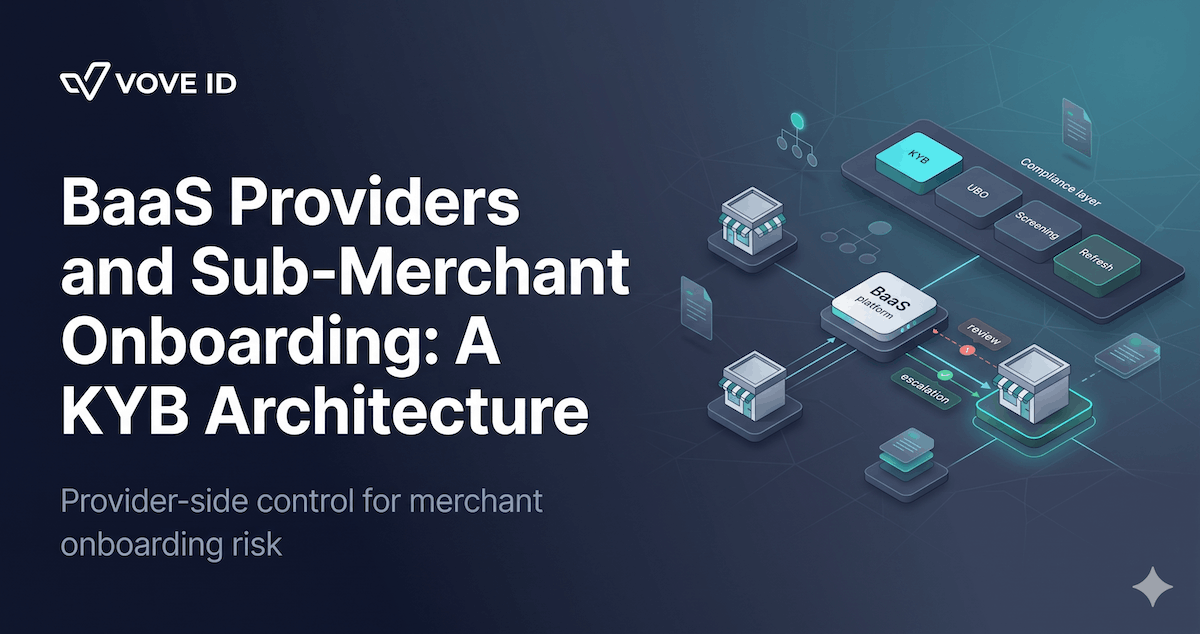
BaaS providers routinely discover that the host platform handled the onboarding experience but not the compliance record. By the time a sub-merchant's risk profile changes — ownership, business model, transaction behavior — the provider is often the last to know. VOVE ID helps BaaS providers build a KYB layer that runs independently of the host platform so the compliance record stays current even when the commercial relationship doesn't change.
This article covers sub-merchant KYB architecture for BaaS providers: where accountability sits, what a one-time onboarding pass misses, and what the provider-side record has to contain to hold up under regulatory scrutiny. For the underlying business verification framework, see our KYB Requirements Explained 2026.
Why BaaS providers can't rely on the host platform's KYB
A BaaS model concentrates a specific tension: the platform owns the merchant relationship and the onboarding surface, while the provider owns the compliance risk and the regulatory exposure.
That split works fine as a commercial structure. It doesn't work as a compliance design.
If the provider enables the activity, routes the funds, or underwrites the payments capability, regulators in 2026 expect the provider to independently understand who the merchant is, who controls it, and when that changes. "The platform ran KYB" is a data source, not a defense.
The platform may optimize onboarding for conversion. That means narrower checks, fewer friction points, and less follow-up on ownership complexity. The provider's risk appetite is different — and its obligations don't move based on the platform's commercial incentives.
This is why the provider needs a separate control layer even when the host platform already performs checks.
Where the accountability actually sits
The clearest principle in BaaS onboarding: delegated collection is not delegated accountability.
A provider can accept merchant data from the host platform. It can use platform APIs. It can integrate into the platform's onboarding motion. What it cannot do is treat the platform's onboarding record as its own. The provider still needs to:
- verify the legal entity independently
- identify and assess UBOs and controllers
- screen the business and key persons against relevant lists
- determine the correct due diligence tier
- trigger a review when the merchant changes
If any of those actions exist only as platform-side events with no provider-side record, the provider has a documentation problem. Documentation problems become regulatory problems when something surfaces.
For a full breakdown of business verification and UBO identification requirements, see our KYB Requirements Explained 2026.
What a single onboarding pass misses
Sub-merchants change. Ownership shifts. Directors are replaced. The business model that was described at activation is not always the one running six months later. Transaction behavior diverges. New products create different exposure.
A KYB check at activation gives you a verified snapshot. It doesn't give you a live compliance position.
The architecture has to support more than onboarding review. It needs event-driven refresh when key facts change, periodic re-validation for higher-risk segments, and case management for material merchant changes. Without those layers, the provider's understanding of the merchant goes stale after activation and stays stale until something forces a review — usually an external signal, usually too late.
The failure mode: when a BaaS provider loses the risk narrative
A European BaaS provider supports a marketplace. The host platform runs merchant onboarding and passes a packaged KYB result to the provider at activation. The model looks efficient.
Six months later, one sub-merchant changes beneficial ownership. The platform's system doesn't re-open the KYB file because the account is active and nothing commercial has changed. Volumes increase. A sanctions-related concern surfaces around the new controlling party.
The provider is asked what it knew and when.
The answer is weak. The original onboarding snapshot from the platform is all the provider has. There was no provider-side trigger on ownership change. No internal case was opened. No refreshed screening outcome is on record. The merchant exists in the provider's system as a technical account attached to payment flows, not as a KYB file with a current decision.
That's the failure: the platform handled the onboarding experience, and the provider lost the risk narrative.
What the provider-side KYB architecture needs to contain
VOVE ID helps BaaS providers run a KYB layer that operates in parallel with host-platform onboarding — integrating into the platform's data without depending on its records.
A defensible architecture gives the provider:
- a merchant record it owns, populated by platform data but not contingent on it
- independent entity verification and key-person screening at onboarding
- change triggers — UBO, director, business model — that open provider-side cases regardless of the platform's status
- a risk tier that the provider assigns and controls, not inherits from the platform
- an audit trail that shows decisions, evidence, and refresh history in one place
The goal isn't to duplicate every platform step. It's to ensure the provider keeps a compliance posture it can actually explain.
KYB architecture checklist for BaaS providers
- Host-platform data feeds into a provider-owned merchant record — not just into the payments system
- UBO and controller changes trigger provider-side refresh, independent of platform-side activity
- Screening results create reviewable cases, not just API pass/fail responses
- Higher-risk merchant segments route into enhanced due diligence with documented rationale
- Evidence survives platform relationship changes and merchant lifecycle events
- The provider's compliance team can reconstruct the full merchant file without platform access
FAQ
Can a BaaS provider rely on the host platform's KYB output?
Platform-collected data is a valid input. It's not a substitute for a provider-side control layer and its own reviewable record. The distinction matters when a regulator asks what the provider knew.
What's the most common failure point in sub-merchant onboarding?
Losing visibility after initial activation. If ownership or business model changes and the provider has no internal trigger, the file goes stale. The provider learns about the risk from an external source, not from its own monitoring.
Does every sub-merchant need the same level of KYB?
No. Risk-based tiers still apply. The point is that the provider must own the logic that determines which tier applies — not inherit that determination from the platform.
What should survive platform transitions?
Entity verification, ownership evidence, screening outcomes, refresh history, and case decisions need to exist in a provider-controlled record that doesn't depend on the platform's continued availability.
Building a BaaS business where the host platform owns the onboarding but your compliance team has to answer the questions? VOVE ID gives BaaS providers a sub-merchant KYB layer that keeps the provider's compliance record current without disrupting the platform's onboarding flow.
This article is intended for general informational purposes only and does not constitute legal, financial, or regulatory advice. KYC/KYB/AML requirements may vary depending on jurisdiction, industry, and specific business circumstances. For up-to-date and binding compliance obligations, readers should refer to the relevant regulatory authorities or consult qualified professionals.