EU Passporting for Payments: When Your Compliance Stack Has to Travel
A payment institution can passport into a new EU market in weeks and still fail in practice. The license travels. The disclosures and monitoring thresholds don't, unless you designed them to.
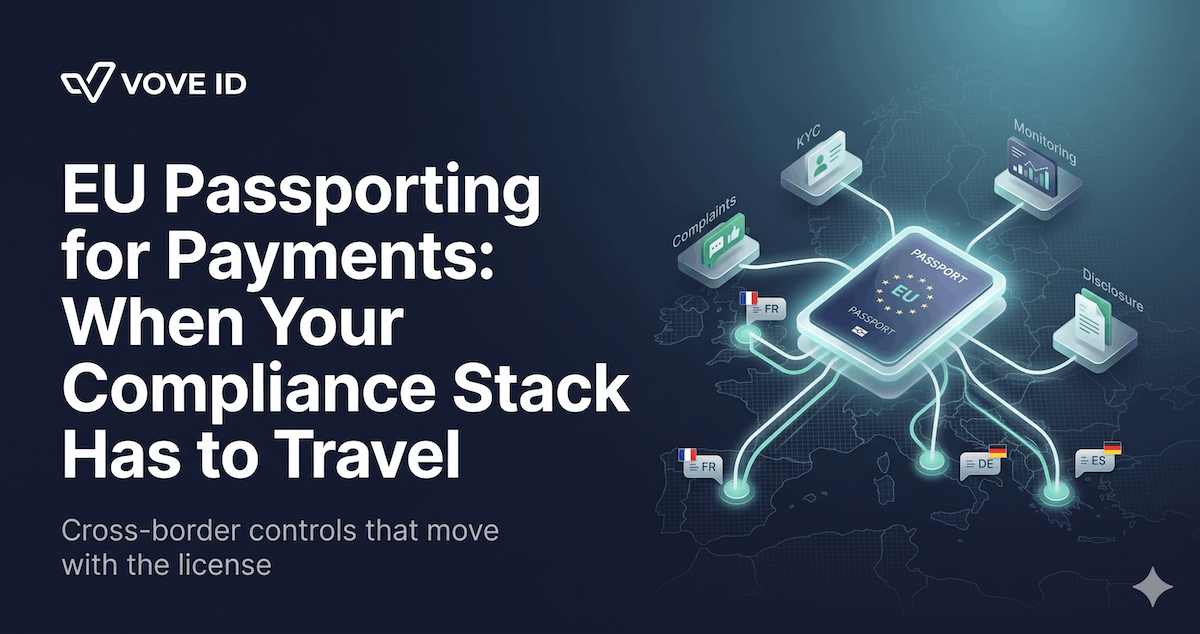
The EU passport gives payment institutions a legal right to operate across member states. It doesn't give them a portable compliance stack. VOVE ID helps payment institutions keep one operating environment while adapting the control layer to each market they enter — so the license expansion doesn't create compliance fragmentation.
This article covers what passporting requires of the compliance stack beyond the home-state license: where operations break first, what host-country expectations look like in practice, and how to design a stack that travels. For the underlying AML framework these institutions operate within, see our AML Requirements Explained 2026.
What passporting actually requires operationally
Home-state authorization is the legal anchor for EU expansion. It's not an operating license for a stack that was built around one regulator, one language, and one customer risk profile.
Passporting teams run into this as soon as the host country produces real activity. The legal right to operate is in place. The complaint arrives in Spanish. The transaction pattern doesn't match the monitoring thresholds calibrated for the Estonian corridor. The disclosure content was designed for the home-market regulator's expectations. The audit log shows all the right steps — for a different market.
None of that is a legal problem. It becomes an operational problem fast, and operational problems become supervisory problems at a pace that surprises most teams that focused on the filing.
At minimum, the compliance stack has to answer five questions before a new market goes live:
- Can onboarding adapt to local risk patterns without becoming a separate product?
- Can reviews and complaints be handled in the languages that actually arrive?
- Can monitoring distinguish between country-specific behavior and genuine risk signals?
- Can disclosures and audit records be produced in the right format for the market?
- Can the institution demonstrate host-country obligations are being met without rebuilding the system market by market?
If any of those answers is "not yet," the expansion isn't operationally ready — regardless of the legal timeline.
Where the stack breaks first
Host-country obligations don't create entirely separate regulatory regimes for passported institutions. They do create operational expectations that expose weak controls quickly.
Language and complaints handling
The most common early failure. A complaint queue built entirely around the home-country team and language becomes a bottleneck the moment host-country volume arrives. Translation adds delay. Context gets lost. A complaint that should resolve in two days sits for ten. Similar cases pile up inconsistently.
This isn't a major AML failure. It's friction that becomes a supervisory concern before any strategic failure surfaces.
Disclosure and customer communications
The core regulatory framework is aligned across the EU. Disclosure expectations aren't always operationally identical. Timing, format, and presentation requirements can differ in ways that create real review risk — especially when the institution hasn't explicitly built for the host market's standards.
Monitoring and escalation
Cross-border activity changes what normal looks like. New corridors, different business models, and local payment behavior all affect how transaction monitoring should interpret patterns. Default thresholds inherited from the home market tend to produce too many false positives in some corridors and miss real signals in others.
Audit retrieval
When a host-country issue surfaces, the institution needs to reconstruct the relevant file quickly: the customer journey, disclosures, decisions, and reviewer actions in one place. If those records are fragmented across systems — or mixed into a home-market evidence trail — the reconstruction is slow and the file looks disorganized.
The failure mode: when a clean legal expansion runs into complaints
An Estonian PI expands into Spain. The legal step completes cleanly. Commercial launch is fast. Volumes build. Then complaints tied to onboarding friction and account restrictions start arriving in Spanish.
The queue is staffed by the home team. English and Estonian issues route well. Spanish ones don't. Translation adds delay. Context between operations and compliance gets lost in the handoff. A complaint that would have taken two days now sits for twelve. Similar cases produce inconsistent escalation decisions because reviewers don't share a common reading of the customer file or the local language details.
The institution hasn't had an AML failure. It hasn't violated the passport terms. But the operational friction is creating supervisory friction — and supervisory friction, if it compounds, creates formal concerns.
That's the pattern: the license travels, the stack doesn't adapt, and the problems emerge from operations rather than from the compliance framework itself.
What a portable compliance design looks like
VOVE ID helps payment institutions keep one operating environment across markets while adapting the right control modules for each one.
The distinction matters because the alternative — country-by-country workarounds — doesn't scale. Each workaround creates a separate evidence trail, a separate review logic, and a gap in the institution's ability to explain its overall compliance posture.
A stack designed for portability gives the institution:
- one customer and case record that spans markets without fragmentation
- localizable disclosure and review steps inside the same product journey — not separate flows
- monitoring logic that adjusts by corridor or market profile without requiring a full rebuild
- complaint and case workflows that preserve ownership and SLA clarity across languages
- audit retrieval that shows the exact version of the journey relevant to the market involved
The goal isn't uniformity — different markets have different risk profiles. The goal is a single operating model where the right modules vary, not a collection of country-by-country systems.
Passporting checklist
- Home-state license assumptions are not hard-coded as universal operating parameters
- Complaint handling can absorb host-country language demand without adding manual handoffs
- Monitoring thresholds account for corridor and market mix, not just home-market baselines
- Local disclosures are built into the same product journey, not handled as exceptions
- Audit retrieval can produce country-specific decisions and timelines without manual reconstruction
- The compliance team can demonstrate host-country obligations without operating a separate system
FAQ
Does passporting mean we can keep the same compliance operations in every EU market?
No. The legal permission extends across markets. The operating model still has to handle local language, complaint handling, disclosure, and risk differences. The institutions that learn this late pay for it through supervisory friction.
Do host countries create separate compliance regimes for passported institutions?
Not in a full legal sense. But they create operational expectations — around complaints, disclosures, and monitoring quality — that expose weak controls before any formal regulatory problem appears.
What breaks first during passporting?
Customer operations. Complaints, escalations, disclosure quality, and monitoring accuracy all surface before more serious strategic failures. They're also the problems that are easiest to prevent with the right stack design.
What does a well-designed passporting stack preserve?
One customer record, consistent case management, localizable review steps, corridor-adjusted monitoring, and audit retrieval that doesn't require manual work per market.
Expanding into a new EU market and not sure whether the compliance stack will travel with the license? VOVE ID helps payment institutions keep one operating environment while adapting the control layer to each market — so passporting doesn't mean building compliance twice.
This article is intended for general informational purposes only and does not constitute legal, financial, or regulatory advice. KYC/KYB/AML requirements may vary depending on jurisdiction, industry, and specific business circumstances. For up-to-date and binding compliance obligations, readers should refer to the relevant regulatory authorities or consult qualified professionals.