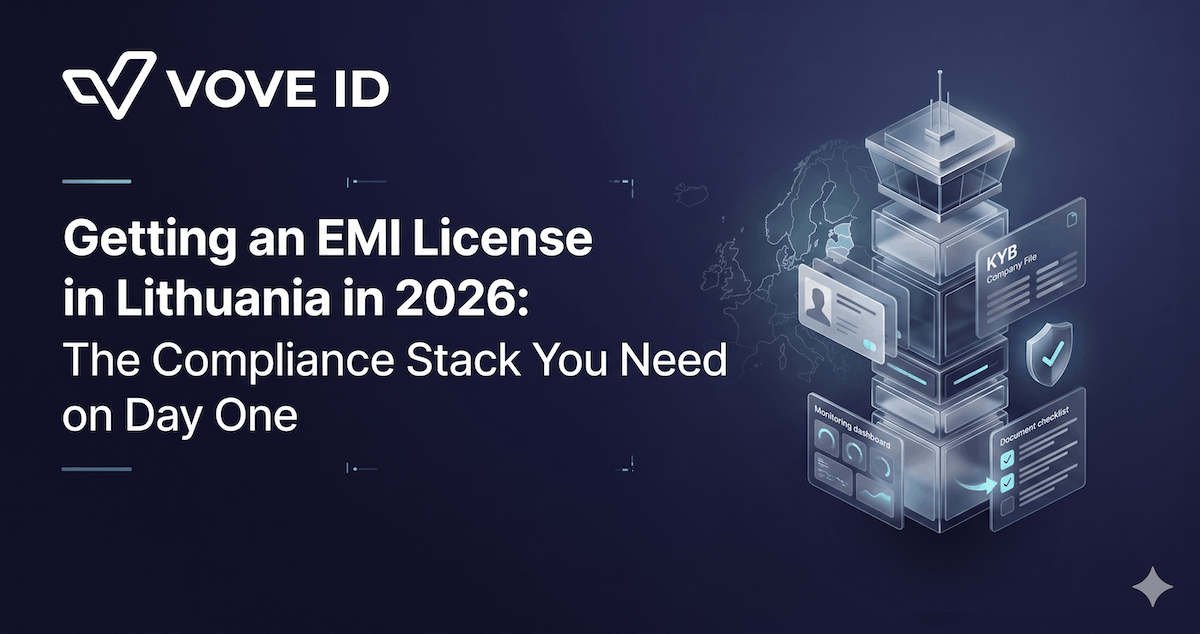
Getting an EMI License in Lithuania in 2026: The Compliance Stack You Need on Day One
Lithuania can be a fast EMI licensing route — but only when the operating model is ready. The Bank of Lithuania isn't just reading the application. It's testing whether the controls actually work.
VOVE ID works with EMI applicants in Lithuania who need to show the Bank of Lithuania a compliance stack that is operational before the licensing review — not a set of policies that describe controls yet to be built. This guide covers what a credible day-one stack looks like and where most applications fall short.
Direct Answer
What compliance stack does an EMI applicant in Lithuania need on day one? It needs more than policy PDFs. A workable day-one stack means live KYC and KYB workflows, screening, monitoring, case handling, and evidence the team can actually demonstrate. The regulator is not only reading the file. It is testing whether the file maps to a real operating model.
What the Bank of Lithuania Actually Reads in 2026
Founders often approach EMI licensing as if the hard part is describing the business model clearly. That matters, but it is not enough. The harder question is whether the compliance model is believable at operating level.
For an EMI applicant, the regulator is typically trying to understand how customers will be identified and verified, how business customers will be reviewed when the model includes merchants, platforms, or corporate clients, how sanctions, PEP, and adverse-media issues will be handled, how alerts will be reviewed, escalated, and closed, how ongoing monitoring will work after onboarding, and how reporting and audit evidence will be preserved.
This is where many applications start drifting. The policy says one thing. The day-one workflow does not exist yet. The regulator can see the gap immediately.
The issue is not whether a startup intends to become compliant after launch. The issue is whether the compliance layer already exists in a form that can be demonstrated, tested, and trusted.
For a full breakdown of KYB requirements including entity verification, UBO mapping, and ownership review, see our KYB Requirements Explained 2026: Complete Fintech Compliance Framework Used by Regulated Institutions.
The Day-One Compliance Stack
The strongest EMI applications are not the ones with the longest documentation set. They are the ones where the control architecture is already shaped into something operational.
A credible day-one stack usually includes five working layers.
First, customer onboarding. Retail and business onboarding need clear intake logic, not a generic form and a manual cleanup step later. Identity collection, document verification, sanctions checks, and risk-based review paths need to be visible from the start.
Second, KYB and ownership review. If the EMI expects to serve platforms, merchants, or other businesses, business verification cannot stay as a future integration. Entity checks, ownership mapping, director verification, and escalation for unclear structures need to be part of the stack on day one.
Third, screening and alert handling. Screening is easy to describe in a policy. It becomes real only when the startup can show what happens after a hit appears. Who owns the queue, what gets escalated, and where the rationale is stored are the details that make the control defensible.
Fourth, monitoring. Startups often think monitoring becomes relevant after growth. Licensing reviews usually take a stricter view. If the product launches successfully, the regulator wants to know the stack can continue to observe customer behavior, review risk shifts, and preserve the evidence trail.
Fifth, reporting and case evidence. It should be possible to show how decisions are recorded, how exceptions are handled, and how the business would support an internal review, partner query, or supervisory request without reconstructing the file from email and chat.
That is the difference between a compliance plan and a compliance stack.
For a full breakdown of AML programme requirements including monitoring, STR obligations, and case evidence, see our AML Requirements Explained 2026: Compliance Operating System for Regulated Financial Institutions.
A Realistic License Failure: When Policy and Operations Diverge in Week Three
An EMI applicant arrives with a polished submission pack. The policies are clean. The organizational chart looks mature. The onboarding narrative sounds convincing. The founders assume the hard part is mostly behind them.
Then the operational questions arrive.
The regulator asks for a live walkthrough of business onboarding. The startup has a vendor selected, but the workflow is not production-ready. KYB still depends on manual coordination. Screening alerts route to a shared inbox. No one can show where exception decisions will live.
Nothing in that scenario looks dramatic. That is exactly why it is dangerous.
The application does not fail because the startup lacked ambition or legal advice. It stalls because the described controls and the operating reality diverge too early. The faster the licensing jurisdiction, the more exposed that divergence becomes.
In other words, speed amplifies readiness. It does not replace it.
How VOVE ID Lands the Day-One Stack
VOVE ID helps EMI applicants move from policy intent to working operations before the gap appears.
Structured KYC and KYB workflows mean the applicant starts with a working path for individuals and businesses that can be reviewed and demonstrated — not a future integration. Screening alerts and case decisions stay in one operating layer, with review path, decision logic, and rationale attached to the case rather than scattered across inboxes. The same stack that verifies the customer can support post-onboarding monitoring instead of forcing the applicant to rebuild the control model after launch.
For EMI applicants in Lithuania, that matters because the licensing story and the launch story are not separate stories. They are one system viewed at two different moments.
Checklist
Policies
- Make sure every policy claim maps to a visible workflow or decision path.
- Remove phase-two dependencies from core onboarding and screening controls.
Live operations
- Be able to demonstrate KYC, KYB, screening, escalation, and case closure as operating processes.
- Define who owns exceptions before the first live customer enters the stack.
Reporting
- Keep reviewer notes, decision rationale, and evidence inside the case file.
- Make sure the stack can support supervisory, partner, and internal review questions without reconstruction work.
Q&A
Is Lithuania still a fast route for EMI licensing in 2026?
It can be fast relative to other jurisdictions, but only when the applicant arrives with a credible operating model. Speed does not compensate for a weak compliance stack.
What is the biggest compliance mistake EMI applicants make?
Treating the application as a documentation exercise rather than an operating-readiness exercise. The regulator usually wants to see that the controls can work in practice, not just on paper.
Does an EMI applicant need live KYB before launch?
If the product model includes business customers, merchant relationships, or corporate counterparties, the applicant should be able to show how business verification and ownership review will actually run from day one.
What should a day-one stack prove?
It should prove that onboarding, screening, monitoring, escalation, and evidence preservation are connected parts of one workable system, with named ownership and a usable audit trail.
Conclusion
Lithuania is attractive because it rewards preparedness. That is also why weak operating models show up quickly there. An EMI application can look complete and still be fragile if the stack behind it is not live enough to demonstrate. The teams that move best are the ones that bring working onboarding, screening, KYB, monitoring, and case evidence into the process before they need to defend it.
Building a Lithuanian EMI application and not sure the compliance stack is ready to demonstrate on day one? VOVE ID gives payment teams one operating layer for onboarding, screening, monitoring, and case evidence — before launch pressure exposes the gaps.
This article is intended for general informational purposes only and does not constitute legal, financial, or regulatory advice. KYC/KYB/AML requirements may vary depending on jurisdiction, industry, and specific business circumstances. For up-to-date and binding compliance obligations, readers should refer to the relevant regulatory authorities or consult qualified professionals.