Bulgaria and Romania: Where EU Passporting Hits Local Friction
The EU passport gets you into Bulgaria and Romania. It does not get you through a local complaint, a supervisory request, or a host-state evidence check. Here is the gap.
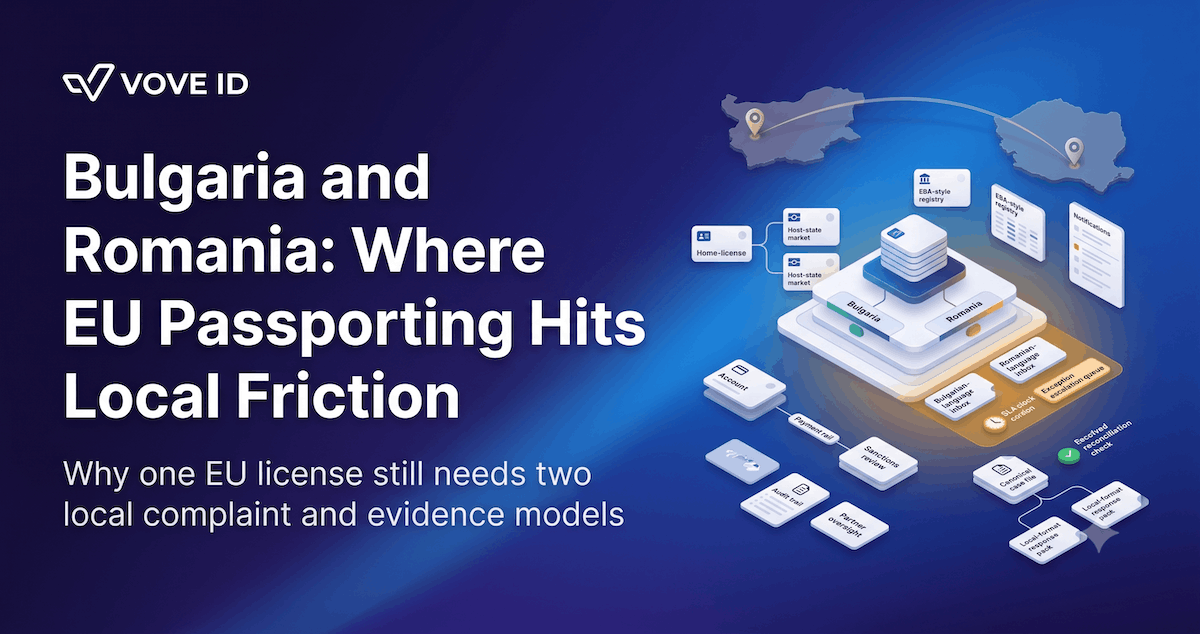
EU passporting into Bulgaria and Romania rarely fails at the notification stage. It fails when a provider assumes one home-state operating model can absorb two host-state consumer environments, two supervisory reading styles, and two local-language complaint flows without extra design.
VOVE ID helps payment and e-money teams operating on cross-border models keep their compliance files defensible in each host-state environment — not just at home. This guide covers the Bulgaria and Romania passporting case specifically. For the underlying KYC and AML frameworks, see our KYC Requirements Explained 2026 and AML Requirements Explained 2026.
Where does EU passporting hit local friction in Bulgaria and Romania? As of 9 June 2026, it usually hits at the points where a cross-border payments or e-money product has to behave locally: complaint handling, customer communications, evidence preservation, agent oversight, and regulator-readable files. PSD2 still gives licensed institutions a route to provide services cross-border, but Article 101 also requires complaint procedures in the official language of each Member State where the service is offered. That is where a head-office-only operating model starts leaking.
On paper, Bulgaria and Romania look straightforward for a passported provider. Both are EU markets. Both have active payments and e-money supervision. Both let a team believe the hard part is getting the home-state license and sending the right notifications.
That is only half true.
The legal right to enter the market is not the same thing as an operating model that survives local complaints, local evidence requests, and local supervisory scrutiny. This is exactly where passporting stops being a licensing story and becomes a file-quality story.
Why passporting looks cleaner than it behaves
The EU framework still does what founders want it to do at a high level. One authorised payment or e-money institution can expand across Member States without rebuilding the core license in every market. That is real.
So is the second half of the picture.
The Bulgarian National Bank regulates and supervises payment service providers and electronic money issuers in Bulgaria and maintains public registers under the national payment-services law. In Romania, the National Bank of Romania authorises and supervises payment institutions under Law 209/2019 and the related secondary framework.
The home license may travel, but the operating file still lands in a host-state environment that has its own register visibility, complaint channels, reporting expectations, and supervisory reading habits. Teams often underestimate that because the product view feels unified: one app, one onboarding flow, one terms stack, one case queue.
The host-state user does not experience the product that way when something goes wrong. The host-state authority does not supervise it that way either.
Bulgaria and Romania are both EU markets, but local friction still appears locally
The common mistake is to treat Bulgaria and Romania as the same expansion move because both sit inside the same passporting perimeter. Operationally, that is too shallow.
The friction points usually show up in five places.
Complaint intake. A cross-border provider can satisfy its own dashboard and still fail the customer moment if complaint intake stays centralised, English-first, or weakly categorized. Under PSD2, complaint procedures have to exist in every Member State where the service is offered, available in the official language of that Member State unless another language is agreed with the user. The response clock also matters: the provider is expected to answer within 15 business days in the normal case.
That is manageable at low volume. It becomes a control problem once Bulgarian and Romanian complaints enter the same queue with different consumer expectations, different document attachments, and different escalation paths.
Customer-facing language. Language is not just a support issue. It affects whether the team can prove what the user saw, what the user accepted, and whether the complaint response addressed the actual issue raised. If a Romanian complaint arrives in Romanian, gets loosely translated, routed to a shared queue, and answered with generic template language, the problem is not tone. The problem is whether the provider can later show that the substance of the complaint was understood and answered correctly. The same risk exists in Bulgaria.
Evidence preservation. When a cross-border payment or e-money dispute escalates, the team needs one reconstructible record showing the user journey, the version of the disclosure or terms shown, the transaction path, the complaint chronology, and the final response. If those artifacts live across separate CRM, payment, and support tools, the file becomes hard to re-read. That is where host-state friction turns into supervisory friction.
Agent and partner oversight. Passporting models often rely on agents, distributors, or local commercial partners. The commercial relationship is local, but the governance is often still home-state. If local sales, onboarding support, or complaint pre-screening happens through lightly governed partners, the provider ends up with local conduct risk and weak central evidence.
Market-specific edge cases. The file breaks fastest in edge cases: beneficiary-name mismatches, account-access disputes, unauthorized transaction complaints, fee-disclosure complaints, payment-delay cases involving an intermediary. These do not fail because Bulgaria and Romania are unusual. They fail because the same central process is expected to absorb two local complaint environments without being designed for either.
For the full KYB framework relevant to partner and agent oversight in EU markets, see our KYB Requirements Explained 2026.
Where a passported stack actually breaks
Take a passported EMI headquartered in another EU Member State, offering wallet and payout services into both Bulgaria and Romania. One onboarding stack, one support team, one complaint workflow, one transaction-monitoring engine.
A Romanian user complains that a beneficiary transfer was delayed and the final fee disclosure did not match the app flow. At roughly the same time, a Bulgarian merchant raises a complaint about a payout delay linked to a sanctions false positive.
The Romanian complaint is filed in Romanian, translated loosely, and assigned to a queue owner who can see the payment event but not the exact disclosure version shown before execution. The response goes out late and does not address every point raised.
The Bulgarian case is different in a different way. The screening alert was cleared manually, but the review notes sit in a different system from the merchant complaint. When the merchant escalates, the provider can show the outcome — but not the full decision path.
Internally, these feel like two unrelated cases. From the outside, they point to the same gap: the product is passported, but the complaint and evidence model is not. That is the real local-friction problem in Bulgaria and Romania.
What teams should build before corridor volume arrives
The answer is not a separate stack for each market. It is one cross-border stack with explicit host-state overlays.
Local-language complaint handling with owned SLAs. Bulgarian and Romanian complaints are not translation tasks. They are regulated workflow entries with local-language intake, queue ownership, response clocks, and full-point responses.
Versioned customer communications. If a fee, disclosure, or payment explanation changes, preserve the version tied to the user event. Otherwise the team cannot reconstruct the complaint file later.
One evidence pack per case. Build a case record that joins customer communications, transaction details, screening outcomes, operator actions, and complaint responses in one place. The point is not better reporting. It is faster defensibility.
Stronger oversight of local-facing partners. If an agent, distributor, or outsourced support layer touches users in Bulgaria or Romania, bring that activity into the same control perimeter. Local contact without central logging is how passporting risk hides.
Host-state readable governance. A good file should make sense when re-read by someone outside the home office — clear chronology, clear ownership, no dependency on tribal knowledge.
How VOVE ID helps teams passport without losing local control
VOVE ID helps payment and e-money teams run one operating stack that still behaves correctly in each host market.
For Bulgaria and Romania, that means onboarding and transaction evidence tied to one case record, local-language complaint and support events attached to the same file, screening and exception decisions preserved with timestamps and reviewer logic, partner and agent activity brought into one auditable workflow, and market-by-market overlays without forking the full product stack.
The commercial expansion works only if the complaint, evidence, and escalation model expands with it.
Practical checklist
Complaint handling
- Make complaint procedures available in Bulgarian and Romanian where the service is offered
- Track the 15-business-day response clock at case level
- Answer each complaint point explicitly, not with generic closure text
Customer communications
- Preserve the exact version of fees, disclosures, and payment messaging shown to the user
- Store the user-facing language alongside the translated internal record
- Keep acceptance evidence attached to the payment or account event
Operations
- Join complaint, screening, transaction, and support artifacts into one case file
- Bring agents and local-facing partners into the same logging and review perimeter
- Test whether a host-state complaint can be reconstructed end to end without manual detective work
Governance
- Design host-state overlays instead of cloning entire local stacks
- Keep escalation ownership clear across home-state and host-state teams
- Review Bulgarian and Romanian edge cases separately before assuming one process fits both
Q&A
Does EU passporting let a payment provider use one complaint process everywhere?
No. PSD2 complaint procedures still have to work in each Member State where the service is offered, including in the local official language unless another language is agreed with the user.
Why do Bulgaria and Romania create local friction if both are inside the EU?
Because the passport solves market entry, not local operating posture. Complaint handling, evidence quality, partner oversight, and customer communications still have to hold up in each host-state environment.
What usually breaks first in a passported Bulgaria or Romania rollout?
The file usually breaks first at complaint intake and evidence reconstruction. Teams can often show that an event happened, but not explain the exact disclosure shown, the review logic applied, or the full response chronology.
What should teams build before volume arrives?
One cross-border case model with host-state overlays: local-language complaint handling, versioned communications, and one evidence pack that joins support, transaction, screening, and response activity.
Conclusion
Passporting into Bulgaria and Romania is not blocked by the law. It is blocked by teams that confuse market entry with operational readiness. The providers that scale cleanly make local-language complaints, local evidence, and local re-readability part of the product from day one.
VOVE ID keeps passported payment flows defensible across Bulgaria and Romania — complaints, screening decisions, and evidence reconstruction in one auditable file.
This article is intended for general informational purposes only and does not constitute legal, financial, or regulatory advice. KYC/KYB/AML requirements may vary depending on jurisdiction, industry, and specific business circumstances. For up-to-date and binding compliance obligations, readers should refer to the relevant regulatory authorities or consult qualified professionals.