KYC & AML Compliance in Luxembourg (2026): Fintech, Funds, and Investor Onboarding
Luxembourg onboarding rarely breaks on a missing document — it breaks when ownership, risk, and approval logic can't be reconstructed later.
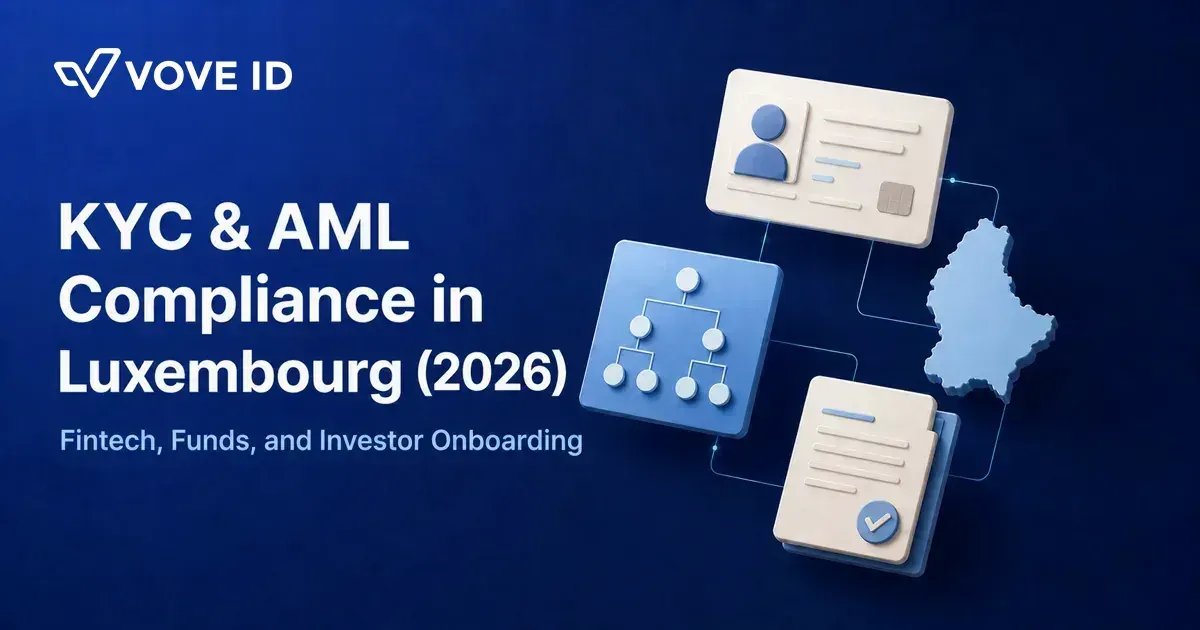
A Luxembourg fund launch rarely stalls because a document is missing. It stalls when nobody can explain, months later, why a particular investor was accepted, who was behind the entity that held the shares, and which reviewer signed off on the remaining uncertainty. VOVE ID helps fintech, fund, and payments teams connect that identity evidence with review actions and an auditable case record, so the explanation still exists once the onboarding queue has moved on.
Professionals in scope of Luxembourg's AML/CFT framework need customer due diligence that identifies and verifies the customer and relevant beneficial owners, understands the relationship, applies a risk-based approach, and supports ongoing review and escalation. For fintech and investor onboarding, the operating challenge is retaining an explainable file across intermediaries, entities, and exceptions — this is exactly where due diligence stalls.
Regulatory Map: Set the Luxembourg Control Perimeter First
Luxembourg's central AML/CFT law is the amended Law of 12 November 2004 on the fight against money laundering and terrorist financing. The framework has continued to change — a law published on 16 July 2026 amended the 2004 law — so teams should test policy and procedure changes against their own current perimeter rather than rely on an old implementation checklist.
For CSSF-supervised professionals, CSSF Regulation No. 12-02 is a central operational reference for AML/CFT requirements. The exact supervisory perimeter depends on the entity and service: a payment institution, electronic-money institution, investment-fund service provider, or other professional must determine the obligations that apply to its own activity and delegation model.
For the identity-control model beneath that perimeter, see the KYC requirements framework.
Investor and Customer Due Diligence: Connect the Parties Before Approval
Luxembourg onboarding often involves more than one person or entity — a retail customer, a corporate investor, an authorized representative, an investment vehicle, a distributor, or an underlying beneficial owner can each introduce evidence that needs to align.
The practical risk is not simply a missing document. It's accepting a relationship without a joined-up explanation of who controls it, why it exists, what activity is expected, and which reviewer accepted the remaining uncertainty. CSSF guidance on beneficial owners illustrates the operating detail involved: professionals should take reasonable measures to verify beneficial-owner identity and collect the information needed to understand intervening legal persons or arrangements. A process should make uncertainty visible, not bury it in attachments.
Remote Onboarding and Exceptions
Digital onboarding can reduce collection effort, but it doesn't remove the need for a defensible assessment. A team needs clear rules for documentary evidence, liveness and face-matching results where those controls are used, ownership gaps, higher-risk relationships, and cases that can't be resolved automatically.
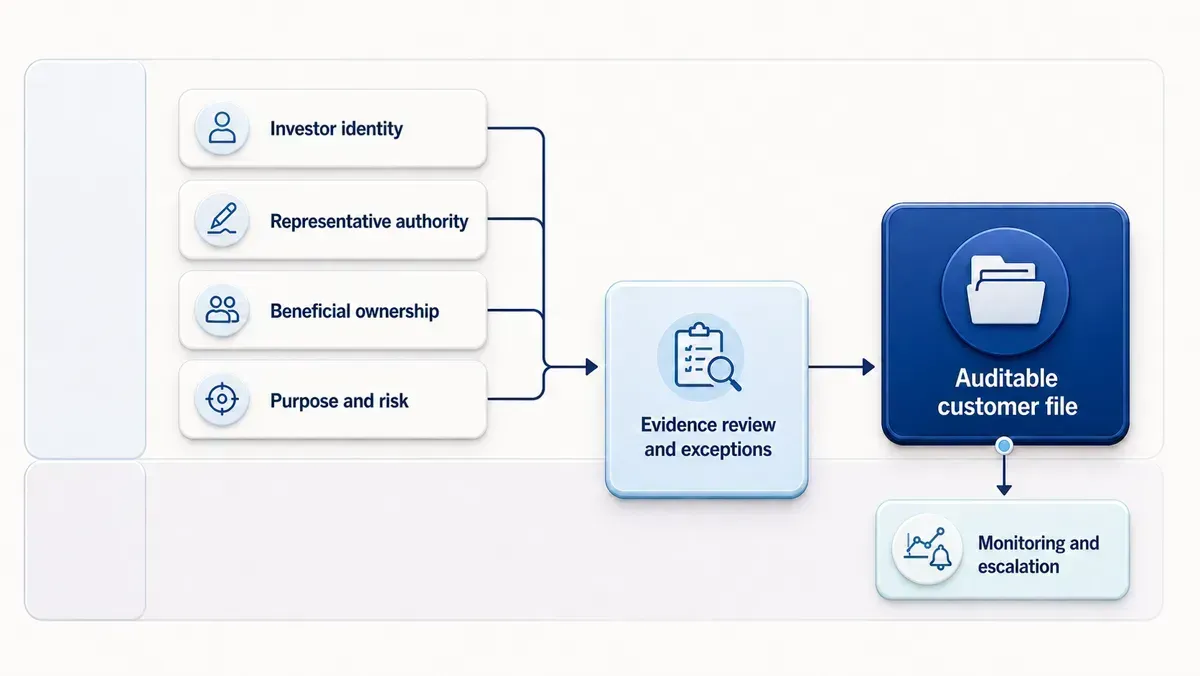
The decision path should answer four questions: what evidence is sufficient, what creates an exception, who can approve it, and where is the rationale retained? If those answers sit in different vendor portals and inboxes, the completed onboarding journey still produces an incomplete compliance file.
Suspicion and Reporting: Build the Escalation Route Before a Case Is Urgent
Luxembourg's Financial Intelligence Unit guidance states that professionals covered by the AML/CFT law must cooperate with authorities and inform the FIU without delay, on their own initiative, when they know, suspect, or have reasonable grounds to suspect money laundering or terrorist financing. The FIU's suspicious-operations guidance is a practical reference for the reporting obligation.
An alert or discrepancy is only useful if it becomes a controlled case. Teams should assign an owner, preserve the facts that generated concern, request and assess further information where appropriate, record the decision, and protect the reporting path from informal workarounds.
For the operating framework behind screening, review, and escalation, see the AML requirements framework.
Records, Delegation, and Auditability
Luxembourg's funds and financial-services ecosystem often involves administrators, distributors, transfer agents, service providers, and delegated processes. Delegation can distribute work, but it doesn't remove the need for the relevant professional to understand evidence quality, exceptions, and the final decision trail.
The test is simple: a compliance reviewer should be able to reconstruct who was onboarded, which ownership and risk information was relied on, what happened when information conflicted, and who approved the result. If the answer requires a manual search across vendors and email threads, the control hasn't been designed as one workflow.
Where VOVE ID Fits Into This
None of the above is a job VOVE ID can do on a firm's behalf — the risk appetite, regulatory classification, and any suspicious-operation report stay with the Luxembourg professional. What VOVE ID can take off a team's plate is the evidence layer underneath those decisions: identity verification, biometric liveness, face matching, AML screening, and KYB checks across a wide range of document types and countries, plus detection of document-template inconsistencies, invalid MRZ checksums, barcode or QR inconsistencies, and image manipulation. In a fund or fintech context, that means the identity and ownership evidence a reviewer needs is already gathered and structured by the time a case reaches them, rather than scattered across whichever tool captured it first.
Practical Luxembourg KYC and AML Checklist
Governance
- Confirm the entity's AML/CFT perimeter, supervisor, and accountable decision owner.
- Map delegated and outsourced onboarding steps to the records and decisions the firm must retain.
- Review policies against current amendments to the Luxembourg AML/CFT framework.
Customer and investor due diligence
- Connect customer, representative, beneficial-owner, purpose, and risk evidence in one file.
- Define evidence and escalation rules for legal arrangements and layered ownership.
- Record the rationale whenever a reviewer accepts an exception or additional evidence.
Monitoring and reporting
- Set review triggers for ownership, activity, and risk-profile changes.
- Assign a controlled case owner before a potential suspicion becomes urgent.
- Maintain a tested route for FIU escalation where reporting is required.
Records and audit
- Preserve source evidence, review actions, and final decisions together.
- Restrict sensitive investor and ownership information by role.
- Test whether a case can be reconstructed across delegated processes without manual searching.
FAQ
What makes Luxembourg investor onboarding difficult? The challenge is often the number of parties and evidence sources, not a single identity check. Teams need a controlled way to connect customer, representative, ownership, purpose, risk, and reviewer evidence.
Does a digital identity check complete AML due diligence? No. It can provide important evidence, but the firm still needs risk-based assessment, beneficial-owner handling where relevant, exception management, ongoing review, and retrievable records.
What should trigger an onboarding escalation? Examples include ownership complexity, inconsistent identity evidence, an unclear relationship purpose, higher-risk connections, or information that can't be validated under the firm's policy.
When must a suspicious operation be reported in Luxembourg? The FIU guidance says covered professionals must report without delay when they know, suspect, or have reasonable grounds to suspect relevant money-laundering or terrorist-financing activity. Firms should validate the exact obligation and procedure for their circumstances.
Final Thoughts
An investor form was never the hard part of Luxembourg compliance — reconstructing the reasoning behind an approval, six months after the fact, is. Fintech and fund teams that keep identity, ownership, risk, review, and escalation evidence in one place aren't just satisfying a supervisor's expectations; they're the ones who can actually answer their own questions when a relationship changes.
KYC and AML compliance in Luxembourg isn't a matter of completing an investor form — it's the discipline of maintaining an explainable relationship file across complex parties and processes. Fintech and fund teams need identity, ownership, risk, review, escalation, and audit evidence to remain connected as the relationship changes.
This article is intended for general informational purposes only and does not constitute legal, financial, or regulatory advice. KYC/KYB/AML requirements may vary depending on jurisdiction, industry, and specific business circumstances. For up-to-date and binding compliance obligations, readers should refer to the relevant regulatory authorities or consult qualified professionals.