From Onboarding to Transaction Monitoring: Designing a Seamless Compliance Journey
A fragmented compliance stack slows investigations and weakens risk detection. This guide explains how to connect onboarding, KYB, and monitoring into one continuous workflow for faster decisions and better control quality.
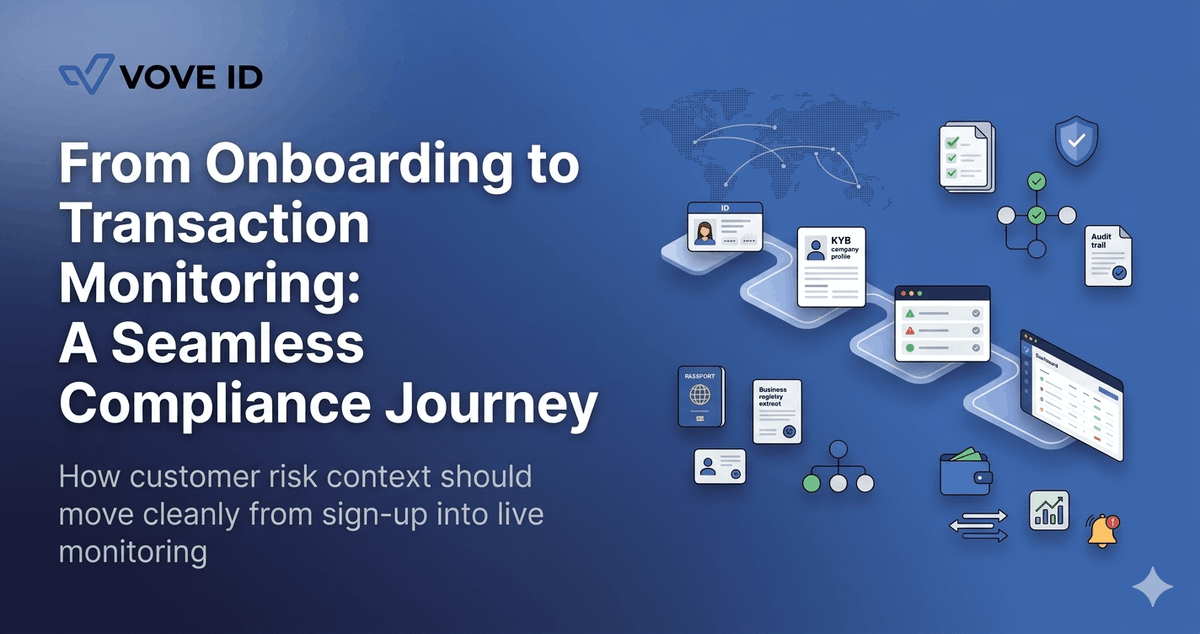
A compliance program breaks down when onboarding and monitoring operate like separate products. The strongest fintech teams carry identity, business, and risk context forward from sign-up into every later screening, review, and transaction decision.
How do you design a seamless compliance journey from onboarding to transaction monitoring?
Start by treating onboarding as the first stage of an ongoing risk relationship, not a one-time checkpoint. Customer identity, KYB data, screening results, risk scoring, and case history should flow into post-onboarding monitoring so teams can make faster and more consistent decisions later.
Many fintechs invest heavily in onboarding and then lose continuity.
They verify identity, collect documents, run sanctions screening, approve the user, and move on. After that, transaction monitoring runs in a separate system with weaker context, different workflows, and a fragmented view of risk.
That split creates operational problems quickly. Monitoring generates alerts without sufficient customer context. Analysts re-check information already collected during onboarding. Product and compliance teams end up managing risk through handoffs instead of a connected workflow.
For payment platforms, stablecoin products, lending apps, B2B fintechs, and cross-border operators, this is an expensive design flaw.
What a fragmented compliance journey looks like
You can usually identify fragmentation by these symptoms:
- onboarding data lives in one tool, monitoring in another
- customer risk scores are not reused after activation
- sanctions and PEP matches are rechecked manually during investigations
- KYB files for business customers sit outside transaction review workflows
- analysts cannot easily see why a customer was originally approved
- product, operations, and compliance teams rely on different versions of the same customer story
In this environment, every downstream review becomes slower and less consistent.
Why onboarding should not be treated as a one-time event
Customer due diligence is not only about account opening. It is about building a risk profile that supports the entire relationship.
At onboarding, a fintech already knows:
- who the customer or business is
- which documents were verified
- country exposure
- whether sanctions or PEP screening raised concerns
- expected use case
- beneficial owners or directors
- whether the relationship starts at standard or enhanced review level
If that information stays trapped in the onboarding layer, monitoring effectively starts blind.
A better model treats onboarding as the foundation of the monitoring dataset.
The handoff most teams get wrong
The weak point is usually activation.
Once a user or business is approved, teams often fail to carry forward the fields that would make monitoring more accurate:
- risk rating
- customer type
- expected transaction ranges
- corridor exposure
- business model
- UBO and control structure
- prior screening matches and resolution notes
Without these signals, monitoring becomes generic. The system sees transactions, but lacks context on why they occur or whether they align with the original profile.
This is where unnecessary alerts multiply.
What a seamless compliance journey should include
A connected workflow typically includes six layers.
1. Identity and business verification at onboarding
The foundation:
- individual identity verification
- document and liveness checks where needed
- legal entity verification for business accounts
- UBO, director, and representative checks
- sanctions, PEP, and adverse media screening
2. Risk profiling before activation
Approval should produce a usable risk profile:
- low, standard, or enhanced review status
- jurisdictional risk markers
- expected products and transaction patterns
- customer or business segment
- restrictions or monitoring triggers applied at approval
3. Shared customer record across stages
An investigator reviewing an alert should see:
- how the customer was verified
- prior screening outcomes
- expected use case
- behavioral changes over time
- related entities or accounts
Without this continuity, investigations become repetitive.
4. Monitoring rules linked to customer context
Different customer types should not be treated identically.
Effective monitoring uses:
- product context
- customer type
- jurisdiction
- onboarding risk score
- expected behavior
- KYB and ownership data
5. Case management with a preserved audit trail
A strong workflow keeps:
- onboarding evidence
- alert triggers
- analyst notes and decisions
- linked entities
- re-screening outcomes
- reporting records
This creates a defensible, unified record.
6. Ongoing refresh and re-verification
Risk evolves. A seamless system includes:
- periodic re-screening
- KYB refresh
- document re-verification
- enhanced due diligence when behavior changes
Why this matters operationally
Faster investigations
With full context available, analysts spend less time reconstructing customer history.
Better alert quality
Monitoring becomes more precise when it uses onboarding risk data.
More consistent decisions
A shared evidence base reduces contradictions across teams.
Cleaner regulator-ready evidence
Teams can explain decisions without stitching together fragmented records.
What to automate first
For teams still relying on manual handoffs:
Link onboarding risk scores to monitoring
Often the fastest improvement.
Centralize sanctions and screening history
Prevents repeated work.
Unify customer and business records
Avoids fragmentation post-activation.
Standardize case workflows
Replaces ad hoc handling with consistent processes.
How VOVE ID supports a seamless compliance journey
VOVE ID helps fintech teams connect key compliance layers:
- KYC and liveness
- KYB and ownership workflows
- sanctions, PEP, and adverse media screening
- risk scoring
- transaction monitoring
- case management
The value is not just having each control, but enabling each to inform the next.
A practical workflow to aim for
| Stage | What should happen |
|---|---|
| Sign-up | Collect identity or business data and use-case info |
| Verification | Run KYC, KYB, sanctions, and ownership checks |
| Decisioning | Approve, reject, or escalate with risk profile |
| Activation | Carry risk data into live account settings |
| Monitoring | Evaluate activity using onboarding context |
| Investigation | Review alerts with full customer history |
| Refresh | Re-screen and update risk as behavior changes |
Questions to ask your team
- Can investigators access full onboarding records from monitoring?
- Does monitoring use customer risk and business context?
- Are sanctions and PEP decisions reusable?
- Can the team explain approval decisions and later alert handling?
- What happens when behavior diverges from the original profile?
If answers involve manual lookup or disconnected tools, the workflow is still fragmented.
Conclusion
A seamless compliance journey is not about fewer controls. It is about connecting them.
Strong fintech teams treat onboarding, KYB, screening, and monitoring as one continuous workflow. That improves alert quality, speeds up investigations, and makes operations scalable.
In 2026, this connected model increasingly defines whether a compliance function keeps up or falls behind.
Need to connect onboarding, KYB, and transaction monitoring into one workflow?
FAQ
1. What is a seamless compliance journey?
A workflow where onboarding data, screening results, and monitoring activity remain connected across the customer lifecycle.
2. Why do fintechs struggle with this?
Because onboarding and monitoring are often implemented as separate systems, leading to data loss and repeated work.
3. Does this only matter for large firms?
No. Smaller teams feel the impact earlier as manual processes break under scale.
4. What should be connected first?
Onboarding risk scores, sanctions history, and case management workflows.