Why diaspora banking apps become compliance risks at 10K users — and how to fix the record before the regulator asks
Diaspora banking apps feel solid at 1K users and exposed at 10K. Here is why the first cohort becomes the real audit risk — and how to fix the record without re-onboarding everyone.
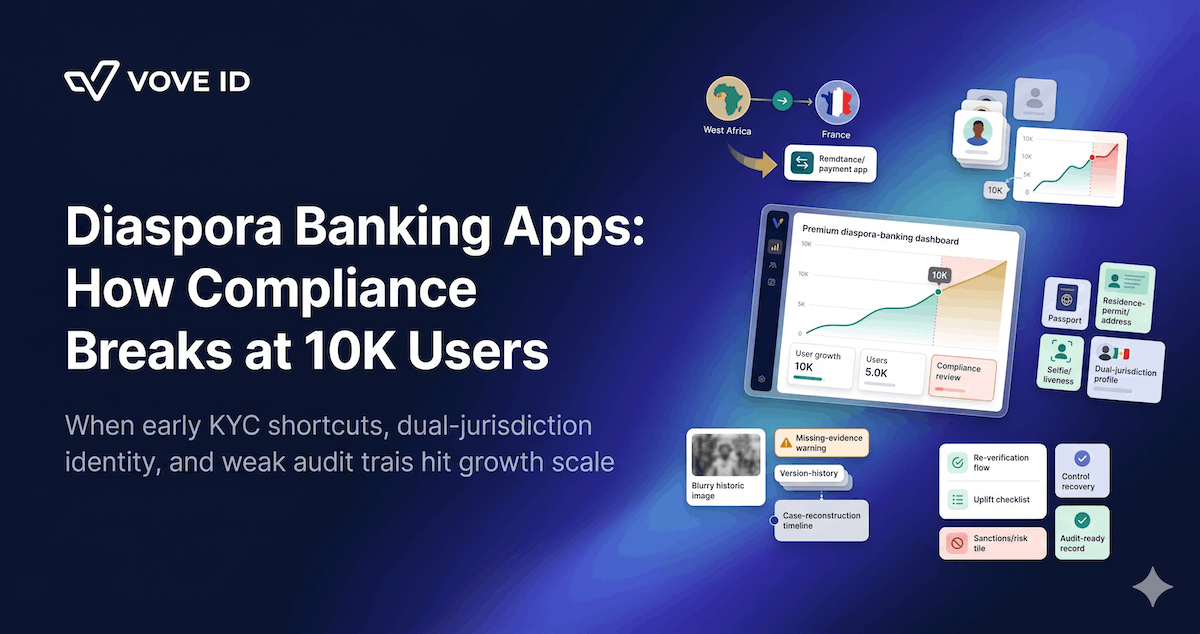
Diaspora banking apps carry a risk that domestic neobanks do not: every user arrives with two identity footprints at once. One belongs to a home country. One belongs to a host country. At 1,000 users, that duality is a product nuance. At 10,000, it is a compliance architecture question — and the answer is usually buried in files that were never built to be retrieved under pressure.
Why do diaspora banking apps often break at 10K users? Because growth converts early onboarding shortcuts into system-wide compliance debt. The app now has enough volume, enough cross-border identity variation, and enough historic records that weak document capture, blurry audit trails, and unresolved home-country versus host-country identity questions stop being manageable exceptions and start becoming supervisory risk.
VOVE ID helps diaspora banking teams operate in exactly that transition zone. On paper, 10K users is a growth milestone. In practice, it is often the point where the regulator, the banking partner, or the internal control function asks whether the compliance architecture built for the first 1K can still hold the next 100K.
That is the real threshold.
Why 10K users is the inflection point
At low scale, teams can still patch over weak controls manually.
If a document image is unreadable, someone asks the user to resend it. If a name format does not match the bank-side system, operations corrects it in the back office. If a risk review is missing context, the team remembers what happened because the company is still small enough for tribal knowledge to matter.
At 10K users, those fixes stop working.
Now the business has:
- too many historic files for manual memory to matter
- too many edge cases across languages, jurisdictions, and document types
- too many live transactions attached to early onboarding decisions
- too much concentration risk if a banking partner or regulator samples old users
The issue is not only scale. It is the collision between scale and memory.
Diaspora banking creates a dual-jurisdiction identity problem from day one
This is what makes diaspora apps structurally different from a domestic wallet or a standard neobank flow — and what separates this problem from the KYB challenges facing SME payment providers.
The user often lives across two identity environments at once: a home-country identity system and a host-country residence, banking, employment, or device footprint. The app has to decide how those two realities fit together.
That can mean reconciling:
- a West African passport with a French address
- a local tax or residence document with a foreign naming convention
- a remittance purpose linked to family support but funded from a European salary account
- a returning user whose current circumstances no longer resemble the original onboarding profile
At small scale, these cases look like product nuance. At supervisory scale, they look like control design.
The first 1K users become the real audit risk
Founders often assume the risk sits in today's onboarding flow. Sometimes it does. But once the app is established, the harder question is usually backward-looking:
Can the institution still defend the early book?
That is where diaspora apps get exposed. The earliest users were often onboarded when the KYC vendor was simpler, image-quality standards were weaker, the app accepted more manual overrides, identity review logic was less structured, and retention and retrieval design was treated as an ops detail.
Then the business grows. Now those legacy files are not harmless history. They are active compliance exposure tied to live users, live wallets, and live transaction behavior.
In France, record quality and retention are not optional details
For diaspora apps operating from France or under French supervisory expectations, this is not a best-practice issue.
The ACPR's guidelines on identification, identity verification, customer knowledge, and retention make clear that AML/CFT controls depend on how well institutions implement customer due diligence and preserve the supporting information and documents behind it.
Article L561-12 of the French Code monétaire et financier requires covered institutions to retain relationship and due-diligence records for five years after the end of the relationship, and transaction-related documents for five years after execution.
So when a diaspora app reaches 10K users, the question is not whether old files still exist somewhere. It is whether they still function as evidence:
- can the identity file be retrieved quickly?
- is the original image still readable?
- can the team tell which review logic applied at the time?
- can later profile changes be separated from the original onboarding facts?
If not, growth has already turned into documentation risk.
For a full breakdown of what AML/CFT controls require at the record level, see our AML Requirements guide.
A realistic diaspora failure: when the ACPR asks for the first cohort
Imagine a France-based app serving a Senegalese diaspora user base.
The business grows fast because the product is useful: local-language onboarding works, pricing is clear, inbound salary funding is straightforward, outbound family-support flows feel familiar. The company crosses 10K users and looks operationally stable.
Then an audit or review asks for evidence on the earliest cohort.
The sample sounds reasonable: show the original identity images for the first 1K users, explain how identity was verified at the time, show what happened when later profile data changed, demonstrate which users were ever uplifted, re-verified, or restricted.
Now the hidden weaknesses appear.
Half the earliest images are technically stored but too blurry for confident re-review. Some names were normalized manually without a preserved rationale. A few users changed host-country address or residency status, but the timeline of those changes is incomplete. Several users remain active even though their original KYC quality would not meet the app's current onboarding standard.
This is not a dramatic fraud story. It is a realistic growth story. And it is exactly why diaspora apps feel solid until they do not.
What a strong rebuild looks like without re-onboarding everyone
The answer is usually not a full restart. Forcing every user through a new onboarding journey is commercially expensive and often unnecessary. The better model is a structured uplift.
Segment the legacy book by evidence quality. Not every old account is equally weak. The first task is to separate users with still-usable identity evidence, users with partial evidence gaps, and users whose original records are no longer defensible. That lets the team target work where the risk actually sits.
Build lightweight re-verification paths. The strongest uplift flows do not treat every user like a new applicant. They ask only for what is missing: a clearer document image, a renewed selfie or liveness check, a current proof-of-address or residence item, an ownership-of-funding-account confirmation. Minimum new friction. Maximum evidence repair.
Preserve one timeline across original KYC and later uplifts. This is where many teams fail a second time. They improve the record but lose the story. The better system shows what the app knew at first onboarding, what changed later, why the user was re-reviewed, and which control conclusion applied at each step. That timeline is what makes the file explainable under audit.
Separate home-country and host-country logic cleanly. Diaspora apps usually confuse themselves when one identity layer overwrites the other. The user may have one nationality, one residence, one funding-country profile, and one beneficiary-country pattern. Those should be linked, not collapsed. When they are collapsed into one blurry customer record, every later alert becomes harder to assess.
For a full framework of what modern KYC requires across the user lifecycle, see our KYC Requirements guide.
How VOVE ID helps diaspora apps grow past the 10K threshold
Take the Senegalese diaspora scenario above. When the regulator samples the first cohort, the failure is not one missing document — it is the absence of a coherent story across onboarding, profile changes, and monitoring events.
VOVE ID gives operations teams a way to reconstruct that story without restarting it. Legacy users are segmented by evidence quality, not treated as a uniform backlog. Re-verification flows collect only what is missing — a cleaner image, a renewed liveness check, a current proof of address — without forcing users through a new onboarding journey. Every uplift stays attached to the original record, so the file shows what the app knew at day one, what changed, and why.
AML screening runs in parallel, so the compliance picture stays current as profile data changes. The practical shift is this: instead of asking "can we survive if someone samples the first 1K users?", the team can ask "which users need uplift first, and how fast can we close the gaps?" That is a solvable operations problem. The other question is an audit emergency.
Practical checklist for diaspora banking teams
Original KYC
- Sample the earliest cohorts and test whether their identity files are still readable and complete.
- Check whether the original review decision can still be reconstructed from stored evidence.
- Identify which legacy users would fail today's onboarding standard.
Uplift
- Build targeted re-verification flows for weak cohorts instead of re-onboarding everyone.
- Trigger new document or liveness collection only where the evidence gap justifies it.
- Keep every uplift tied to the original customer record, not as a disconnected new file.
Operations
- Preserve a timeline of changes to name, address, residency, and funding profile.
- Separate home-country and host-country attributes in the customer model.
- Make sure analysts can pull one coherent user file without checking chat, tickets, and vendor dashboards separately.
Audit
- Test whether you can export a defensible sample from the first 1K users quickly.
- Confirm that retention settings still support the required lookback period.
- Review whether image quality — not only image presence — is being tracked as a control.
FAQ
Why 10K users and not 5K or 50K? Because 10K is often where historic exceptions stop being locally manageable and start becoming institution-wide exposure. It is an operating threshold more than a legal threshold.
Is this only a problem for French-regulated apps? France is the clearest example because ACPR's expectations around CDD and the five-year retention rule under L561-12 make the operational gap very visible. But the same structural problem appears under DNB supervision in the Netherlands, BaFin in Germany, and FCA in the UK for firms serving diaspora corridors — anywhere that a supervisor can ask for a historic cohort and the answer depends on records built during a faster, less controlled growth phase.
Do teams need to re-onboard everyone? Usually not. Most need a risk-based uplift program that targets weak cohorts first and preserves a clean audit trail while repairing the evidence base.
What breaks first in practice? Usually image quality, historic decision traceability, and the ability to explain how home-country and host-country identity signals were reconciled.
Conclusion
Diaspora banking apps do not become risky only when they grow. They become risky when growth forces the business to rely on records that were never built to survive scrutiny.
At 10K users, the real product question is no longer only acquisition or retention. It is whether the first cohorts can still be defended as clearly as the latest ones.
The teams that answer it early gain something more valuable than audit readiness. They gain the ability to grow the next 100K users on a foundation the first 1K already proved. That is the difference between a compliance function that chases the product and one that runs ahead of it.
Want to see how VOVE ID helps diaspora banking apps repair legacy KYC, run targeted uplifts, and keep one audit-ready customer record as they scale?