Cross-border SME payments in Europe are a KYB problem first — and most providers solve it last
Cross-border SME payments stall before the first transfer — because the same business arrives as four different records. Here is how EU providers lose deals to a KYB problem no one puts in the deck.
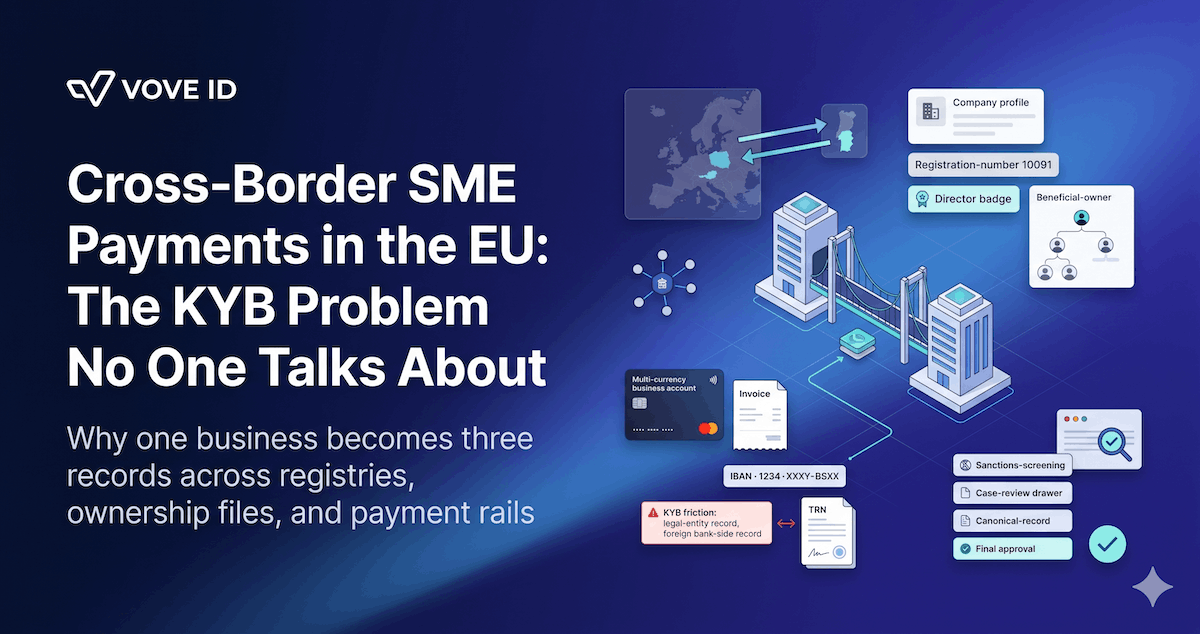
A German GmbH opening a Spanish multi-currency account is not an exotic use case. By 2026 it is table stakes for any EU payments provider that wants SME volume. The problem is not that the business is hard to find. The problem is that the same business arrives as three or four partially matching records — one in the home registry, one on the bank account, one on the invoice, one in the ownership file — and the provider has to decide whether those records describe the same company before the first euro moves.
Most providers say yes and push the ambiguity forward. That is where the compliance debt starts.
Why are cross-border SME payments in the EU a KYB problem first? Because the payment can move before the business record is truly resolved. The rail may work, but if the entity name, directors, beneficial owners, registry extract, and bank-side customer record do not line up across jurisdictions, the provider is left with a weak compliance file and a fragile commercial relationship.
VOVE ID helps cross-border SME payment providers operate in a market where company information is technically more connected than it used to be, but still not operationally uniform. On paper, one EU SME should be easy to verify once. In practice, the same SME often appears as several partially matching records across the corridor. That is what turns onboarding friction into a revenue problem.
Why the SME payment problem starts before the first transfer
The payment flow only looks clean after the business has already passed through several identity gates: company existence, company number and registration status, directors or authorized signatories, beneficial owners, bank account ownership, and business purpose and expected transaction profile.
If even one of those gates is weak, the provider is not really running a payments workflow. It is running a manual exception workflow disguised as onboarding.
That matters more in the SME segment because the businesses are often expanding into another EU country for the first time, opening accounts outside their home jurisdiction, using local operating names that differ from the registered legal name, controlled by founders who sign quickly but document ownership slowly, or sending counterparties to support when one field does not match the foreign provider's system.
The rail is not what breaks first. The record is.
One SME often becomes four different records
This is the pattern teams miss when they only think in terms of account opening.
The same business often arrives as several different versions of itself — not because anyone is being deceptive, but because cross-border operations are genuinely messy.
The home-country registry has the legal name. The bank account was opened under a shortened trading name. The invoices use a brand that is more visible than the legal entity. The director who signs the application is listed correctly in one document and with a shortened middle name in another. The beneficial owner filed late and the register has not caught up.
None of this is fraud. All of it is a KYB problem.
When a provider cannot collapse these versions into one canonical record before activation, it is not running a payments workflow — it is running a permanent exception queue. Every payment review starts with the same question: is this the same company we thought we onboarded?
The EU is interconnected at the registry layer, but not standardized at the operating layer
By 2026, BRIS gives providers real-time access to company information across EU member states, Iceland, Liechtenstein, and Norway. That is a meaningful improvement. It is not a complete KYB stack.
BRIS confirms that a company exists. It does not resolve how a foreign provider should consume that record, how current director data is, where beneficial-owner evidence comes from, or whether a bank or EMI still wants additional documents. The interconnection layer exists. The operational gap remains.
AML harmonization raises the bar, but it does not remove the KYB gap
Regulation (EU) 2024/1624, published on 19 June 2024, is designed to harmonize core AML/CFT rules more directly across the Union. That pushes compliance expectations toward more consistency.
But harmonized rules do not create harmonized business records by themselves. For a cross-border SME payments provider, the hard work is still local and operational: pulling a usable company record, linking it to the right signatory, mapping beneficial owners, making sense of foreign-language or foreign-format evidence, and keeping one explainable file when the business starts transacting.
That is why the product pitch often sounds simpler than the onboarding reality.
For a full breakdown of what the 2024 AML regulation requires at the operational level, see our AML Requirements guide.
A realistic failure: when a German GmbH cannot be verified by a Spanish provider
Imagine a German GmbH opening a Spanish multi-currency account to collect from customers in Southern Europe.
The business looks legitimate: it is active in Germany, it has a valid registration number, its founder can explain the cross-border use case, its expected volumes are reasonable.
Then the application hits the actual KYB stack.
The Spanish provider can see part of the company record but not enough to complete onboarding confidently. The director listed in one document appears with a shortened middle name in another. The operating brand on invoices is more prominent than the legal entity. The bank account evidence uses a local commercial label. The provider asks for notarized translations and additional ownership evidence.
The SME does what most SMEs do. It gets impatient.
Commercially, the provider loses because the business sees only friction. From a compliance perspective, the provider also loses because it still does not have one canonical entity file tying together the German registry record, the actual signatory, the beneficial-owner layer, and the Spanish payment relationship.
This is the KYB problem no one talks about in glossy cross-border payments decks.
What strong EU SME KYB looks like in production
The best operators do not try to eliminate cross-border complexity. They build around it.
One canonical entity record. The company should not live as separate records in onboarding, sanctions review, account setup, and operations. A stronger model creates one canonical business identity with home-country registry source, standardized legal name, registration identifiers, director and signatory mapping, and foreign-market account context.
Beneficial-owner mapping that is usable, not merely collected. Many teams gather UBO information and still cannot explain ownership clearly under review. A stronger file maps who owns the company, who controls it, who is acting for it, and which records support each conclusion. That becomes decisive when the cross-border business later triggers enhanced due diligence, a bank-partner review, or a suspicious-activity investigation.
Cross-border document handling by design. If the provider expands across Europe, foreign-language and foreign-format evidence is not an edge case — it is standard operating reality. That means the process should assume registry extracts from other jurisdictions, translation differences, non-local legal forms, and supporting corporate documents that do not look domestic.
Monitoring that starts from the actual business model. Payments monitoring only works if the provider really understands the SME it onboarded. Without that baseline, teams cannot judge whether volume growth is expected, corridor usage is plausible, counterparties fit the stated business purpose, or account behavior suggests layering, mule risk, or hidden third-party use. Weak KYB guarantees weak monitoring later.
For a complete framework of what KYB requires across entity, ownership, and monitoring layers, see our KYB Requirements guide.
How VOVE ID resolves the same SME across registries
Return to the German GmbH scenario. The failure is not one missing document — it is the absence of a single resolved entity that the Spanish provider can point to at every step of the relationship.
VOVE ID helps payment providers collapse fragmented business evidence into one operational record before that fragmentation reaches live payments. Teams can retrieve and reconcile business records across national registries using KYB infrastructure, map directors, signatories, and beneficial owners into one case, keep translated or foreign-format documents tied to the same entity file, store the rationale for why a foreign account relationship belongs to that exact business, and move from onboarding to monitoring without losing the identity trail.
AML screening runs against the resolved entity from day one, so monitoring starts from a verified baseline rather than a fragmented one. The real objective is not only faster approval. It is a cleaner explanation when a bank partner, auditor, or regulator asks why this SME was allowed onto the platform and how the provider knew it was the same company at every step.
Practical checklist for cross-border SME payment teams
Entity
- Confirm the legal entity name, registration number, and jurisdiction from a primary registry source.
- Store one canonical entity record rather than separate onboarding and operations versions.
- Record trade names and operating brands as aliases, not substitutes for the legal entity.
Ownership
- Map directors, signatories, and beneficial owners separately.
- Keep the evidence for ownership and control attached to the live account record.
- Review whether the person signing the account actually matches the authority shown in the company file.
Cross-border fit
- Test whether your KYB process can resolve a company from another EU jurisdiction without manual reinvention.
- Decide in advance which foreign documents require translation, certification, or escalation.
- Check whether the bank-account holder name matches the same entity the registry record supports.
Operations
- Push identity mismatches back into onboarding, not into the first payment review.
- Make sure monitoring rules are built on the verified business model, not only on payment behavior.
- Review how quickly an analyst can reconstruct the full business file for a live SME account.
FAQ
If BRIS exists, why is EU SME KYB still difficult? Because BRIS improves access to company information, but it does not eliminate differences in field coverage, document quality, ownership evidence, or the way providers operationalize foreign business records.
Why does this matter so much for payment providers? Because the provider is judged on the quality of the business relationship it opened, not only on whether the first payment technically settled.
Is this mostly a foreign-language problem? No. Language is part of it, but the deeper issue is entity resolution across registries, account relationships, ownership files, and operational records.
What should teams fix first? Fix canonical entity resolution first. If one SME still appears as multiple semi-matching records inside your stack, every later control will be weaker than it should be.
Conclusion
Cross-border SME payments in Europe do not usually stall because the rail is missing. They stall because the business record is unresolved.
The providers that win the EU SME corridor are not the ones with the fastest rails. They are the ones that can look at a German GmbH, a French SARL, and a Polish sp. z o.o. — each arriving with its own registry format, ownership structure, and document set — and produce one coherent KYB file for each before the first transfer clears.
That file is not a compliance artifact. It is the foundation the entire commercial relationship rests on.
Want to see how VOVE ID resolves EU SMEs across national registries, ownership layers, and payment workflows in one KYB stack?