Get Compliant From Day One: Why Fintechs Need One Compliance Operating Layer
The cheapest time to get compliance architecture right is before launch. Here's why "we'll fix it later" rarely works out that way.
Ask an early-stage fintech founder about their compliance plan, and the answer is often a checklist: connect a KYC provider, run new customers against a sanctions list, write an AML policy document because the bank partner asked for one. Check, check, check. Compliance handled.
It isn't, not in the way the term usually matters. A checklist tells you that individual controls exist. It doesn't tell you whether those controls work together, whether they hold up as the business changes, or whether they'll survive the first time a regulator or banking partner looks closely.
The gap between "we have the required tools" and "we are compliant from day one" is where a lot of early-stage fintechs quietly accumulate a problem they won't notice until it's expensive to fix.
What "day one" compliance actually requires
The phrase "compliant from day one" gets used loosely, often to mean nothing more than "we did the minimum a banking partner or payment processor required to open an account." That minimum is usually basic identity verification at signup and a sanctions list check. Both are necessary. Neither is sufficient.
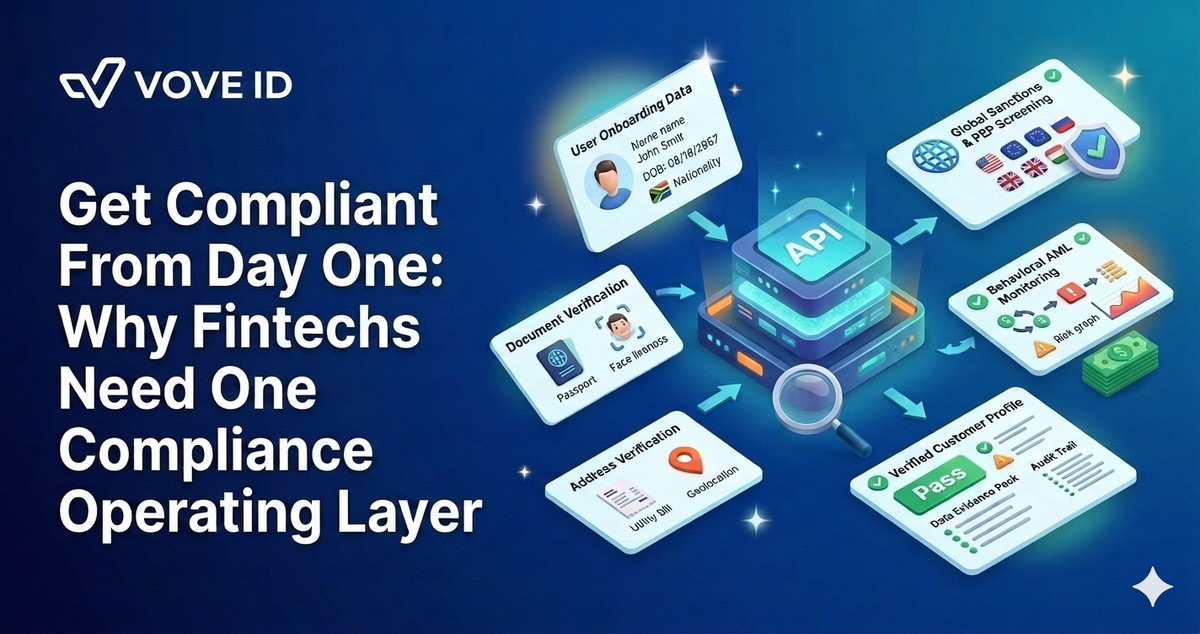
A functioning compliance operating layer, even at the earliest stage, needs to cover a few things that a launch checklist often skips. Ongoing monitoring of customer activity, not just a one-time check at onboarding, because risk profiles change after the first transaction. A way to verify business customers, not just individuals, if the product serves businesses at all, even informally. A documented process for what happens when something gets flagged, not just a tool that generates the flag. And a data structure that connects these pieces, so a result from one check is visible to the others.
None of this needs to be elaborate at launch. A five-person fintech doesn't need an enterprise compliance team. But it does need these pieces to exist in a form that can grow, rather than in a form that has to be replaced.
Why the checklist approach creates debt, not savings
The appeal of the checklist approach is obvious: it's fast and cheap, and it satisfies whatever immediate requirement triggered it, usually a banking partner's onboarding questionnaire. For a company trying to ship a product and get its first users, that's a reasonable trade in the moment.
The problem is what happens next. Each piece of the checklist tends to get built as a standalone solution to a standalone requirement. The KYC check exists because the bank required identity verification. The sanctions screen exists because the bank's compliance team flagged it as mandatory. Neither was built with the other in mind, because at the time, nobody was thinking about how they'd need to work together later.
Six months in, the company adds a business-facing product line and needs KYB. The team reaches for the fastest option, often a different vendor than the one used for individual KYC, because that's what's available or what a new partner requires. A year in, transaction volume grows enough that ad hoc, manual review of flagged accounts stops being workable, and a monitoring tool gets added on top of everything else.
At no point did the company make a bad decision given what it knew at the time. But the cumulative result is the same fragmented stack that larger fintechs spend years trying to untangle, just built faster and with less deliberation.
For what a connected AML program needs to cover as transaction volume grows, see our AML Requirements Explained 2026 guide.
The cost shows up at the worst possible moments
Compliance debt, unlike technical debt, doesn't usually show up as a slow accumulation of friction that the team notices and budgets time to fix. It shows up as a hard stop at moments that matter.
A Series A due diligence process turns up that customer risk data lives in three disconnected systems with no audit trail connecting them, and the round gets delayed while the company scrambles to produce documentation that should have existed already. A new banking partner's onboarding review asks how KYC findings inform ongoing monitoring, and the honest answer is that they don't, because the two systems were never connected. An application for a new license in a second market requires demonstrating a working AML program, and what exists is a policy document that doesn't reflect how the systems actually operate.
In each case, the underlying issue isn't that the company lacks compliance tools. It's that the tools were never built to work as a program, and proving that they function as one, after the fact, is far harder than building them that way from the start.
What building it right from the start looks like
Getting compliance right from day one doesn't mean over-building for a scale the company hasn't reached yet. It means choosing a foundation where the pieces are connected by default, so growth doesn't require rebuilding the foundation itself.
Concretely, that means individual identity verification and business verification running on the same underlying system, so a flag on a person carries over to any business entity they're connected to, even if the business-facing product launches later. It means transaction monitoring that's wired to onboarding data from the start, even if the monitoring rules are simple at first, so there's a single risk profile per customer rather than separate ones per system. And it means a structure where adding sanctions lists, document types for a new market, or new monitoring rules is a configuration change to the existing system, not a new integration with a new vendor.
For the identity verification side of this foundation, see our KYC Requirements Explained 2026 guide, and for business verification and UBO mapping, see our KYB Requirements Explained 2026 guide.
VOVE ID is built around this principle: KYC, KYB, AML screening, and transaction monitoring run on shared infrastructure from the first integration, so an early-stage fintech isn't choosing between "fast and cheap now" and "connected and defensible later." The same setup that gets a five-person team through their first banking partner review is the one that, configured further, supports a due diligence process or a new license application later.
The decision that's cheapest before it's made
There's a narrow window, early in a fintech's life, where the cost of building a connected compliance foundation and the cost of building a disconnected one are roughly the same. Both take an integration. Both take some engineering time. Neither is particularly expensive at the scale of a pre-launch or just-launched company.
That window closes the moment the first ad hoc addition gets made, the second vendor for the second product line, the manual monitoring spreadsheet that becomes a workflow nobody wants to migrate away from. After that, the cost of connecting things retroactively is real, and it tends to surface exactly when the company has the least slack to deal with it.
Compliant from day one isn't a compliance milestone. It's an architecture decision, made once, early, when it's still cheap to make.
Getting compliance right at launch isn't about doing more, it's about doing it in a way that doesn't need to be redone. VOVE ID gives early-stage fintechs KYC, KYB, AML screening, and transaction monitoring on one connected platform from the first integration, so the foundation that gets you through your first banking partner review is the same one that scales with the business.
This article is intended for general informational purposes only and does not constitute legal, financial, or regulatory advice. KYC/KYB/AML requirements may vary depending on jurisdiction, industry, and specific business circumstances. For up-to-date and binding compliance obligations, readers should refer to the relevant regulatory authorities or consult qualified professionals.