Government Verification in Kenya: A Practical Integration Handover
Plan a Kenya government-verification integration with clear source access, coverage, decision rules, operational recovery and a launch handover checklist.
Before adding government verification to Kenyan onboarding, agree on who may access the source, which records the check covers, and how a response becomes a customer decision. A working connection is only the start. The integration needs a clear scope, an exception path and evidence that operations can retrieve.
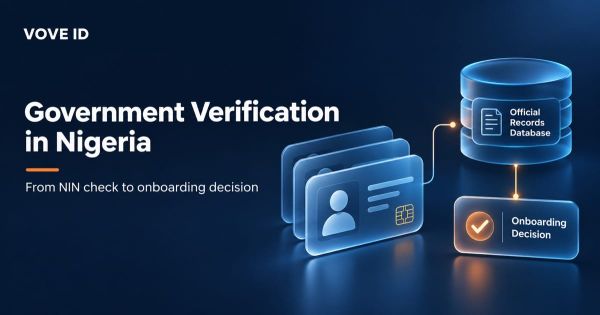
Our Kenya KYC and KYB implementation guide covers the broader program, and Mastering KYC in Kenya covers the compliance basics. This article is narrower: a handover checklist for the government-data connection itself, covering access, coverage and operations. For the decision rules that sit on top of a source response, see our Nigeria government verification decision flow, which applies the same logic to a different market.
Confirm the current source and the permitted use
Kenya's State Department for Immigration and Citizen Services describes National Population Data Management, formerly IPRS, as operating the Maisha Integrated Population Register for authentication services. Its access guidance lists organizational, data-protection and agreement requirements. Treat the current authority and access arrangement as part of the integration specification.
Record the legal entity using the service, the approved purpose and the data categories requested. Confirm how your provider's arrangement applies to your organization. General API availability is not evidence that every customer has unrestricted access to every government record.
Ask for a coverage matrix rather than a country checkbox
"Kenya supported" is too broad for an implementation ticket. Ask your provider to fill in a matrix like this one, and ask separately about national-ID holders and other identity-document categories relevant to your customer base.
Question | What to record |
|---|---|
Identifier accepted | Which identifier the check takes as input |
Population covered | Which customer groups the source can return a result for |
Inputs required | Fields your onboarding flow must collect |
Attributes returned | What comes back, and what your rules may use it for |
Unresolved-result behavior | What the response looks like when there is no match or no answer |
Unsupported categories | Who is not covered, and the alternative journey for them |
Do not infer residency, immigration permission or account eligibility from an identity match unless the contracted check actually returns the relevant evidence and your policy supports that use. Keep unsupported categories visible so the product team can design the correct alternative journey.
Translate the response into an owned action
Engineering should preserve the provider's original status and map it to internal outcomes. For each outcome, write the customer message, responsible queue, permitted product access and resolution condition.
Source result | Internal outcome | Owner | Next step |
|---|---|---|---|
Completed match | Proceed | Onboarding flow | Move to the next required check |
Material attribute difference | Review | Compliance reviewer | Resolve under the agreed review process |
Incomplete or unavailable | Recover | Integration owner | Retry through the supported mechanism, then escalate |
Here is an illustrative case, not a customer incident. An applicant enters their names in a different order from the register. Your matching policy decides whether that is a permitted difference, needs corroboration or goes to a reviewer. "Pending" without an owner or a next step is an unfinished workflow.
Test the handover between teams
Use an approved test environment to walk through a clean match, a name discrepancy, an unsupported identifier, a technical failure and an access-denied response. These are proposed test cases, not claims about particular provider error codes.
Ask an operations reviewer to resolve each case using only the information your system actually exposes. If they need an engineer to search raw logs, improve the case record before launch. Restrict sensitive source data to the people who need it, and use masked references in ordinary support tools.
Make access changes recoverable
Assign an owner for credentials, agreements, source notices and schema changes. If verification stops because an access condition changes, the customer should not receive a message saying their identity is invalid.
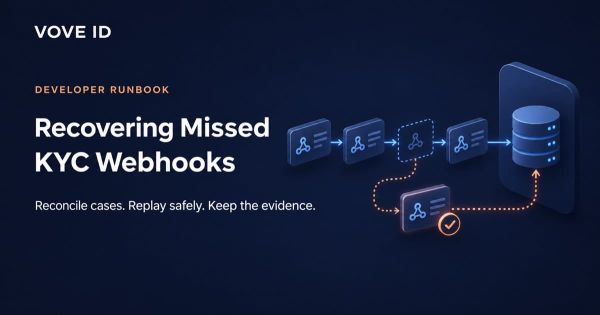
Record the failed attempt, reconcile its outcome and retry only through the supported mechanism. Keep technical incidents separate from substantive mismatches in reporting. Otherwise an outage can look like a sudden decline in customer quality.
Use a concrete launch handover
- Approved source route and organizational owner.
- Coverage matrix and unsupported customer categories.
- Field mapping and versioned decision rules.
- Test cases with expected customer and reviewer outcomes.
- Technical recovery procedure and escalation contact.
- Evidence retention and access controls.
Where VOVE ID fits
VOVE ID's platform combines document and biometric verification, AML screening and audit-ready case records. For a Kenya rollout, ask which government-data checks, required inputs, returned attributes and access conditions apply to your account, then fill in the coverage matrix above before you build.
Discuss your Kenya onboarding flow with VOVE ID
Sources checked November 24, 2026. This is implementation guidance; confirm current access conditions and institution-specific obligations before deployment.