Government Verification in Nigeria: From NIN Check to Onboarding Decision
Turn a Nigeria government-verification result into a clear onboarding decision, with mismatch handling, recovery and a traceable evidence record.
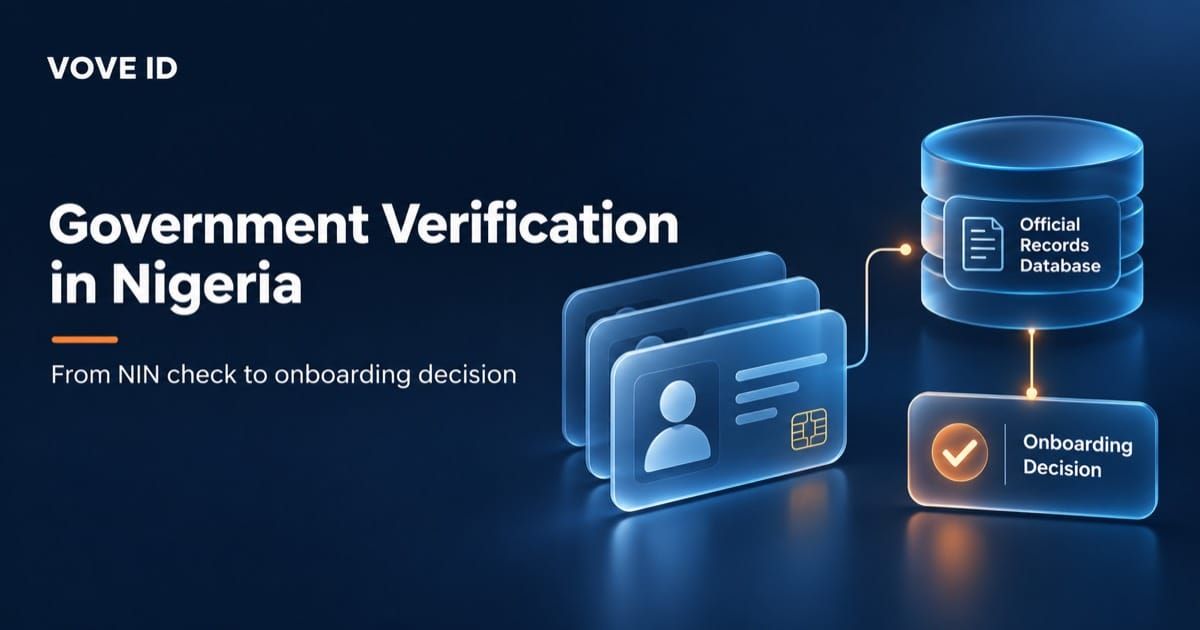
Government-data verification in Nigeria should produce a clear identity-check result and a separate onboarding decision. Confirm the permitted verification route, collect the required identifiers, interpret the source response, and record why the customer was accepted, asked for more evidence, or declined. A successful lookup alone is not a complete onboarding file.
Our Nigeria KYC guide explains the wider requirements. This article focuses on the implementation between a source check and the decision your product actually makes. If you are building for Kenya, our handover checklist for the Kenyan government-data connection covers access and coverage questions that this article leaves aside.
Start with the identity source and access route
Nigeria's National Identity Management Commission describes the National Identification Number (NIN) as a unique identifier linking a person to their National Identity Database record. Its NIN overview is a useful starting point for understanding the identifier.
NIMC's NINAuth guidance describes QR-code and share-code verification flows that rely on the NIN holder's consent. These are different user journeys: do not design your screen around one method while your contracted integration supports another. Confirm the permitted route, required customer interaction, returned attributes and account access before implementation.
Keep NIN and Bank Verification Number (BVN) checks separate in your design. The NIN sits with NIMC, while the BVN is managed by NIBSS within the banking system, so they are different identifiers from different sources. If your product needs both, record each result independently rather than labeling one successful check as completion of both.
Write the decision rules before building the happy path
Agree on a small outcome vocabulary with engineering, operations and compliance. The model below is a proposed internal one, not a claim about any provider's response schema.
Outcome | Meaning | Owner | Customer path |
|---|---|---|---|
Verified | The required source check completed and the attributes meet the agreed matching rules | Onboarding flow | Continue to the next step |
Mismatch | The source responded, but one or more required attributes differ | Reviewer | Secure correction or corroborating evidence |
Unresolved | The available response does not establish the required result | Named queue | Next check scheduled, customer informed |
Unavailable | The check could not complete because of a technical or access problem | Integration owner | Retry without blaming the customer |
Preserve the original provider result and map it to these internal states. An HTTP success can carry a negative identity result; a timeout can leave a check unresolved. Neither should silently become an approval.
Make the customer journey explain what is needed
Tell the customer which identity check they are completing, why it is needed, and what information will be processed. Capture the permissions or notices required for your chosen route. Ask for the minimum supported inputs and validate obvious formatting mistakes before submitting a request.
Do not ask a customer to paste identity details into an ordinary support chat to repair a failed check. Give them a secure way to correct an input or complete the required authentication step. Support should be able to see the case status and next action without receiving unnecessary identity data.
Resolve mismatches without rewriting the evidence
Suppose the applicant enters a shortened first name and the source returns a different representation. This is an illustrative case, not a customer incident. Your matching policy should determine whether the difference is permitted, requires corroboration, or needs a reviewer.
Keep the submitted value, source value where retention is permitted, matching rule and reviewer rationale distinguishable. Do not overwrite the application with the source response and lose the fact that a difference existed. Equally, do not let an analyst silently change a date of birth just to make the check pass.
Where BVN and NIN results differ, route the disagreement to the policy-defined process. A majority vote across sources is not a substitute for understanding which attributes are required and how discrepancies must be resolved.
Treat source availability as an operational condition
Separate a customer problem from a service problem. Invalid input may require correction. An access-denied response belongs with the integration owner. A temporary service failure may be recoverable without asking the customer to start again.
Give unresolved cases an owner and a next-check time. Before retrying, check whether the earlier request completed, using the provider's supported status or reference mechanism. Follow its retry guidance and avoid an unlimited loop of chargeable lookups. Keep the customer's product access consistent with the approved incomplete-verification policy.
Store a decision record you can reconstruct
A useful record connects the application, verification attempt and business decision:
- The source or provider, check type and request reference.
- When the check ran and its confirmed outcome.
- The required attributes checked and the rule version applied.
- The relevant notice or permission record.
- Any exception, reviewer and rationale.
- The resulting onboarding action and its timestamp.
Define retention and access controls for each category. Operational logs should not become an uncontrolled second store of raw NINs, identity documents or biometric data.
Test the cases that could otherwise disappear
- A clean result reaches the intended next onboarding step.
- A required attribute mismatch reaches a named review queue.
- An incomplete authentication step gives the customer a useful recovery path.
- A timeout remains unresolved until reconciled.
- A repeated request cannot produce duplicate account actions. Our guide to idempotency in KYC APIs covers the retry side of this.
- An access problem alerts the integration owner rather than blaming the customer.
- A reviewer can reconstruct the decision from the saved record.
Use approved test data and the provider's supported environment. Agree on who signs off the identity rules and the operational recovery path before production traffic begins.
Where VOVE ID fits
VOVE ID's platform combines document and biometric verification, AML screening and audit-ready case records. For a Nigeria rollout, confirm which government-data checks, required inputs, returned fields and access conditions apply to your account. Then combine the relevant source result with the other checks your onboarding policy requires.
Talk to VOVE ID about your Nigeria verification flow, including mismatch handling, customer recovery and the evidence your team needs to retain.
Implementation guidance, checked November 23, 2026. Confirm the rules applicable to your institution with the relevant authorities and advisers; this workflow is not a statement that one lookup satisfies every KYC obligation.