KYB Compliance in the UAE (2026): Business Verification for Regulated Entities
Master KYB compliance in the UAE for 2026 with expert insights on Federal Decree-Law No. 20, CBUAE rules, and actionable strategies to protect your business from financial crime.
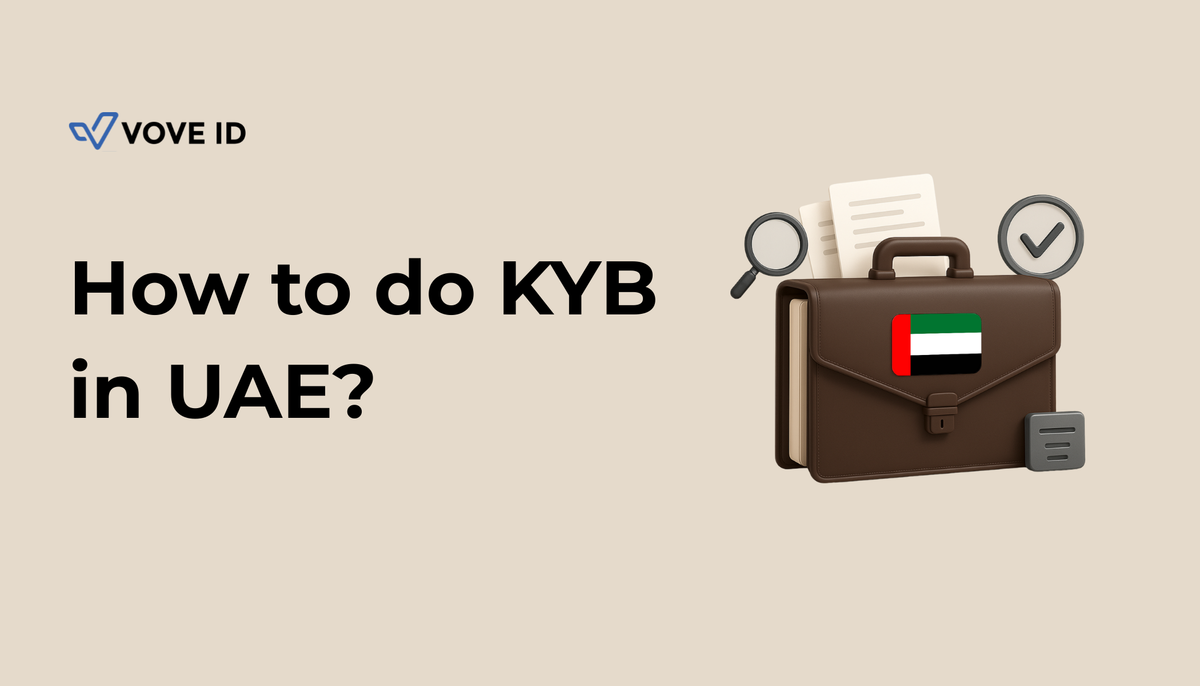
The UAE's position as a global trade and financial hub makes business verification one of the more complex KYB environments in the region. Multi-layered ownership structures, free zone entities, offshore holding companies, and a high concentration of VASPs and DNFBPs all create real friction in corporate onboarding. With the UAE's 2026 FATF mutual evaluation approaching — following its grey list exit in 2024 — regulators are actively tightening KYB expectations across all supervised sectors.
This guide covers the UAE-specific KYB layer: registries, UBO requirements, free zone distinctions, sector-specific obligations, and where business verification breaks in practice.
The Legal Framework
KYB in the UAE is governed by Federal Decree-Law No. 20 of 2018 on AML and counter-terrorism financing, operationalised through Cabinet Decision No. 10 of 2019. These establish the core business verification obligations: confirm legal existence, identify beneficial owners, assess risk, and monitor throughout the relationship.
Three regulatory bodies set KYB expectations in practice:
CBUAE supervises mainland banks, payment institutions, exchange houses, fintechs, and e-money providers. It sets the baseline KYB standard for the majority of regulated entities operating in the UAE.
DFSA governs financial services firms in the Dubai International Financial Centre (DIFC) under its own AML Rulebook. DIFC maintains a public beneficial ownership register — a meaningfully higher transparency standard than the mainland.
FSRA governs the Abu Dhabi Global Market (ADGM) under its AML/CFT Rulebook. ADGM's framework aligns closely with federal law but with FSRA-specific guidance on EDD triggers and high-risk entity categories.
For VASPs, VARA (Dubai Virtual Assets Regulatory Authority) and SCA (Securities and Commodities Authority) add sector-specific KYB obligations on top of the federal framework.
Non-compliance carries fines up to AED 50 million and potential licence revocation under federal law.
Who Must Conduct KYB
KYB obligations apply when onboarding corporate clients. Regulated entities required to conduct KYB include:
- Banks, finance companies, and exchange houses
- Payment service providers and licensed fintechs
- Investment firms and insurance providers
- VASPs regulated by VARA and SCA
- Real estate agents — a high-risk sector under active enhanced supervision
- DNFBPs: lawyers, accountants, auditors, dealers in precious metals and stones
Non-regulated entities — e-commerce platforms, B2B service businesses — are encouraged to conduct KYB voluntarily to reduce counterparty risk, even without a formal regulatory obligation.
UAE Business Registry Infrastructure
Mainland companies are registered with the relevant emirate-level authority — DED (Dubai), ADDED (Abu Dhabi), or equivalent. The trade licence is the primary document confirming legal existence and permitted business activities. For fintechs and payment platforms, CBUAE licensing status must also be verified.
Free zone companies are registered with their respective free zone authority — DIFC Registry, ADGM Registration Authority, DMCC, JAFZA, and many others. Each free zone has its own incorporation documentation. A key distinction: DIFC maintains a public register of beneficial owners, which means UBO data for DIFC-incorporated entities is accessible directly — unlike mainland entities where UBO data is held in the CBUAE registry and accessible only to regulators and obliged entities.
Federal-level verification is available through the Ministry of Economy for certain entity types, particularly for DNFBPs and foreign company branches.
A complete UAE KYB file starts with: trade licence or certificate of incorporation, confirmed registration status with the relevant authority, and the applicable regulatory licence where the business is a supervised entity.
UBO Requirements
A beneficial owner in the UAE is defined as any natural person who directly or indirectly owns or controls 25% or more of a company, or who otherwise exercises effective control. This threshold is consistent with FATF standards.
UBO data is held in the CBUAE beneficial ownership registry for mainland entities — accessible to regulators and obliged entities with legitimate interest, but not publicly available. This contrasts with DIFC's public register and creates a meaningful difference in how UBO verification is conducted across jurisdictions within the UAE itself.
Where no natural person meets the 25% threshold, the senior managing official becomes the default UBO for documentation purposes.
Practical complexity in the UAE context:
- Free zone holding structures are common — particularly in DIFC and ADGM — often used for tax efficiency. These can obscure ultimate ownership chains and require deeper tracing
- Offshore shareholders from high-risk jurisdictions require verification beyond UAE registries
- Nominee arrangements are used in some structures; regulated entities must look through to the actual controlling party
- Cross-emirate structures where the operating entity and holding company are registered in different jurisdictions add verification layers
UBO data must be kept current — changes in ownership or control trigger re-verification obligations, not just initial capture. The full UBO mapping methodology is covered in our KYB Requirements guide.
Sector-Specific KYB: VASPs and Real Estate
VASPs and Crypto Businesses
Virtual asset service providers face the most layered KYB environment in the UAE. Depending on where they operate, they are subject to:
- VARA (for Dubai-based VASPs) — with specific KYB requirements for institutional and corporate clients of crypto platforms
- SCA (federal, for non-Dubai VASPs) — applying AML/CFT rules aligned with federal Decree-Law No. 20
- DFSA (for DIFC-based crypto firms) — with its own AML Rulebook requirements
For VASPs onboarding business clients, KYB must include verification of the counterparty's own regulatory status — an unregistered VASP as a client is a red flag requiring escalation. Travel Rule compliance for B2B crypto flows requires robust KYB data on both sides of the transaction.
Real Estate
Real estate is one of the sectors FATF specifically flagged during the UAE's grey list period. Enhanced supervision of real estate agents is ongoing, and the sector faces higher KYB scrutiny than most. Source of funds verification for property transactions is mandatory, and real estate agents must conduct full KYB on corporate buyers — not just individual clients.
Ongoing Monitoring
KYB in the UAE does not end at onboarding. CBUAE and free zone regulators require continuous monitoring of business relationships:
- Transaction activity must be consistent with the declared business model
- Sanctions and PEP screening on UBOs and directors must be ongoing, not just at onboarding
- Changes in ownership, control, or regulatory status trigger re-verification
- Suspicious activity must be reported to the FIU via the goAML platform
Records must be retained for 5 years after the relationship ends, available to the FIU within 30 days upon request.
Platforms like VOVE ID connect onboarding KYB and lifecycle monitoring into a single workflow — entity verification, UBO capture, sanctions screening, and monitoring triggers — structured for CBUAE, DFSA, and FSRA audit requirements.
Where KYB Breaks in Practice
Free zone complexity. The UAE has over 40 free zones, each with different registration documentation and varying levels of transparency. KYB teams that treat all free zone entities the same will miss meaningful risk differences between a DIFC-incorporated firm (public UBO register, DFSA supervision) and an entity in a smaller, less regulated free zone.
Layered ownership structures. Holding company chains, offshore shareholders, and nominee arrangements are common in UAE corporate structures. KYB cannot stop at the first layer. VOVE ID supports multi-jurisdictional entity and UBO verification across 190+ countries — essential when ownership chains run through non-UAE entities.
VASP counterparty verification. For platforms transacting with crypto businesses, verifying VARA or SCA registration status is now part of the standard KYB workflow — not an optional check.
Monitoring gaps. Many UAE-based firms build strong onboarding KYB but fail to extend it into lifecycle monitoring. This is a specific gap FATF identified in its 2024 follow-up review, and it is expected to be a focus area in the 2026 mutual evaluation.
2026 FATF evaluation pressure. The upcoming evaluation means regulators are actively looking for systematic KYB gaps. Firms that cannot demonstrate consistent, documented business verification across their client base face heightened inspection risk in the near term.
Getting KYB Right in the UAE
The UAE's KYB environment rewards firms that treat business verification as an operational system — not a documentation exercise. Complex ownership structures, multi-regulator oversight, and active FATF evaluation pressure mean that both verification depth and audit trail quality matter.
VOVE ID is used by regulated businesses in the UAE to build KYB workflows that hold up under CBUAE, DFSA, and FSRA scrutiny — from entity verification and UBO mapping to ongoing monitoring and goAML-ready documentation. If you're building or reviewing KYB operations in the UAE, talk to our team.
This article is intended for general informational purposes only and does not constitute legal, financial, or regulatory advice. KYC requirements may vary depending on jurisdiction, industry, and specific business circumstances. For up-to-date and binding compliance obligations, readers should refer to the relevant regulatory authorities or consult qualified professionals.