How to Scale Stablecoin Volume Without Increasing AML Risk
Stablecoin growth doesn't slow down because rails can't handle volume. It slows down because compliance systems weren't designed to scale with it. Here's how to fix that before the pressure hits.
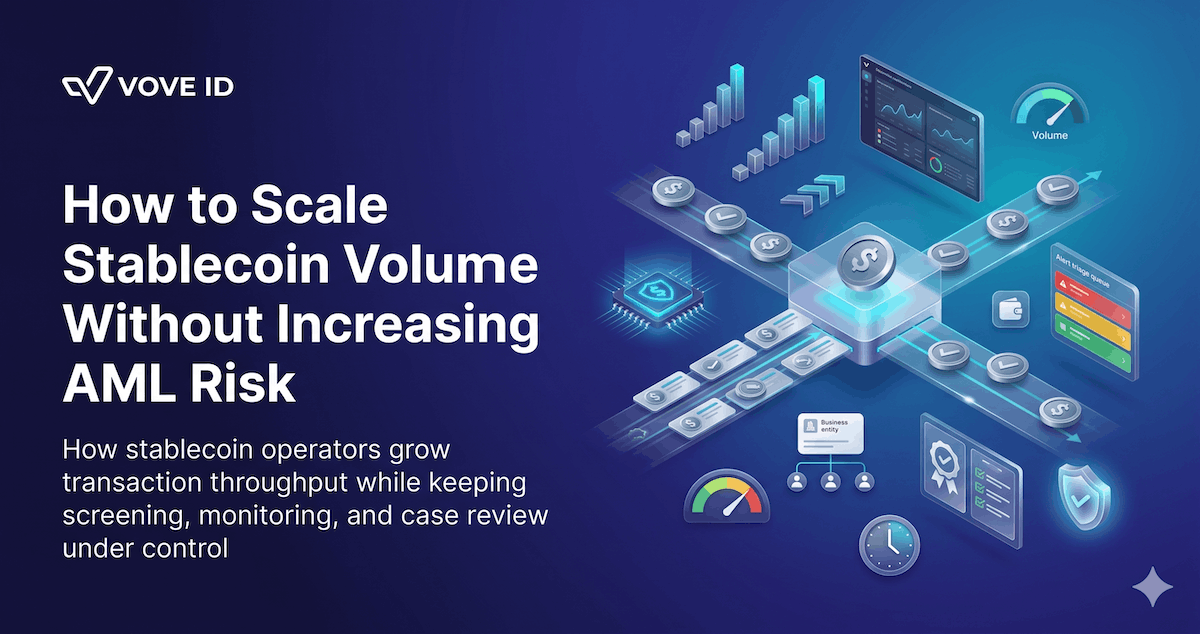
Stablecoin growth does not fail because transaction demand arrives too fast. It fails because compliance systems do not scale at the same speed. As volume rises, the real challenge is keeping sanctions controls, transaction monitoring, KYB, and case handling precise enough to protect the business without slowing the product down.
How can stablecoin providers grow volume without increasing AML risk?
By scaling risk controls with throughput instead of after it. That means connecting onboarding context to monitoring, automating sanctions and counterparty screening, triaging alerts by severity, and using KYB to understand who sits on the other side of higher-volume flows. Growth becomes dangerous when volume rises faster than visibility, prioritization, and review capacity.
Stablecoin teams often talk about scale as a product or treasury problem.
Can the rails hold more volume?
Can settlement stay fast?
Can liquidity and redemption operations keep up?
Those questions matter. But they are not the whole story.
When stablecoin volume increases, AML exposure usually increases faster than teams expect because more volume means more of everything:
- more counterparties
- more jurisdictions
- more sanctions touchpoints
- more unusual transaction patterns
- more alerts
- more review pressure
If the compliance stack does not scale with that growth, the business eventually chooses between two bad outcomes:
- operational drag from too much manual review
- hidden risk because the team starts clearing too much too quickly
That tradeoff is avoidable, but only if the controls are designed for scale from the beginning.
Why AML risk rises as stablecoin volume grows
The reason is not only that more transactions exist.
The real issue is that stablecoin products tend to grow across multiple complexity layers at once:
- customer count
- average transaction value
- cross-border corridor count
- business counterparties
- wallet interactions
- velocity of movement
That compounds risk.
The FATF said on 3 March 2026 that stablecoins have grown rapidly, with more than 250 in circulation by mid-2025 and market capitalisation above USD 300 billion. In the same report, FATF highlighted illicit-finance risks linked to stablecoin misuse, especially in peer-to-peer activity through unhosted wallets.
That is the right frame for operators.
Stablecoins are attractive because they are fast, interoperable, and liquid. Those same traits also make them useful for bad actors if controls are weak.
So when volume rises, teams should expect pressure in four areas:
1. More sanctions exposure
More corridors and more counterparties mean more chances to encounter blocked persons, sanctioned geographies, or indirect exposure through business relationships and wallet behavior.
2. More monitoring noise
As transaction counts rise, weak rules generate noise at a much faster rate. A tolerable alert problem at low volume becomes a backlog problem at scale.
3. More counterparty risk
Stablecoin businesses do not only face end-user risk. They also face risk through merchants, OTC desks, distributors, treasury partners, and business customers.
4. More pressure on human reviewers
Without triage and automation, analysts become the scaling bottleneck. Review quality falls exactly when the business needs it to become more consistent.
The controls that have to scale with throughput
1. Sanctions and wallet screening
Sanctions controls cannot stay static while transaction volume multiplies.
At scale, teams need:
- screening at onboarding
- ongoing rescreening
- wallet and counterparty screening where relevant
- clear disposition workflows
- documented escalation paths
The point is not simply to screen more often. It is to make screening usable at speed.
If a team has high screening coverage but no clean escalation workflow, it still does not have a scalable control.
2. Transaction monitoring with customer and counterparty context
Monitoring should not operate as a generic transaction filter.
It should use:
- customer type
- business type
- corridor
- expected use case
- prior risk score
- sanctions and screening history
That is how the system learns the difference between:
- expected treasury movement
- normal corridor settlement activity
- unusual structuring behavior
- counterparty patterns that deserve escalation
Without context, the system has to guess. At scale, guessing becomes expensive.
3. Alert triage and case management
This is where many teams break.
The controls technically exist, but all alerts land in one queue with roughly equal treatment. Once that happens, review capacity becomes the limiting factor for safe growth.
A scalable workflow separates:
- immediate escalations
- high-priority analyst review
- standard review
- low-confidence alerts that may require more automation before human attention
The VARA rulebook requires virtual asset service providers to continuously monitor business relationships, update indicators used to identify suspicious transactions, and route suspicious activity promptly to the MLRO.
That is a useful operating principle beyond Dubai.
Continuous monitoring only works when the queue is structured well enough for the team to act on it.
4. KYB for counterparties and business customers
This is one of the most overlooked scaling controls in stablecoins.
Retail KYC may be strong, but growth often starts to depend more on business relationships:
- merchants
- payout partners
- market makers
- B2B customers
- treasury clients
- corridor operators
If the company does not understand who these entities are, who owns them, and how their risk profile changes over time, then a large part of volume growth sits on a weak foundation.
Strong KYB at scale means:
- legal entity verification
- beneficial owner mapping
- sanctions screening on the entity and relevant controllers
- expected-use profiling
- periodic refresh and ongoing monitoring
The common mistakes that make volume growth dangerous
1. Manual review grows linearly with volume
This is the most obvious failure pattern.
At low volume, a team can compensate for weak automation with smart analysts. At higher volume, that stops working. Queue age rises. Decision quality falls. Product teams start treating compliance as a latency problem.
2. One-size-fits-all monitoring rules
A stablecoin treasury customer, a corridor payment product, and a retail wallet user should not all be monitored under the same alert assumptions.
If every profile gets the same thresholds, the team either:
- produces too many false positives, or
- leaves real gaps in higher-risk segments
Usually both.
3. Onboarding and monitoring are disconnected
This is a structural issue.
If monitoring cannot see what was learned during KYC or KYB, then the alerts are weaker and noisier. Investigators spend more time re-creating customer context instead of making decisions.
4. Teams optimize for raw alert volume instead of signal quality
More alerts do not mean better AML.
The better question is whether alerts convert into meaningful cases at a rate that shows the system is learning what risk matters for the actual product.
5. KYB is treated like a setup task, not a live control
Counterparty risk changes. Ownership changes. Activity changes. If business due diligence is never refreshed, the company is scaling on stale assumptions.
What a scalable operating model looks like
The goal is not to automate everything blindly.
The goal is to make sure each layer informs the next one.
Below is a workable model for stablecoin teams:
| Layer | What should happen |
|---|---|
| Onboarding | verify person or business, screen sanctions and risk factors, capture expected use case |
| Risk scoring | assign customer or entity risk based on geography, product, ownership, and behavior assumptions |
| Activation | apply limits or controls based on risk level |
| Monitoring | evaluate transactions, wallets, corridors, and counterparties using onboarding context |
| Triage | route alerts by severity and confidence instead of one undifferentiated queue |
| Investigation | review alerts with full KYC, KYB, and history attached |
| Refresh | re-screen, re-score, and refresh entity data when exposure changes |
That is what allows a team to keep growing without treating compliance as a separate manual back office.
The metrics that matter most as volume grows
The sheet brief called out three metrics, and they are the right starting point:
Alert-to-case ratio
This tells you whether monitoring rules are generating useful signals or just noise.
If alert volume grows sharply but meaningful cases do not, the system probably needs better tuning.
Review time
This shows whether the team can still move fast enough as throughput increases.
Longer review times mean either:
- the queue design is weak
- the investigation workflow is too manual
- or both
False positives
This is not just an efficiency metric. It is a control-quality metric.
Too many false positives create backlog, slow good activity, and reduce attention available for real risk.
Teams should also watch:
- queue age by severity
- investigation completion rate
- case-to-SAR conversion where relevant
- business-account refresh completion
But if you only start with three, start with the three above.
How VOVE ID helps stablecoin teams scale safely
VOVE ID helps teams connect the controls that usually break apart during growth:
- KYC and liveness
- KYB and beneficial ownership workflows
- sanctions, PEP, and adverse media screening
- transaction monitoring
- alert routing and review
- audit-friendly case handling
That matters because a scalable AML stack is not a pile of tools.
It is a workflow where onboarding context, counterparty context, and live transaction behavior all support the same decision system.
For stablecoin teams, that is how compliance stops being the thing that slows growth and starts becoming the thing that makes growth more defensible.
Practical questions to ask before volume doubles
Before pushing into the next stage of growth, stablecoin operators should ask:
- Can our monitoring rules distinguish between customer types and corridor types?
- Are sanctions and wallet checks connected to case handling?
- Which business counterparties are still weakly verified?
- How long do high-priority alerts sit before review?
- What percentage of alerts are false positives?
- Does our KYB process refresh entity data after onboarding?
If those answers are weak now, they will be worse after volume scales.
Conclusion
Stablecoin providers do not keep AML risk flat by working harder after volume arrives.
They do it by designing controls that scale with throughput before the pressure shows up in the queue.
That means:
- context-rich monitoring
- scalable sanctions controls
- structured alert triage
- serious KYB for counterparties
- metrics that show whether the system is learning
The teams that get this right do not just reduce risk.
They protect speed, customer experience, and operating leverage at the same time.
That is what sustainable stablecoin growth actually looks like.
Need to scale stablecoin volume without building AML bottlenecks into the product? Talk to the team.
FAQ
1. Why does AML risk rise so quickly with stablecoin volume?
Because growth increases counterparties, corridors, wallet interactions, sanctions exposure, and alert load at the same time.
2. What control should stablecoin teams strengthen first?
Usually the connection between onboarding context and transaction monitoring. Without that, alert quality degrades quickly as volume grows.
3. Is KYB really necessary for stablecoin scale?
Yes. Many large exposures come from business customers, merchants, distributors, and treasury counterparties rather than retail users alone.
4. Which metrics should teams monitor most closely?
Start with alert-to-case ratio, review time, and false positives. Those three usually reveal whether the monitoring program can scale cleanly.