Veriff Alternative: VOVE ID vs Veriff for Africa and MENA Fintechs
Fintech teams evaluating a Veriff alternative in Africa and MENA are rarely comparing identity verification alone. The real question is whether KYC, KYB, and AML workflows can operate as one system.
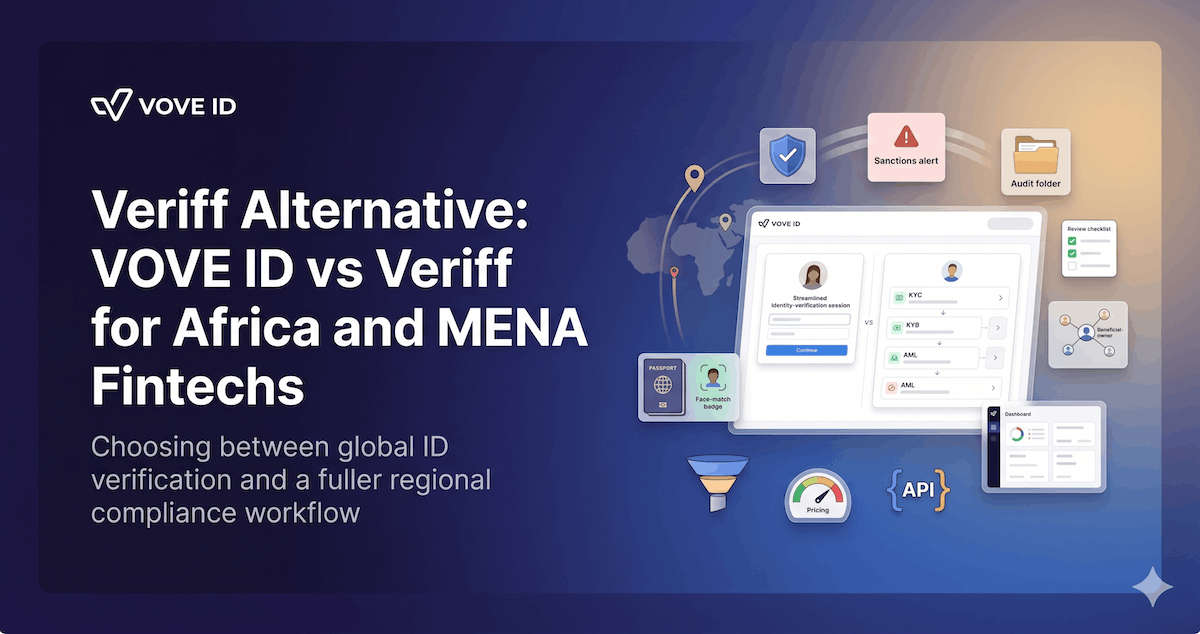
Fintech teams looking for a Veriff alternative are usually not asking whether Veriff can verify identities. They are asking whether identity verification alone is enough for the markets, onboarding model, and compliance stack they actually need to run in Africa and MENA. In 2026, that decision often comes down to product scope, operating fit, and whether KYC, KYB, sanctions, and monitoring live inside one workflow.
What is the best Veriff alternative for Africa and MENA fintechs?
For teams that need more than document verification, VOVE ID is a strong Veriff alternative. It is especially useful when the business needs Africa and MENA operating fit, business onboarding, sanctions and AML controls, and pricing that maps cleanly to live verification volume and compliance workflow complexity.
Veriff is a serious identity verification platform.
Its current public product covers document and identity verification, biometric and liveness checks, sanctions and PEP screening, adverse-media screening, and ongoing monitoring. It also publishes self-serve pricing and broad document coverage across more than 230 countries and territories.
That means the comparison should start from a clear premise: this is not a case of a weak vendor versus a strong one.
It is a fit question.
Where Veriff is strongest
Veriff is strongest when the main job is consumer identity verification at scale.
Its public product emphasizes:
- global document coverage
- fast identity verification flows
- biometric and liveness checks
- multilingual onboarding
- sanctions, PEP, and adverse-media screening
For teams centered on individual onboarding, that is a credible package.
The issue is not whether Veriff can verify users. The issue is whether the business needs a broader compliance operating layer than identity verification alone.
Where the comparison gets more practical for Africa and MENA fintechs
This is where many evaluations change shape.
1. Identity verification is not the whole workflow
Many Africa and MENA fintechs do not only verify individuals.
They also need to onboard merchants, SMBs, treasury users, program partners, or corridor counterparties. That means KYB, beneficial-owner logic, sanctions and PEP checks, and review workflows often matter as much as document verification itself.
If the team is really buying a compliance workflow, not only an IDV layer, the evaluation criteria shift.
2. Coverage headlines are not the same as corridor readiness
Veriff publicly states support for users in more than 230 countries and territories and publishes a country-by-country support list.
That is useful.
But for Africa and MENA teams, the real evaluation still happens corridor by corridor:
- which document types matter most in the target market
- which fallback flows are available when documents are weak
- how local fraud pressure affects review operations
- whether downstream AML and KYB controls stay connected to the onboarding result
This means one thing: a long country list is not the end of diligence.
It is the start.
3. Pricing is more than the headline verification rate
Veriff now publishes self-serve pricing, which changes the comparison from older enterprise-only assumptions.
That makes it easier for startups to test. But pricing still needs to be evaluated in the context of the whole compliance stack. If KYC sits in one product, KYB in another, and monitoring or case handling somewhere else, the real operating cost is not only the per-verification number.
For lean fintech teams, tool sprawl is usually more expensive than it first looks.
VOVE ID vs Veriff: what the tradeoff usually looks like
The best comparison is not feature count.
It is operating model.
| Category | Veriff | VOVE ID |
|---|---|---|
| Core strength | Global identity verification and fraud-resistant onboarding | Unified KYC, KYB, AML, and onboarding workflow for fintech operations |
| Public posture | Strong self-serve IDV product with wide document coverage | Fintech-focused compliance infrastructure shaped around real onboarding and monitoring workflows |
| Best fit | Teams optimizing primarily for individual identity verification | Teams needing identity checks plus business verification, sanctions, review logic, and AML operations in one flow |
| Africa and MENA evaluation lens | Verify exact country, document, and fallback fit carefully | Built for teams that need regional operating fit plus broader compliance workflow continuity |
| Workflow question | Excellent when identity verification is the center of the stack | Strongest when the business needs one control surface across KYC, KYB, and AML |
This is not an argument that Veriff lacks capability.
It is an argument that many Africa and MENA fintechs have a wider compliance problem than ID verification alone.
When VOVE ID is the better fit
1. You are onboarding both individuals and businesses
If the roadmap includes merchants, SMBs, marketplace sellers, treasury customers, or program partners, identity verification alone stops being enough quickly.
Teams need KYB, beneficial-owner review, screening, and case management tied to the onboarding decision.
2. You want onboarding and AML to stay connected
A pass or fail identity result does not tell the whole story.
Teams also need to carry that context into sanctions review, transaction monitoring, escalation, and later investigations. That is where disconnected tools create real operational drag.
3. You operate in markets where review operations matter
In Africa and MENA, the challenge is often not only whether a document can be read.
It is how the team handles low-confidence cases, document variance, repeat attempts, business onboarding edge cases, and later AML review. A broader workflow can matter more than a narrower verification score.
4. Your team is lean and needs one system to do more
Many fintech teams do not want to assemble a compliance stack vendor by vendor.
They want one workflow that covers individual onboarding, business onboarding, sanctions logic, and operational review without turning every edge case into a manual handoff.
That is where VOVE ID has the clearer fit.
Practical checklist for evaluating a Veriff alternative
Before choosing between Veriff and VOVE ID, ask:
Identity
- Confirm the exact documents and markets that matter to the launch plan.
- Test fallback behavior for low-confidence or edge-case submissions.
- Check how quickly reviewers can understand why a session failed.
Workflow
- Decide whether the stack only needs KYC or also needs KYB and AML operations.
- Check whether onboarding results flow into sanctions, monitoring, and case handling.
- Measure how many manual handoffs exist between verification and compliance review.
Economics
- Compare total workflow cost, not only the per-verification headline.
- Check whether pricing stays sensible as volume and review complexity change.
- Count how many separate tools the team will still need after the first launch.
If the team only needs global consumer IDV, Veriff may be enough.
If the team needs a broader compliance operating layer for Africa and MENA fintech use cases, VOVE ID is the stronger answer.
Conclusion
Veriff is a credible identity verification product.
But many Africa and MENA fintechs are not only buying identity verification. They are buying a way to run onboarding, screening, business verification, and AML operations without breaking the workflow into disconnected pieces.
That is why the better alternative is often not the vendor with the longest feature list. It is the vendor whose product matches the compliance job the team actually needs to do.
Want to compare VOVE ID against your current Veriff evaluation with your real markets, documents, and workflow needs in view? Talk to the team.
FAQ
1. Is Veriff a strong identity verification platform in 2026?
Yes. Veriff publicly offers document and identity verification, liveness, sanctions and PEP screening, adverse-media screening, and ongoing monitoring, with broad international document coverage.
2. Why would a fintech in Africa or MENA still look for an alternative?
Usually because the team needs more than IDV. Business onboarding, KYB, sanctions workflow, monitoring, and lean-team operations often matter just as much as document verification.
3. Does Veriff publish pricing now?
Yes. As of May 2026, Veriff's pricing page shows public self-serve plans. Teams should still compare the total workflow cost, not only the base verification rate.
4. When is VOVE ID the better fit?
VOVE ID is usually the better fit when a fintech wants KYC, KYB, AML, and operational review to work as one system, especially across Africa and MENA use cases.