MiCA Is Coming: What Stablecoin Providers Need to Fix in Their KYC/KYB Stack Now
Excerpt: MiCA is already applying. The 1 July 2026 transition deadline makes one question urgent: are your KYC, KYB, and AML controls strong enough to survive regulator review before the window closes?
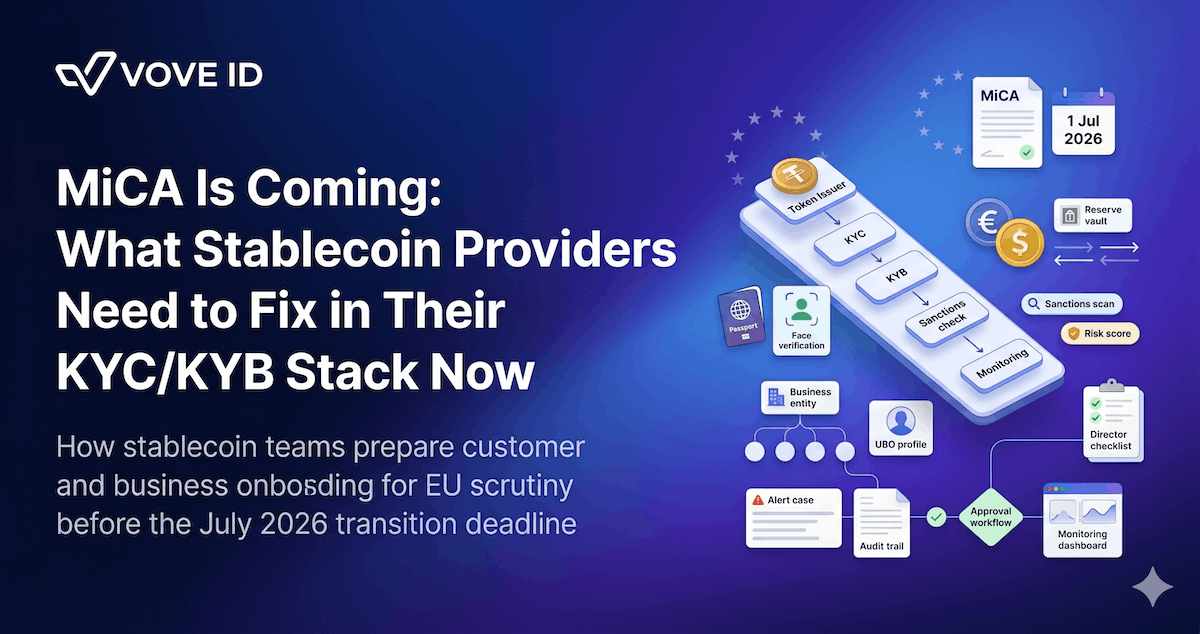
For stablecoin teams serving Europe, the KYC and KYB problem in May 2026 is not whether MiCA exists. It does. The urgent issue is whether your onboarding, ownership verification, sanctions controls, and monitoring workflow are strong enough before the last MiCA transition window closes on 1 July 2026.
What do stablecoin providers need to fix in their KYC and KYB stack for MiCA?
They need four things first: risk-based customer due diligence, stronger business onboarding with real UBO mapping, ongoing screening and monitoring after activation, and an evidence trail that can survive regulator review. For many teams, the biggest gap is not missing one control. It is running KYC, KYB, and AML in separate tools that do not produce one coherent supervisory story.
The title says MiCA is coming, but the important clarification is this:
MiCA is already here.
The EU's Markets in Crypto-Assets Regulation started applying in phases:
30 June 2024: the rules forasset-referenced tokensande-money tokensstarted applying30 December 2024: the broader MiCA framework started applying1 July 2026: the EU-wide end point for MiCA transitional periods
That last date matters because ESMA said on 17 April 2026 that the transitional period officially expires across the EU on 1 July 2026. After that date, any entity providing crypto-asset services to EU clients without a MiCA licence will be in breach of EU law.
For stablecoin issuers, distributors, exchanges, and payment firms, that changes the practical question.
It is no longer:
"When should we start getting ready for MiCA?"
It is:
"Which KYC and KYB weaknesses will become visible first when supervisors, banking partners, and enterprise customers look closely at our operating model?"
Why stablecoin providers have a different MiCA problem
Stablecoin providers do not only have a retail onboarding problem.
They usually sit across several risk layers at once:
- retail users or wallet holders
- business customers
- liquidity or treasury counterparties
- distribution partners
- payment or settlement flows across jurisdictions
That means MiCA readiness is not just about identity verification at sign-up.
It is about whether the business can explain:
- who it onboarded
- which entities it allowed into the system
- who ultimately owns or controls those entities
- what level of risk each relationship carries
- how those customers and counterparties are monitored after activation
This is where a lot of stablecoin teams still have hidden debt.
They invested in launch speed, reserve structure, product distribution, and legal analysis. But their KYC and KYB workflow is still fragmented, heavily manual, or built around a retail-first view of compliance.
That is exactly the sort of weakness that gets more expensive as MiCA oversight tightens.
Which stablecoin businesses are in scope
MiCA touches different stablecoin-related firms in different ways, but the practical pressure reaches broadly across the stack.
At minimum, teams should think carefully about:
- issuers of
e-money tokens - issuers of
asset-referenced tokens CASPsdistributing, custodying, exchanging, transferring, or executing orders involving crypto-assets- stablecoin payment products serving EU clients
- stablecoin treasury or corridor products onboarding business customers and counterparties in Europe
The EBA states that issuers of asset-referenced tokens and e-money tokens must hold the relevant authorisation to operate in the EU under MiCA. That does not mean every business has the same onboarding obligations in exactly the same form. It does mean the days of weak, undocumented onboarding logic are over.
KYC fixes stablecoin providers should make now
1. Move from identity checks to real customer due diligence
Many teams still treat KYC as document verification plus a sanctions hit list.
That is too thin for a stablecoin operating model.
A more defensible KYC stack should include:
- identity capture and verification
- liveness or impersonation controls
- sanctions and
PEPscreening - geography and residency risk checks
- purpose-of-account or expected-use information
- risk-based step-up checks for higher-risk profiles
The point is not to create friction everywhere.
The point is to make sure a high-risk customer, a treasury user, a cross-border operator, and a low-risk retail customer do not all pass through exactly the same workflow with exactly the same review logic.
2. Add source-of-funds and source-of-wealth triggers where the risk justifies it
For stablecoin products, customer risk often depends less on the presence of an ID document and more on:
- transaction size
- corridor exposure
- business model
- link to higher-risk jurisdictions
- unusual funding patterns
That means a serious MiCA-era stack needs clear escalation logic for when extra due diligence is required.
If a team cannot explain when it asks for more information and why, then it does not really have a risk-based onboarding model.
3. Stop treating monitoring as a separate phase
Customer due diligence is not finished when the account goes live.
Stablecoin risk changes quickly because behavior changes quickly. Wallet usage, counterparties, corridors, and transaction velocity can all move fast after activation.
So the KYC stack should feed directly into:
- sanctions rescreening
- transfer monitoring
- risk-score updates
- review thresholds
- case escalation
If onboarding data never reaches the monitoring layer, the monitoring layer operates half blind.
KYB fixes stablecoin providers should make now
1. Verify the entity, not just the paperwork
Stablecoin teams often onboard businesses that look simple on the surface:
- payment companies
- OTC desks
- merchants
- treasury clients
- market makers
- corridor partners
The weak version of KYB checks only whether a company exists.
The stronger version verifies:
- legal existence
- registration status
- directors or control persons
- beneficial ownership
- sanctions exposure
- expected use case
- jurisdictional risk
That difference matters because stablecoin businesses often generate risk through their counterparties, not only through end-user wallets.
2. Fix UBO mapping before regulators or banks ask for it
This is one of the first places business onboarding breaks.
Entity verification is often nominally complete, but ownership mapping is:
- outdated
- manually stored
- inconsistent across files
- missing supporting evidence
- not connected to screening
That creates a control gap.
Retail KYC can look polished while business onboarding remains hard to defend.
For a MiCA-facing stablecoin business, UBO logic should be operational, not theoretical. Teams need a repeatable method to identify and verify beneficial owners, screen them, and refresh the record when ownership or control changes.
3. Refresh business records, not just individual records
Many firms remember to rescreen people but forget to refresh companies.
That is risky in a stablecoin context because business relationships change in ways that matter for AML exposure:
- new directors
- new beneficial owners
- license changes
- new markets
- new products
- different transaction patterns
If the entity profile frozen at onboarding no longer matches the real relationship, KYB has quietly failed.
The operational gaps regulators will notice first
The most common MiCA-readiness failures are not abstract legal failures. They are operating-model failures.
1. Retail KYC is decent, but business onboarding is weak
This happens when the team bought a smooth identity verification flow but never built a strong counterparty and business verification program around it.
That is dangerous for stablecoin businesses because some of the biggest exposures sit with merchants, distributors, corporate clients, liquidity partners, and payment counterparties.
2. Sanctions screening exists, but ongoing screening is inconsistent
A one-time check at onboarding is not enough for a product moving value continuously. Teams need re-screening, alert handling, and documented decisions.
3. The transition date is treated like a planning date instead of a hard stop
1 July 2026 is not a vague policy milestone. ESMA has already stated that the transitional period expires across the EU on that date.
If a firm is not authorised by then, or is relying on controls that are still half-built, the problem becomes immediate.
4. Evidence is spread across disconnected tools
A regulator or banking partner may ask a basic question:
"Show me how this customer or business was onboarded, screened, approved, and monitored."
If the answer requires jumping between inboxes, spreadsheets, ticket threads, and separate vendors, the process is weaker than it looked during procurement.
What a MiCA-ready stablecoin KYC/KYB stack should look like
Below is the standard most teams should be aiming for now:
| Stage | What needs to happen |
|---|---|
| Customer onboarding | verify identity, screen sanctions and PEPs, capture expected use case |
| Business onboarding | verify legal entity, map UBOs, screen owners and directors, assign risk |
| Approval | document who approved, why, and under which risk logic |
| Activation | carry customer and entity risk context into live account settings |
| Monitoring | screen transfers, review unusual behavior, rescore when activity changes |
| Refresh | re-screen people and businesses, refresh ownership and entity data |
| Investigation | route alerts into a case workflow with full onboarding context |
| Audit trail | preserve evidence so the relationship can be reconstructed later |
This is the shift from a collection of compliance tools to one compliance system.
How VOVE ID helps teams close the MiCA gap
VOVE ID helps stablecoin teams connect the layers that usually sit apart:
- KYC and liveness
- KYB and beneficial ownership verification
- sanctions, PEP, and adverse media screening
- monitoring and alerting
- audit-friendly case handling
The important benefit is not just automation.
It is operational continuity.
The same risk context used to approve a customer or business can keep informing how that relationship is monitored later. That is the kind of structure that becomes easier to defend under MiCA-era supervision.
A practical checklist to use now
If you run a stablecoin product serving Europe, ask these questions immediately:
- Are we still relying on a transitional assumption that ends on
1 July 2026? - Can we explain which part of our business is issuer risk, CASP risk, or counterparty risk?
- Does our business onboarding process include real UBO mapping and screening?
- Do sanctions checks continue after onboarding?
- Does monitoring use customer and entity risk context from onboarding?
- Can we reconstruct the full approval and monitoring history for one sample business account?
If those answers are weak, the issue is probably not legal interpretation. It is workflow design.
Conclusion
MiCA is not a future event for stablecoin providers. The framework has already been applying since 30 June 2024 for stablecoin token categories and since 30 December 2024 more broadly, and the EU-wide transitional period ends on 1 July 2026.
That means the teams with the biggest remaining risk are not the ones still reading MiCA summaries.
They are the ones still operating fragmented KYC, KYB, and monitoring systems that cannot hold up under scrutiny.
The fix is straightforward in principle:
build one workflow that verifies customers and businesses properly, carries risk context into monitoring, and preserves a clean evidence trail from onboarding to review.
That is what MiCA-ready execution looks like now.
Need to close KYC, KYB, and AML gaps before MiCA transition windows end? Talk to the team.
FAQ
1. Does MiCA start on 1 July 2026?
No. MiCA has applied in phases since 30 June 2024 and 30 December 2024. 1 July 2026 is the EU-wide end point for transitional periods.
2. Why does KYB matter so much for stablecoin providers?
Because many stablecoin risks sit with business customers, treasury users, distributors, and counterparties rather than with retail users alone.
3. What is the most common MiCA KYC/KYB failure?
Fragmentation. Teams often have identity verification, business verification, sanctions screening, and monitoring in separate workflows that do not produce one defensible supervisory record.
4. What should teams fix first?
Risk-based customer due diligence, real UBO mapping, ongoing screening after onboarding, and an audit trail that connects approval to monitoring.