KYB in the UK: Compliance Requirements, Workflow, and Practical Challenges
Navigate UK KYB requirements under MLR 2017 with UBO verification and a risk-based compliance approach. VOVE ID supports streamlined KYB workflows designed to simplify financial crime compliance processes.
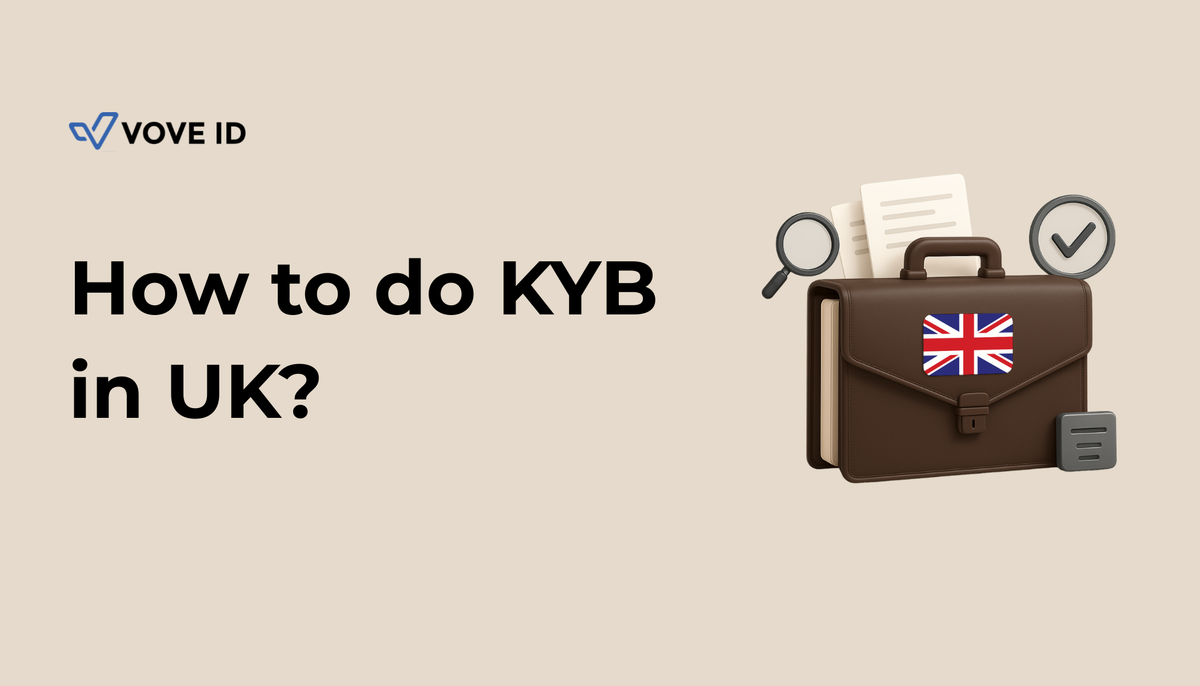
In the United Kingdom, business verification is not a procedural formality but a regulatory requirement embedded in anti-money laundering obligations and corporate transparency rules. KYB in the UK is built on registry-based disclosure, beneficial ownership reporting, and a risk-based compliance model. Platforms such as VOVE ID typically operationalize these requirements into structured workflows that connect onboarding, verification, and ongoing monitoring.
The UK approach relies heavily on Companies House data, but this data functions as a disclosure system rather than a verified source of truth, which directly shapes how KYB must be implemented in practice.
UK KYB often requires reconciling registry data with real operational control, as filing accuracy can vary across entities and updates may lag behind real-world changes.
For a broader breakdown of KYB processes, see the KYB overview
Key Challenges of KYB in the UK
KYB in the UK appears structured on the surface, but operational execution reveals several structural weaknesses.
1. Companies House is a disclosure registry, not a verification authority
Companies House allows public access to corporate data, but much of it is self-reported. This creates gaps in:
- director accuracy
- shareholder reporting
- declared business activity
The registry is currently evolving toward stronger identity verification under recent reforms, shifting from passive disclosure toward active validation.
2. Beneficial ownership is often indirect and multi-layered
While PSC data provides transparency for individuals with significant control, ownership is frequently structured through layered entities. PSC disclosure may not fully capture control in cases of dispersed or indirect ownership structures, requiring reconstruction beyond registry-level data.
3. Nominee arrangements and formation services
UK company formation services and nominee structures can obscure effective control, requiring enhanced verification beyond official filings.
4. Regulatory tightening under ECCTA 2023
The Economic Crime and Corporate Transparency Act introduces mandatory identity verification for directors and stronger controls over filed information, significantly increasing compliance expectations.
5. Misclassification of risk
UK entities are often treated as inherently low risk, which can result in insufficient onboarding scrutiny despite underlying ownership or activity complexity.
Additional risk factors include discrepancies between declared and operational business activity or registered addresses.
KYB Workflow in the UK (Operational View)
A compliant UK KYB process typically follows this sequence:
Step 1 — Entity lookup
- Query Companies House register
- Extract registration details, status, and officers
- Review filing history for inconsistencies or unusual changes
Step 2 — Ownership structure mapping
- Identify shareholders
- Reconstruct direct and indirect ownership layers
Step 3 — PSC / UBO verification
- Identify persons with significant control (>25% or effective control)
- Validate identity and control relationship
Step 4 — Risk assessment
- Business sector classification
- Geographic and cross-border exposure
- Detection of shell or inactive entities
- PEP and sanctions screening
Step 5 — Decisioning
- approve / reject / escalate
Step 6 — Ongoing monitoring
- director changes
- ownership updates
- adverse media signals
This reflects the UK’s risk-based AML framework under the Money Laundering Regulations 2017 (MLR 2017).
UK Regulatory Framework
KYB obligations in the UK are defined by multiple regulatory layers:
Money Laundering Regulations 2017 (MLR 2017)
Core AML framework defining regulated entities and requiring:
- customer due diligence (CDD)
- enhanced due diligence (EDD)
- ongoing monitoring
Financial Conduct Authority (FCA)
Regulates and supervises AML compliance for financial institutions and enforceable entities.
Companies House
Primary corporate registry providing disclosed company data, historically based on self-reporting, now undergoing reform toward stronger verification.
Persons with Significant Control (PSC) regime
Requires disclosure of individuals exercising significant control, typically above the 25% ownership threshold or equivalent influence.
Economic Crime and Corporate Transparency Act 2023 (ECCTA)
Introduces mandatory identity verification for directors and strengthens accuracy requirements for corporate filings.
Non-compliance may lead to regulatory enforcement actions, including penalties imposed by relevant UK authorities.
KYB Checklist for UK Businesses
A structured KYB process in the UK should include:
- Company registration verified via Companies House
- Legal status confirmed (active, dissolved, or inactive)
- Directors identified and screened
- PSC / UBO identified and validated
- Ownership structure mapped
- Sanctions and PEP screening completed
- Risk classification assigned
- Enhanced due diligence applied where required
- Records retained for regulatory minimum periods (typically 5 years)
- Monitoring triggers configured for ongoing updates
Conclusion
KYB in the UK is not defined by regulatory complexity alone, but by the limitations of publicly disclosed data and the increasing sophistication of ownership structures. Effective compliance depends on combining registry data, beneficial ownership analysis, and continuous monitoring into a unified operational workflow.
Explore how to implement a UK-ready KYB workflow
This article is intended for general informational purposes only and does not constitute legal, financial, or regulatory advice. KYB requirements may vary depending on jurisdiction, industry, and specific business circumstances. For up-to-date and binding compliance obligations, readers should refer to the relevant regulatory authorities or consult qualified professionals.