UBO Verification API: Automating Ultimate Beneficial Owner Checks in 2026
A UBO verification API turns beneficial ownership into a structured compliance workflow, connecting entity resolution, ownership mapping, identity verification, and sanctions screening into one repeatable system.
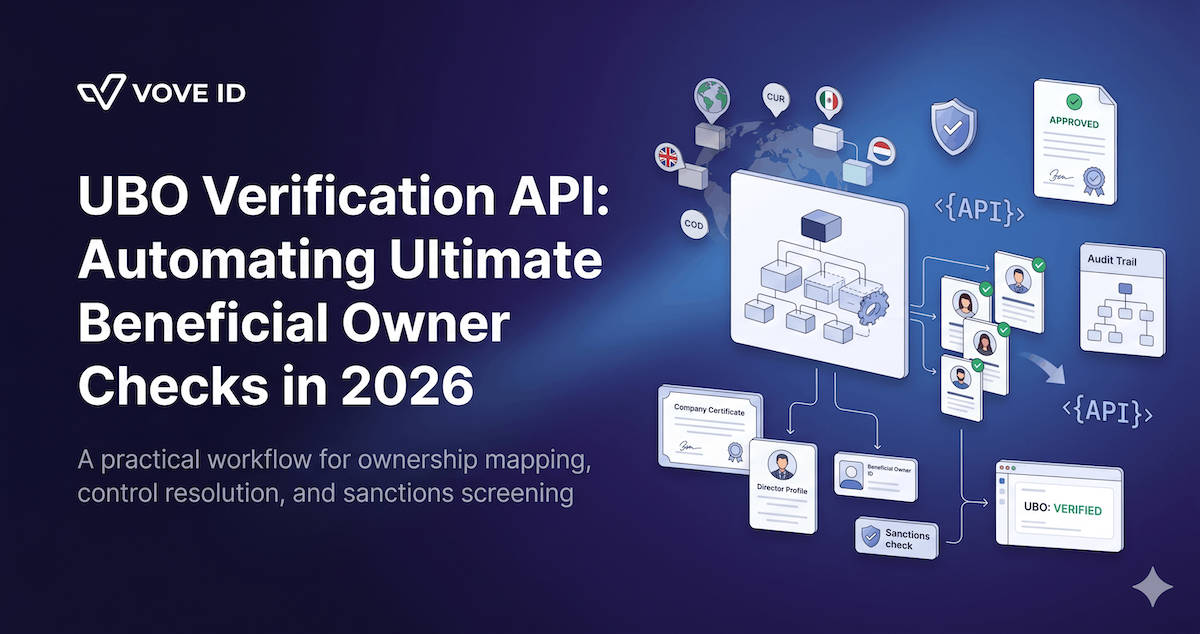
A UBO verification API helps fintech teams identify the real people who ultimately own or control a business, verify those individuals, screen them for sanctions and PEP exposure, and maintain a structured audit trail linked to onboarding records. In 2026, this capability is critical because regulators no longer accept company names, registry extracts, or director listings as sufficient proof of ownership transparency. They expect firms to understand who sits behind the entity, how control is distributed, and whether the ownership structure introduces hidden AML risk.
What is a UBO verification API and how does it work?
A UBO verification API is infrastructure that converts beneficial ownership checks into a structured KYB workflow: entity resolution, ownership graph mapping, identification of natural persons with ownership or control, identity verification, sanctions and PEP screening, and generation of an audit-ready compliance record. It replaces manual registry research, spreadsheet-based ownership tracing, and fragmented internal notes with a repeatable system-level process embedded into onboarding flows.
Business onboarding often appears complete at the surface level while remaining incomplete at the risk layer.
The company is registered. Documents are uploaded. Directors are listed. The legal entity passes initial KYB checks. From an operational perspective, everything looks ready for activation.
But at compliance level, one critical uncertainty remains: who ultimately owns or controls this business relationship?
This is not a theoretical gap. It is one of the most common failure points in KYB programs that rely heavily on entity-level verification without structured beneficial ownership resolution.
For lenders, B2B marketplaces, embedded finance providers, treasury platforms, and KYB infrastructure teams, UBO data is not an optional enrichment field. It is a core dependency for risk decisioning. It determines whether a business relationship is transparent, whether hidden exposure exists, and whether onboarding decisions can withstand regulatory scrutiny later.
In practice, incomplete ownership visibility creates silent risk accumulation inside onboarding pipelines.
What UBO verification actually means
UBO stands for ultimate beneficial owner.
A UBO is the natural person who ultimately owns or controls a legal entity, even when ownership is distributed across multiple layers such as holding companies, trusts, nominee arrangements, offshore structures, or indirect shareholding chains.
This distinction is important because UBO resolution is not a simple extension of KYB entity checks. It is a separate analytical layer that reconstructs human control behind corporate structures.
KYB answers: “what is this business?”
UBO resolution answers: “who is behind this business?”
Both are required, but they operate on different dimensions of risk.
A common mistake in fintech systems is treating beneficial ownership as a static registry field. In reality, it is a dynamic structure that often requires reconstruction across fragmented and incomplete data sources.
Most regulatory frameworks use ownership thresholds such as 25% as a baseline indicator. However, ownership percentage alone is insufficient.
Control can exist through:
- voting rights
- board influence
- appointment rights
- shareholder agreements
- informal governance structures
Regulatory frameworks such as FinCEN rules and FATF guidance explicitly reflect this duality between ownership and control.
A complete UBO model must therefore resolve both:
- economic ownership
- effective control
Why beneficial ownership is central to AML systems
Beneficial ownership sits at the core of AML frameworks because it is one of the most common mechanisms used to obscure financial risk.
Corporate structures are frequently used to:
- conceal sanctions exposure
- fragment fraud proceeds
- disguise beneficial control
- obscure politically exposed individuals
- create distance between activity and responsibility
This is why regulators have progressively shifted toward stricter transparency expectations.
FATF Recommendation 24 and its updated guidance emphasize that beneficial ownership information must be accurate, accessible, and current, not just collected at onboarding and stored passively.
FinCEN’s framework similarly reinforces that both ownership and control define reporting obligations.
From an operational fintech perspective, this creates a clear requirement:
a KYB system that does not resolve beneficial ownership at scale is structurally incomplete from a risk standpoint.
What a complete UBO verification process includes
A production-grade UBO workflow is not a single API call or lookup function. It is a structured sequence of linked processes inside a KYB system.
1. Entity resolution and validation
The process starts with establishing the legal identity of the business:
- legal name
- registration number
- jurisdiction
- incorporation status
- entity classification
- registered address
This provides the foundation layer but does not introduce ownership insight.
2. Ownership structure reconstruction
The next step involves mapping the structural relationships of the entity.
This includes:
- direct shareholders
- parent entities
- subsidiaries
- intermediate holding companies
- directors and officers
- governance and voting structures
At this stage, the system is not looking at individuals yet. It is reconstructing the ownership graph.
3. Identification of UBO candidates
Once the structure is reconstructed, the system identifies natural persons who meet beneficial ownership or control criteria.
This typically includes:
- individuals above ownership thresholds
- individuals exercising effective control regardless of ownership
- directors in diffuse ownership environments
- multiple individuals across different ownership branches
This step converts structural data into person-level entities.
4. Identity verification of individuals
Each identified UBO must then be verified as a real individual.
This involves:
- identity document validation
- biometric or liveness checks where applicable
- cross-database verification
- additional documentation depending on jurisdiction and risk level
This step ensures that ownership intelligence is tied to verified identity data.
5. Sanctions and risk screening
Once identity is confirmed, each UBO is evaluated for compliance exposure:
- sanctions screening
- PEP classification
- adverse media analysis
- network-based risk signals where applicable
This links ownership structure directly to financial crime risk assessment.
6. Audit trail and evidence generation
The final output of the process is a structured compliance record, not just a decision.
This includes:
- full ownership resolution logic
- identified UBOs and classification reasoning
- verification results
- screening outcomes
- data sources and timestamps
This layer is critical for auditability and regulatory defensibility.
Why manual UBO processes fail at scale
Manual beneficial ownership workflows degrade quickly under real production conditions.
Common issues include:
- fragmented data across documents and systems
- inconsistent interpretation of ownership vs control
- delayed screening execution
- lack of structured audit records
- inability to maintain updated ownership states
As complexity increases, even correct decisions become difficult to reconstruct or defend.
How a UBO verification API changes the model
A UBO verification API replaces fragmented manual workflows with a structured orchestration layer. In implementations such as VOVE ID, this approach connects entity resolution, ownership mapping, identity verification, and sanctions screening into a single compliance workflow.
Instead of independent steps, it coordinates:
- entity resolution
- ownership graph construction
- UBO identification
- identity verification
- sanctions and PEP screening
- unified compliance output
The key shift is consistency at scale.
Every onboarding event follows the same logic, produces the same structure of output, and generates traceable compliance evidence.
This moves UBO resolution from a manual investigation process into a system-level infrastructure component inside KYB architecture.
Where UBO APIs are most valuable
SME lending
Used for ownership concentration analysis and hidden exposure detection.
B2B marketplaces
Used to scale onboarding without manual ownership reconstruction.
Treasury and payments infrastructure
Used to maintain transparency in cross-border financial flows.
Embedded finance platforms
Used as a core KYB dependency where speed and compliance must coexist.
Key evaluation criteria
When assessing a UBO verification API, important capabilities include:
- separation of ownership and control logic
- handling of multi-layer corporate structures
- verification of natural persons (not only entities)
- integrated screening within resolution flow
- explainability of UBO determination
- support for ongoing monitoring and updates
Weakness in these areas typically results in partial automation rather than true compliance infrastructure.
Conclusion
UBO verification is a foundational layer of KYB systems focused on resolving the real individuals behind corporate entities.
It operates as a dedicated infrastructure component inside onboarding workflows, distinct from entity-level verification and distinct from downstream monitoring systems.
A UBO verification API standardizes this layer by combining ownership mapping, identity verification, sanctions screening, and audit logging into a single repeatable process.
This allows fintech platforms to scale onboarding while maintaining transparency over the individuals who ultimately control the businesses they serve.