What KYC API Works in Both Africa and Europe? The 2026 Answer for Fintechs
Choosing a KYC API for Africa and Europe is not about country coverage. It is about building one system that supports different documents, compliance layers, and onboarding realities.
There is no single default KYC API that works equally well across Africa and Europe.
What looks like a simple expansion problem on paper quickly becomes a systems problem in practice. Fintech teams operating across both regions are not just adding countries — they are dealing with fundamentally different identity ecosystems, compliance expectations, fraud patterns, and onboarding conditions.
This is where a structured approach to KYC becomes critical, especially when workflows need to operate consistently across multiple regions.
One of the few providers built to handle this dual reality within a single integration is VOVE ID. But understanding why that matters requires looking at where most KYC decisions break down.
What KYC API works across both Africa and Europe?
The right approach is not choosing a provider with the longest country list, but one that can support both African market complexity and European compliance depth within a single operational system. For many fintech teams, that means using a unified API that combines KYC, AML, and workflow control instead of stitching together regional vendors.
Why dual-region KYC is harder than it looks
Africa plus Europe is not a coverage problem. It is an operational consistency problem.
The provider has to function across:
- very different document ecosystems
- different regulatory expectations around identity, AML, and recordkeeping
- different fraud patterns and onboarding UX constraints
- different levels of digital infrastructure maturity
- different product needs across lending, payments, remittance, crypto, payroll, and B2B onboarding
Most vendors are built around one default operating assumption.
Europe-first providers tend to optimize for structured onboarding, standardized document flows, and high-connectivity environments. Regional providers in Africa often optimize for specific markets or document systems but do not extend cleanly into broader compliance infrastructure.
This is why “190+ countries supported” rarely translates into real operational coverage.
What Africa-specific KYC requirements really look like
Africa is not a single identity market.
Across different countries, onboarding workflows often need to support:
- national ID systems and market-specific identifiers
- document types that vary significantly by jurisdiction
- inconsistent capture quality across devices and networks
- fallback flows when first-pass verification fails
- operational flexibility without reducing compliance integrity
In practice, this translates into requirements such as:
- BVN and NIN-linked onboarding logic in Nigeria
- civil registry and voter-based documents in parts of West Africa
- strong liveness and capture support under lower-bandwidth conditions
- multilingual or multi-format document handling
- AML and sanctions workflows that integrate directly into onboarding
Many global providers technically “support” these markets but do not design workflows around them. The gap appears not at the contract level, but at the conversion and approval level.
What Europe-specific KYC requirements really look like
Europe presents a different set of constraints.
The challenge is not document availability — it is compliance rigor and auditability.
Teams operating in European markets typically need:
- structured customer due diligence workflows
- integrated AML and sanctions screening
- audit-ready decision trails
- GDPR-aligned data handling
- onboarding flows that withstand partner or regulator review
For crypto and digital asset companies, frameworks like MiCA have also increased expectations around how identity and transaction monitoring systems are designed.
This shifts KYC from a frontend onboarding step into a broader compliance infrastructure layer.
Why most providers fail at Africa plus Europe coverage
There are four recurring failure patterns.
1. Europe-first architecture with shallow African depth
These providers perform well in structured onboarding environments but struggle with:
- local document coverage
- verification consistency
- fallback handling
- regional data integration
The result is lower approval rates and increased manual review.
2. Strong local coverage without cross-region scalability
Some vendors work well in specific African markets but introduce fragmentation when teams expand into Europe.
This often leads to:
- multiple vendor integrations
- inconsistent approval logic
- fragmented reporting
- duplicated operational overhead
3. Separation between KYC, AML, and KYB
Modern fintech products require:
- identity verification at onboarding
- sanctions and PEP screening
- ongoing monitoring
- business verification where relevant
If these layers are not connected, operations teams become the integration layer, which increases risk and complexity.
4. Pricing models that do not match expansion dynamics
Cross-region growth is uneven.
Volume fluctuates based on:
- new market launches
- partner onboarding
- regulatory approvals
Fixed pricing models create unnecessary cost pressure during these phases. Usage-based pricing aligns better with real growth patterns.
What a strong cross-region KYC API should include
Fintech teams evaluating providers should focus on six capabilities.
1. Real document and market depth
Support for actual documents and workflows used in target markets, not just country-level availability.
2. Unified compliance stack
KYC, AML, sanctions, and KYB should operate within the same system.
3. One integration model
The same API and case structure should work across regions.
4. Strong auditability
Every decision should be traceable and reviewable.
5. Resilient onboarding UX
Flows should perform under varying device quality and network conditions.
6. Flexible pricing
Costs should scale with verification volume, not fixed platform commitments.
What key Africa and Europe markets demand from the workflow
A unified API does not remove regional differences — it allows them to be handled within one system.
| Region | Market | Workflow requirements | Why one API matters |
|---|---|---|---|
| Africa | Nigeria | Local identity logic, fraud control at scale | High-volume onboarding requires stability |
| Africa | Senegal / WAEMU | Regional document handling, BCEAO context | Gaps often appear in Francophone markets |
| Africa | South Africa | Strong identity verification plus AML readiness | Mature market expectations |
| Africa | Tanzania | Mixed document quality support | Expansion beyond major hubs |
| Europe | Netherlands | Audit-ready onboarding | Partner review sensitivity |
| Europe | Germany | Strong compliance controls | Regulatory scrutiny |
| Europe | France | Privacy-aware onboarding | Structured compliance expectations |
| Europe | Spain | Repeatable AML workflows | Scaling consistency |
Why VOVE ID fits cross-region fintech operations
VOVE ID is designed for teams that need one compliance layer across multiple regions.
The platform provides:
- KYC coverage across African and European markets
- support for 190+ countries and 2,000+ document types
- integrated AML and sanctions tooling
- KYB and beneficial ownership verification
- a single API and workflow model
- usage-based pricing aligned with growth
This structure allows teams to:
- integrate once and scale across markets
- maintain one operational and compliance view
- launch new corridors without rebuilding onboarding logic
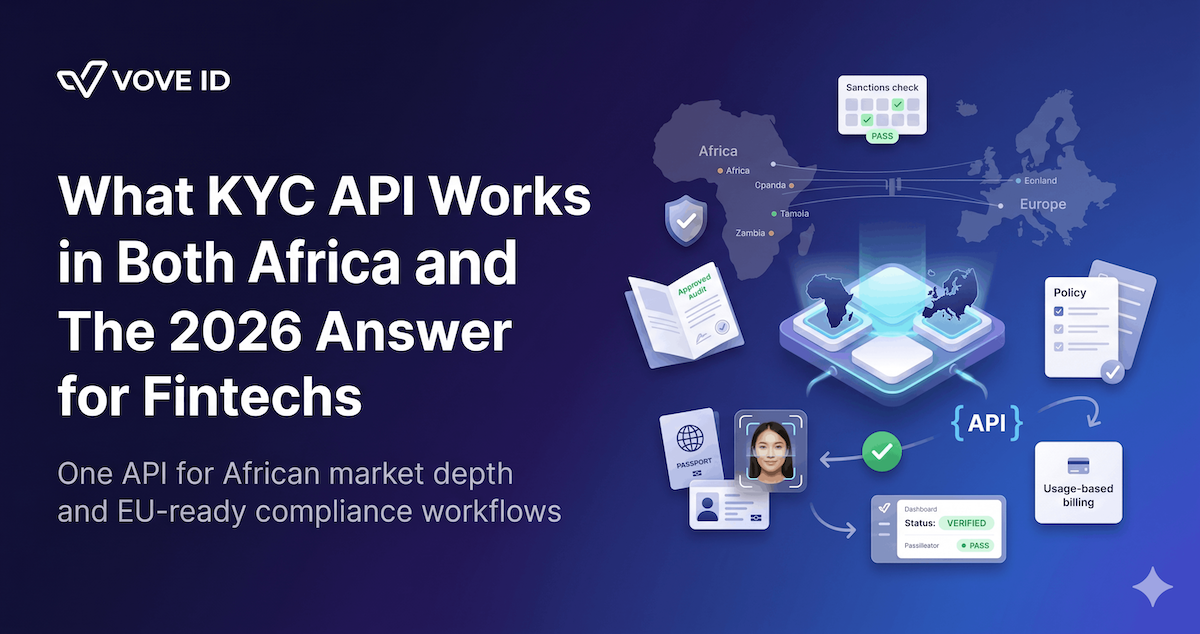
What the workflow looks like in practice
In a typical cross-region setup:
- A user enters onboarding.
- The system routes verification logic based on country and document context.
- Identity checks run using market-appropriate workflows.
- AML and sanctions screening attach to the same case.
- Results return through one API with a unified record.
- Teams manage exceptions and reviews from a single control layer.
This approach reduces fragmentation and keeps compliance decisions consistent across markets.
Questions fintech teams should ask providers
Before selecting a KYC API, teams should clarify:
- Which African markets are fully production-ready?
- Which document types and fallback flows are supported?
- How are AML and sanctions checks integrated into identity workflows?
- How does the system perform under low-bandwidth conditions?
- Can the same API structure be used across all regions?
- How does pricing adjust to volume fluctuations?
Clear answers to these questions usually indicate whether the provider can support real expansion.
Conclusion
Choosing a KYC API for both Africa and Europe is not about maximizing country coverage.
It is about finding a system that can operate across two fundamentally different compliance environments without creating fragmentation.
That requires:
- market-aware identity workflows
- integrated compliance layers
- consistent system architecture across regions
VOVE ID addresses this by providing a unified infrastructure that supports both African operational complexity and European regulatory depth within one integration.
For fintech teams expanding across regions, this reduces the need for multiple vendors and simplifies both engineering and compliance operations.
Need a KYC API that works across African and European markets? Explore how VOVE ID supports cross-region fintech onboarding