KYB in Brazil 2026: Business Verification Requirements for Fintech Platforms
Brazil KYB in 2026 requires more than registry checks. It combines ownership analysis, beneficial-owner verification, and AML-aligned business onboarding.
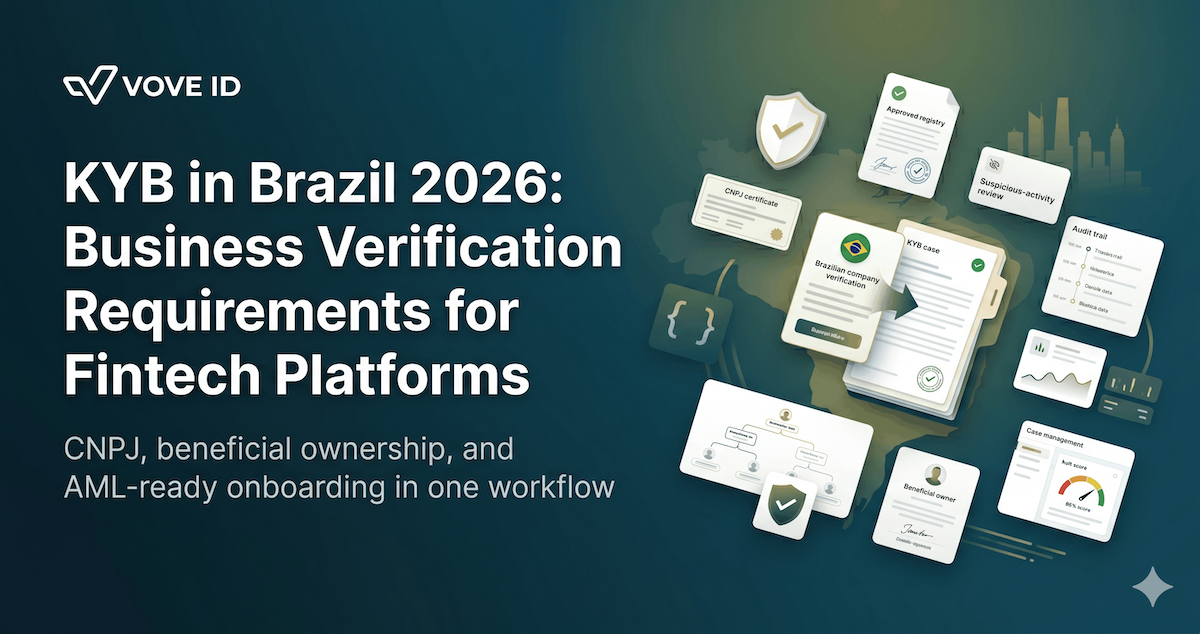
Brazil is one of the most important fintech markets in Latin America, but it is not a market where business onboarding can stay lightweight for long. If your platform is onboarding Brazilian companies in 2026, a real KYB workflow needs more than a CNPJ lookup. It requires legal-entity validation, shareholder and management review, beneficial-owner analysis, risk classification, and a documented escalation path when the business profile does not align with expected activity.
For payments, lending, treasury, embedded finance, and B2B platforms, this matters because Brazilian business onboarding sits at the intersection of multiple control layers. The operational baseline is shaped by anti-money laundering obligations under Law No. 9,613/1998, risk-based procedures used by Banco Central do Brasil supervised institutions, beneficial-owner transparency expectations tied to Receita Federal records, and suspicious-activity reporting expectations connected to Coaf.
In practice, KYB in Brazil 2026 functions as company verification embedded inside AML scrutiny, rather than a separate onboarding step.
For more information, read the KYB compliance guide.
Why Brazil KYB matters now
Brazil combines three structural conditions that increase KYB complexity:
- a large and highly active business ecosystem with significant fintech adoption
- strict regulatory expectations around AML controls and customer due diligence
- company structures that often extend beyond simple registry-level verification
This combination creates a predictable failure pattern.
Many teams initially treat onboarding as a question of whether a company exists in the registry. Over time, it becomes clear that operational risk is driven by ownership structure, control relationships, representatives, and transaction behavior rather than registration status alone.
At that point, basic verification no longer reflects actual exposure.
The Brazil KYB legal and compliance landscape
Although implementation varies across institutions, the regulatory direction is consistent.
1. Law No. 9,613/1998 as the AML foundation
Brazil’s AML framework establishes obligations around prevention, monitoring, and reporting of suspicious activity. For fintech operators, this translates into a requirement that onboarding data supports downstream AML processes rather than existing independently from them.
Weak entity verification reduces the quality of monitoring outcomes later in the lifecycle.
2. Banco Central risk-based AML expectations
Circular No. 3,978/2020 defines AML policies and internal controls for supervised institutions under Banco Central do Brasil. It introduces a risk-based approach that includes identifying and qualifying beneficial owners where applicable.
Even when fintechs operate through partnerships or intermediated models, these expectations propagate through banking and payment partners, effectively shaping KYB requirements at the platform level.
3. Payment account regulation and data reliability
Resolução BCB No. 96/2021 governs payment account lifecycle processes. In practice, this reinforces a core operational requirement: business identity data must remain accurate enough to support account opening, maintenance, and monitoring processes over time.
KYB is therefore not a static onboarding checkpoint but a persistent data responsibility.
4. Securities market AML obligations
CVM Resolution No. 50/2021 extends AML obligations to securities-related entities. Platforms operating in investment or market infrastructure contexts must treat business onboarding as a regulated compliance function rather than a commercial intake process.
5. Beneficial ownership formalisation via Receita Federal
A key shift in 2026 is the operationalisation of beneficial-owner reporting through Receita Federal’s e-BEF system, which became mandatory in January 2026 for obligated entities.
This does not eliminate verification complexity, but it increases the importance of aligning onboarding logic with structured beneficial-owner information.
6. Coaf reporting integration
Suspicious-activity reporting remains part of the AML chain via Coaf. KYB data quality directly affects the ability to detect, interpret, and escalate unusual business behavior after onboarding.
What a Brazil KYB check should include
A complete KYB workflow typically operates across six layers.
1. CNPJ verification
Core entity validation includes:
- legal name
- registration status
- legal form
- address and company metadata
This step confirms existence but does not establish control, ownership, or risk.
2. QSA and corporate structure analysis
The QSA layer provides visibility into:
- shareholders
- directors and administrators
- controlling entity relationships
- structural changes over time
This is where complexity begins to emerge in most onboarding flows.
3. Beneficial-owner resolution
A complete KYB decision must establish:
- ultimate ownership
- effective control
- identity of controlling persons
- consistency between structure and declared activity
In 2026, this step is reinforced by increasing formalisation of beneficial-owner data in Brazil.
4. Representative and signatory validation
This layer ensures that individuals acting on behalf of the entity:
- are correctly identified
- have authority to operate
- are consistent with registry or corporate records
This is essential in payment, credit, and account-access scenarios.
5. Screening and risk classification
KYB outputs must support:
- sanctions and PEP screening
- industry and activity risk scoring
- ownership complexity assessment
- geographic and cross-border exposure
- expected transaction behaviour modelling
Without this layer, onboarding decisions lack operational defensibility.
6. Continuous monitoring and refresh
Business verification outcomes must remain valid over time. This requires:
- ownership change detection
- risk re-evaluation triggers
- activity-based monitoring updates
- periodic re-verification logic
Brazil-specific KYB challenges
Complex ownership structures
Business entities often include layered ownership models, requiring deeper beneficial-owner resolution.
Registry limitations
CNPJ data provides legal existence but not operational risk context.
Authority ambiguity
The acting representative may not reflect actual control structures.
High-value fintech exposure
Payment, lending, and embedded finance flows increase the impact of incomplete KYB decisions.
How KYB connects to AML in Brazil
KYB functions as the input layer to AML systems.
It informs:
- expected transaction profiles
- risk scoring models
- escalation thresholds
- monitoring logic
- case investigation workflows
Without structured KYB inputs, AML systems rely on assumptions rather than verified business context.
This creates both over-flagging and under-detection simultaneously.
What a practical Brazil KYB workflow looks like
A production-grade process typically includes:
- CNPJ verification
- QSA review
- Beneficial-owner identification
- Representative validation
- AML screening and risk scoring
- Risk classification decision
- Audit record creation
- Monitoring and refresh configuration
How VOVE ID handles Brazil KYB
VOVE ID operationalises Brazil KYB as a structured API workflow:
- entity validation via CNPJ data
- corporate structure and QSA mapping
- beneficial-owner resolution
- representative verification
- sanctions and PEP screening
- unified audit trail across the lifecycle
This supports fintech use cases including payments, lending, embedded finance, marketplaces, and B2B onboarding.
The key advantage is consistency: the same decision logic applies across all onboarding cases, reducing manual reconstruction and operational variance.
Questions fintech teams should ask
- Does KYB extend beyond CNPJ validation?
- Are beneficial owners explicitly identified and verified?
- Is signatory authority validated independently?
- Are AML and KYB outputs structurally linked?
- Can onboarding decisions be reconstructed for audit purposes?
- Is there a mechanism for ongoing ownership and risk updates?
Weak answers indicate fragmentation between onboarding and compliance systems.
Conclusion
Brazil KYB in 2026 operates as integrated compliance infrastructure rather than a standalone verification step.
A complete model must combine entity validation, ownership transparency, representative verification, risk classification, and AML alignment within a single operational system.
This structure ensures onboarding decisions remain defensible, scalable, and aligned with regulatory expectations across Brazil’s fintech ecosystem.
Need to structure KYB for Brazilian business onboarding at scale? Get in touch to explore how to operationalize it via API.
FAQ
1. Is CNPJ validation sufficient for KYB in Brazil?
No. It only confirms registration. A full KYB workflow requires ownership, control, and risk assessment layers.
2. Why is beneficial-owner analysis critical in 2026?
Because regulatory expectations and structured reporting systems increasingly require clear identification of ultimate ownership and control.
3. When is enhanced due diligence required?
Typically when ownership is complex, risk indicators are elevated, or business activity deviates from expected patterns.
4. Which fintech use cases require strong KYB in Brazil?
Payments, lending, embedded finance, marketplaces, treasury platforms, and any B2B onboarding involving fund movement or financial exposure.