KYC & AML Compliance in Burundi (2026): A Regime Rebuilt in Real Time
Burundi rewrote its AML/CFT law in 2025 and reorganized its FIU in 2026. Here is what that means for KYC and AML in financial services.
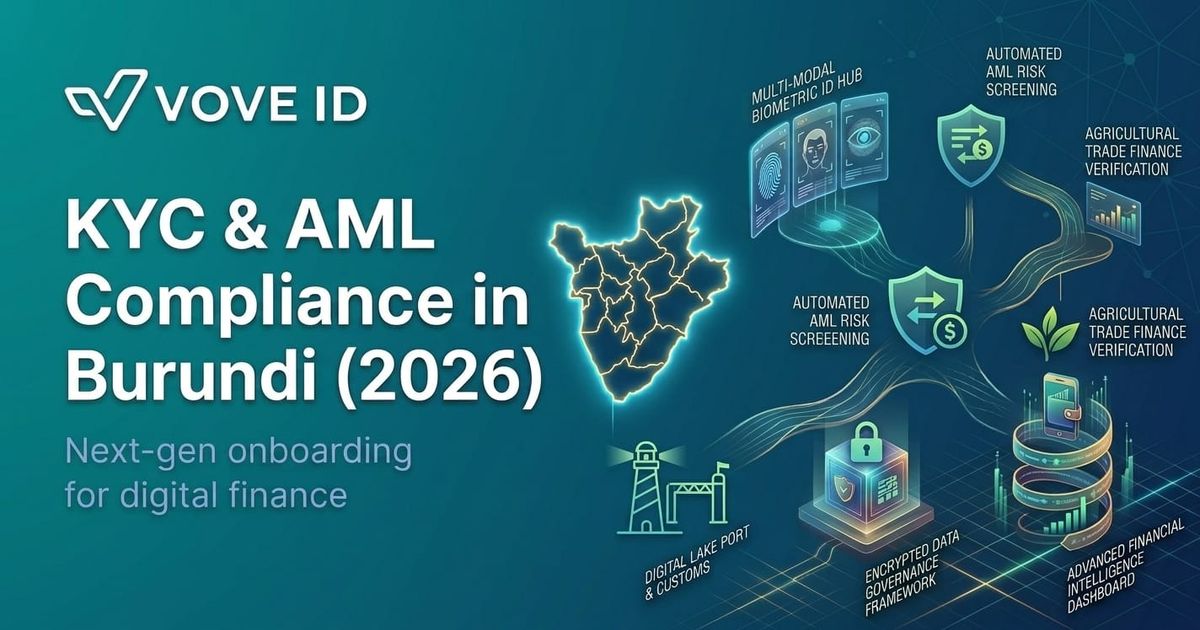
Burundi's AML/CFT framework spent over a decade resting on a single 2008 law, with no completed Mutual Evaluation Report to test it against international standards. That changed abruptly across 2025 and 2026: a rewritten law, a reorganized financial intelligence unit, new central-bank regulations, and a first-ever national risk assessment, all landing within roughly twelve months. For a financial-services business operating in Burundi, understanding this reform wave — and what's still pending — matters more than memorizing the old rulebook.
The operating answer
A Burundian financial-services business needs risk-based AML/CFT controls built for a regime that is actively catching up to international standards, not one that has settled into a stable baseline. Digital onboarding works when identity evidence, risk rationale, and monitoring history stay connected in a case a reviewer can defend as the underlying rules keep shifting — not when it produces a fast approval built for a rulebook that's already out of date.
VOVE ID links the original onboarding decision to whatever comes next — a new screening hit, a scope change, a regulator's next directive — so extending a case doesn't require reconstructing it from scratch.
Establish the Burundian perimeter
Burundi's AML/CFT law dates to Loi n°1/02 du 4 février 2008 portant lutte contre le blanchiment de capitaux et le financement du terrorisme, but it was substantially rewritten by Loi n°1/08 du 27 mars 2025 — a reform that redefines money laundering and terrorist financing in line with international standards and, notably, brings virtual asset (cryptocurrency) platforms into scope for the first time, requiring them to meet the same obligations as traditional financial institutions.
The country's financial intelligence unit, the Cellule Nationale de Renseignement Financier (CNRF), was reorganized by Décret n°100/009 du 9 février 2026, which amended the earlier 2020 decree governing its creation, mandate, and structure. On 30 January 2026, the Banque de la République du Burundi (BRB) issued new implementing regulations under the 2025 law, tightening governance, customer due diligence, transaction monitoring, and suspicious transaction reporting obligations for supervised institutions, explicitly aligned with FATF and ESAAMLG (Eastern and Southern Africa Anti-Money Laundering Group) standards.
Burundi has never completed a Mutual Evaluation Report, but that changed course in November 2025: the CNRF organized a workshop that validated the country's first National Risk Assessment (ENR), a direct precursor to the ESAAMLG-led mutual evaluation the country is now undergoing. Burundi is not currently on the FATF list of jurisdictions under increased monitoring.
For a payment, remittance, or virtual-asset-adjacent license, the first operational task is confirming which obligations under the 2025 law and the January 2026 BRB regulations already apply — since a program built against the old 2008 text alone will already be out of date.
For the underlying identity-control model, see our KYC requirements framework.
Build a case that accounts for a newly-in-scope sector
Bringing virtual asset platforms under the same AML/CFT obligations as banks is one of the most consequential parts of the 2025 reform — it means any business touching crypto rails in Burundi now needs a due-diligence program built for that status from day one, not adapted after the fact once supervisory guidance catches up.
For any business customer, the file needs to connect entity identity, ownership, and declared activity — including whether that activity touches virtual assets — in one place. A completed KYB record that doesn't capture this newly regulated status tells a reviewer little about whether the customer's real risk profile has been assessed under the current law rather than the one it replaced.
For the broader entity- and beneficial-ownership model, see our KYB requirements framework.
Case note: a customer onboarded before the rules caught up
A Bujumbura-based financial institution onboards a payments business in late 2024, before the March 2025 legal reform, under due-diligence standards built for the 2008 law. The business's declared activity includes facilitating transfers that touch a virtual-asset exchange as one settlement leg — a detail the original onboarding didn't need to flag, because virtual assets weren't yet explicitly in scope.
When the 2025 law and the January 2026 BRB regulation take effect, that customer's activity now falls squarely under new obligations the original case was never built to satisfy. The institution has to decide whether to treat this as a full re-onboarding or an extension of the existing case — and without a structured original file, reconstructing the customer's history to make that determination takes far longer than it should.
This isn't a screening failure — nothing about the customer was ever flagged as suspicious. It's a design failure: a case built for one legal regime didn't anticipate the next one arriving with a newly in-scope sector attached.
Connect monitoring to a supervisory function still under reorganization
Reporting entities submit suspicious transaction reports to the CNRF, which was itself reorganized as recently as February 2026. Given that recency, and Burundi's status as a country undergoing its first-ever mutual evaluation, firms should expect further procedural clarifications from the CNRF and BRB as the ESAAMLG evaluation process continues.
In practice, that means building an internal escalation route resilient enough to route reports correctly even as the receiving institution's own structure evolves, and documenting the rationale behind every reporting decision clearly enough to withstand a first-ever external review.
For the broader screening, case-management, and escalation model, see our AML requirements framework.
Design for a jurisdiction with no track record to lean on
Because Burundi has never completed a Mutual Evaluation Report, there's no established effectiveness baseline the way there is in markets with a multi-round evaluation history. That makes the country's own primary sources — the 2025 law, the January 2026 BRB regulation, and CNRF guidance — the most reliable reference points, rather than general assumptions carried over from better-documented neighbors.
The operational test: if BRB or the CNRF issued new guidance tomorrow — plausible, given the pace of the last twelve months — could existing customer cases absorb it without a full rebuild? In a jurisdiction moving this fast, that's not a hypothetical.
Field checklist
Governance
- Confirm current obligations under Loi n°1/08 du 27 mars 2025 and BRB's January 2026 implementing regulations, not the superseded 2008 text alone.
- Assign accountable owners for risk assessment, exceptions, monitoring, and CNRF reporting.
- Track ESAAMLG mutual evaluation developments for further procedural changes.
Onboarding
- Flag any virtual-asset-adjacent activity explicitly, given its new in-scope status under the 2025 law.
- Capture entity identity, ownership, and declared activity in a form that can be extended if legal scope changes.
- Record the original risk rationale for every business relationship in a retrievable form.
Monitoring
- Define triggers for regulatory updates that require revisiting existing customer files.
- Compare live activity against the original relationship profile at defined intervals.
- Maintain a tested internal escalation route into the CNRF.
Records
- Retain source evidence, risk ratings, and reviewer decisions together.
- Restrict access to sensitive identity and case data by role.
- Test whether a reviewer can extend an existing case with new evidence without rebuilding it from scratch.
Questions teams ask before launch
Which law governs AML/CFT in Burundi right now?
Loi n°1/08 du 27 mars 2025, which substantially amended the original 2008 AML/CFT law, alongside implementing regulations the Banque de la République du Burundi issued in January 2026.
Is Burundi on the FATF grey list?
No. Burundi is not currently on the FATF list of jurisdictions under increased monitoring, though it has never completed a Mutual Evaluation Report and is now undergoing its first one via ESAAMLG.
Does Burundi's AML/CFT law cover crypto and virtual-asset businesses?
Yes. The 2025 reform explicitly brought virtual asset platforms into scope, requiring them to meet the same AML/CFT obligations as traditional financial institutions.
Where are suspicious transaction reports filed in Burundi?
Reports go to the Cellule Nationale de Renseignement Financier (CNRF), reorganized by decree in February 2026. Firms should follow their approved internal escalation procedures and current BRB guidance for the applicable reporting decision.
The operating position
Three separate instruments — a new law, a new regulation, a reorganized FIU — landed within about a year of each other, ahead of a mutual evaluation Burundi has never faced before. Treat the current rulebook as a snapshot, because it will keep moving: a case file that can only be read against today's rules will already be behind by the time BRB or the CNRF issues its next round of guidance.
See how VOVE ID keeps onboarding cases ready for Burundi's next regulatory update.
This article is intended for general informational purposes only and does not constitute legal, financial, or regulatory advice. KYC/KYB/AML requirements may vary depending on jurisdiction, industry, and specific business circumstances. For up-to-date and binding compliance obligations, readers should refer to the relevant regulatory authorities or consult qualified professionals.