KYC & AML Compliance in Djibouti (2026): A Strategic Trade Hub's Compliance Reality
Djibouti runs on trade, not tourism. Here is what its port-and-remittance economy means for KYC and AML in financial services.
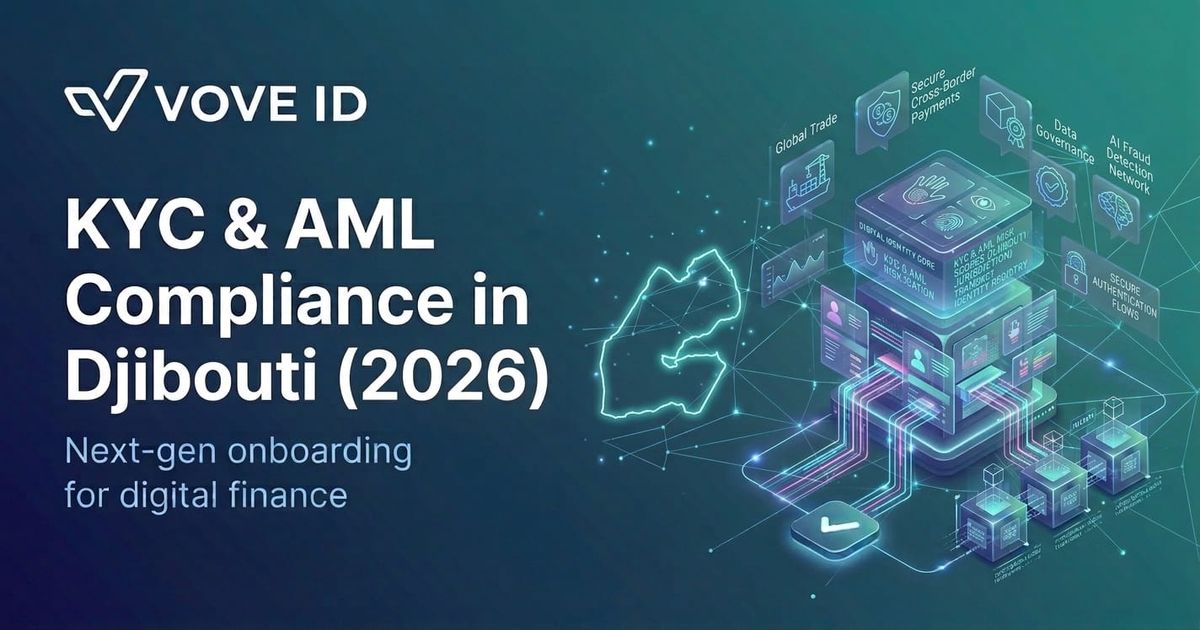
Djibouti has one of the smallest populations in the Horn of Africa and one of the region's most consequential ports. Nearly all of landlocked Ethiopia's seaborne trade moves through Djiboutian territory, and the country's own exports are dominated by re-exports to Ethiopia rather than domestic production. For a financial-services business operating there, that trade-hub role — not the size of the local retail market — is what shapes AML exposure.
The operating answer
A Djiboutian financial-services business needs risk-based AML/CFT controls built for a cash-heavy, trade- and port-driven economy, where informal foreign-exchange activity and cross-border counterparty risk matter more than pure customer volume. Digital onboarding works when identity evidence, business-purpose context, and monitoring history stay connected in one case that a reviewer can still explain later — not when it produces a fast approval that can't be reconstructed.
VOVE ID gives compliance teams one place to hold identity evidence, declared business purpose, screening results, and reviewer sign-off — useful anywhere, but particularly so where a customer's real risk sits in a trade or logistics relationship that a document check alone won't reveal.
Establish the Djiboutian perimeter
Djibouti's AML/CFT framework traces back to a law adopted in 2001, substantially developed by Law No. 133/AN/11/6th L (2011), which formalized the country's Financial Intelligence Unit — the Cellule de Renseignement Financier (CRF) — as the body that receives and analyzes suspicious transaction reports. The Banque Centrale de Djibouti (BCD) is the central bank and prudential supervisor for banks, financial institutions, and money-transfer operators.
Djibouti joined the Middle East and North Africa Financial Action Task Force (MENAFATF) in 2018 and underwent its first mutual evaluation on-site visit in February–March 2024. That evaluation, along with a 2024 IMF Article IV consultation, flagged unresolved gaps: pending legal amendments to AML/CFT laws, decrees for implementing targeted financial sanctions, and a decree formalizing the FIU's own organization and operation — reforms that were still being pushed through as of the IMF's 2024 report. Teams should confirm current enactment status with BCD or the CRF rather than assume all recommended reforms are already law. Djibouti is not currently on the FATF list of jurisdictions under increased monitoring.
For a payment, remittance, or trade-finance-adjacent license, the first operational task is confirming the BCD authorization category and understanding how much of the business's real exposure runs through port, free-zone, or cross-border trade activity rather than domestic retail transactions.
For the underlying identity-control model, see our KYC requirements framework.
Build a case that accounts for cash and informal exchange activity
MENAFATF's mutual evaluation identifies Djibouti's core AML/CFT vulnerabilities directly: a predominant use of cash, agents operating in jurisdictions with weak AML/CFT compliance, transactions tied to high-risk jurisdictions, and a significant informal manual foreign-exchange market operating alongside the licensed sector. In the banking sector specifically, the evaluation points to inconsistent staff training and limited AML/CFT supervisory capacity at BCD as structural weaknesses.
For a business customer — an import-export trader, a freight forwarder, a bureau de change, or a company operating inside the Djibouti Ports & Free Zones Authority (DPFZA) — that means the onboarding record needs to connect entity identity, ownership, the nature and destination of trade flows, and expected counterparties, not just a completed document check. A completed KYB file without that trade context tells a reviewer little about whether a customer's actual activity matches what they declared.
Case note: a trade relationship that outgrew its declared purpose
A Djibouti City-based bureau de change onboards a small trading company that declares its business as import-export logistics support for goods transiting to Ethiopia. The company submits registration documents, identity evidence for its representative, and a modest expected transaction volume tied to routine freight-related payments.
Over time, transaction volume rises well beyond the declared logistics-support activity, and payments begin flowing to counterparties in jurisdictions the original onboarding never mentioned. Each individual transaction clears identity and sanctions screening — the counterparties aren't on any list, and the paperwork is in order.
The pattern is only caught when a periodic review compares current activity against the original file and finds the two no longer resemble each other. This isn't a screening failure. It's a monitoring failure: nothing in the workflow was built to notice that a customer's real activity had drifted from the purpose it was onboarded under.
Connect suspicious-activity decisions back to the original file
Reporting entities submit suspicious transaction reports to the CRF. Given the capacity constraints the 2024 MENAFATF evaluation documented at both BCD and the FIU, a firm's own internal escalation quality — clear evidence, a documented rationale, a traceable decision trail — carries more weight in Djibouti than in markets with a larger, better-resourced financial intelligence function.
In practice, that means defining trigger events for transaction-volume growth, new counterparties, and activity that no longer matches the declared business purpose, and ensuring each trigger produces a case that retains the original onboarding rationale alongside the new evidence.
For the broader screening, case-management, and escalation model, see our AML requirements framework.
Design onboarding for a market that still requires physical presence
Djibouti's banking sector — 13 banks, three of them Islamic finance institutions — has historically required an individual to be physically present to open an account, which has limited how diaspora and remote customers can be onboarded through traditional banks. Mobile money is still developing: D-Money, run by Djibouti Telecom, and WAAFI, from Salaam Bank, are the two main platforms, only partially interoperable with each other, alongside 19 licensed non-bank remittance service providers regulated by BCD as financial auxiliaries. Formal remittance inflows are comparatively modest in GDP terms — historically in the range of 1–2% of GDP, with France as the leading source given the size of the Djiboutian community there — but they still move through a financial system where only a minority of the adult population accesses formal financial services.
That combination — limited financial inclusion, developing digital rails, and a physical-presence requirement at most banks — is exactly where a properly designed remote onboarding flow can extend reach without loosening the evidence standard, provided the resulting case is still one a compliance officer can defend.
Field checklist
Governance
- Confirm BCD licensing category and current AML/CFT obligations, and track pending legal reforms flagged by the 2024 MENAFATF evaluation.
- Assign accountable owners for risk assessment, exceptions, monitoring, and CRF reporting.
- Align procedures with current BCD guidance rather than assuming all IMF-recommended reforms are already enacted.
Onboarding
- Capture entity identity, ownership, and declared trade or business purpose for any import-export, logistics, or free-zone-adjacent customer.
- Record the original risk rationale for every business relationship in a retrievable form.
- Define an evidence standard for automated approvals and a clear escalation path for manual exceptions.
Monitoring
- Define triggers for transaction-volume growth, new counterparties, and activity diverging from declared business purpose.
- Compare live activity against the original relationship profile at defined intervals.
- Maintain a tested internal escalation route into the CRF.
Records
- Retain source evidence, risk ratings, and reviewer decisions together.
- Restrict access to sensitive identity and case data by role.
- Test whether a reviewer can reconstruct a case history without cross-referencing multiple systems.
Questions teams ask before launch
Which law governs AML/CFT in Djibouti right now?
Djibouti's AML/CFT framework dates to a 2001 law, substantially developed by Law No. 133/AN/11/6th L (2011), which formalized the CRF. Further legal amendments recommended by the 2024 MENAFATF evaluation were still pending as of the IMF's 2024 Article IV report — firms should confirm current status with BCD or the CRF.
Is Djibouti on the FATF grey list?
No. Djibouti is not currently on the FATF list of jurisdictions under increased monitoring.
Why does Djibouti's port and trade role matter for AML compliance design?
Because much of the country's real financial-crime risk, per MENAFATF's own evaluation, runs through cash usage, informal foreign-exchange activity, and cross-border trade counterparties rather than domestic retail banking — a business customer's declared trade purpose needs to stay connected to its actual activity.
Where are suspicious transaction reports filed in Djibouti?
Reports go to the Cellule de Renseignement Financier (CRF), Djibouti's Financial Intelligence Unit. Firms should follow their approved internal escalation procedures and current BCD guidance for the applicable reporting decision.
The operating position
Djibouti's compliance challenge isn't a large domestic market to monitor — it's a small financial system carrying an outsized share of cash, informal exchange, and cross-border trade risk because of what the country's ports connect to. An onboarding flow that looks complete on day one but can't track a customer's activity against its declared purpose over time will miss exactly the risk MENAFATF's own evaluation says matters most.
A case file that tracks declared purpose against actual activity is the difference between catching that drift early and catching it only when a threshold forces a look-back.
This article is intended for general informational purposes only and does not constitute legal, financial, or regulatory advice. KYC/KYB/AML requirements may vary depending on jurisdiction, industry, and specific business circumstances. For up-to-date and binding compliance obligations, readers should refer to the relevant regulatory authorities or consult qualified professionals.