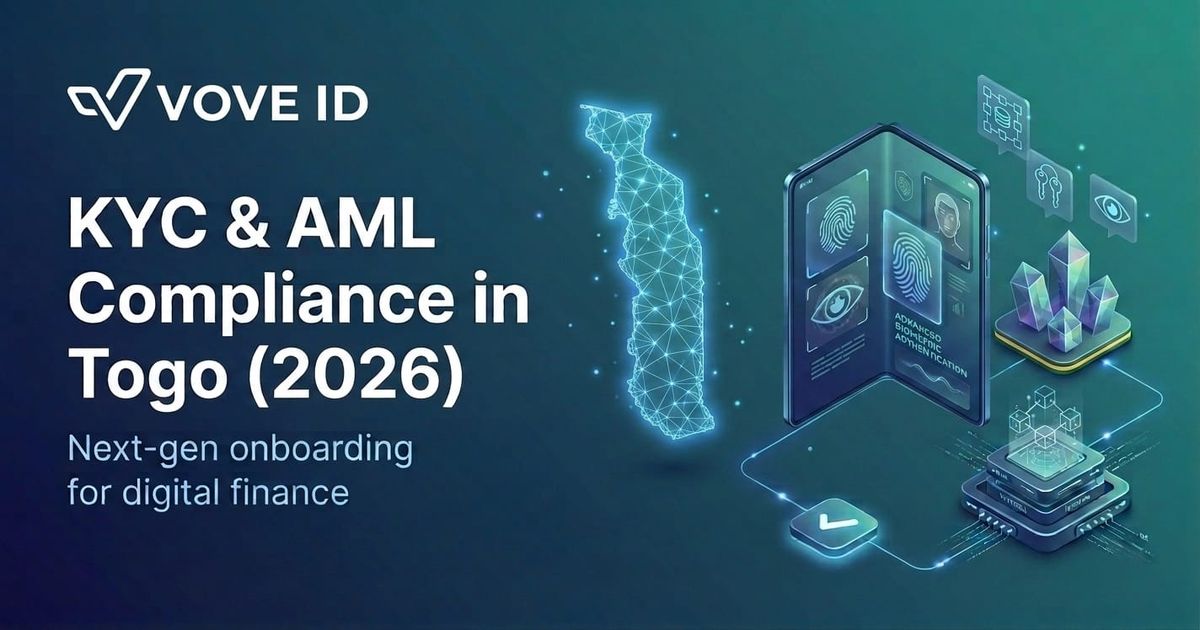
KYC & AML Compliance in Togo (2026): BCEAO Rules for a Regional Banking Hub5
Togo hosts the headquarters of Ecobank, BOAD, and EBID, and just replaced its AML/CFT law. Here is what that means for KYC, KYB, and AML in 2026.
Togo occupies an unusual position in West African finance: it is a comparatively small national market that also happens to host the regional headquarters of some of the continent's largest banking institutions. Ecobank Transnational Incorporated, the pan-African banking group with operations across more than 30 African countries, is headquartered in Lomé — alongside the West African Development Bank (BOAD) and the ECOWAS Bank for Investment and Development (EBID). That concentration of regional banking infrastructure means Togo's compliance environment gets scrutinized well beyond what its domestic market size would suggest.
On top of that, Togo's National Assembly adopted a new AML/CFT law in its final reading on February 27, 2026, replacing the 2018 framework (Law No. 2018-16) and aligning national rules with the FATF's revised recommendations and a 2023 UEMOA directive. For fintechs, payment institutions, and mobile-money operators, KYC and AML in Togo now sit inside three moving layers at once — regional BCEAO regulation, a freshly rewritten national law, and a banking sector under closer supervisory watch because of what else operates out of Lomé.
The Togo compliance architecture in 2026
Togo compliance is not a standalone national framework. It is a layered system combining UEMOA regional regulation, BCEAO instructions, and CENTIF-Togo enforcement under the new 2026 law.
Instead of thinking in generic "KYC/AML terms," teams need to understand how these layers interact operationally.
1. UEMOA and BCEAO rules define the baseline
Togo operates inside the UEMOA monetary union alongside Côte d'Ivoire, Senegal, Benin, Burkina Faso, Mali, Niger, and Guinea-Bissau, which means payment regulation is largely harmonized across the region. The same BCEAO texts that shape onboarding in neighboring markets apply in Togo:
- Instruction No. 001-01-2024 (payment services in UMOA)
- Instruction No. 003-03-2025 (customer identification and verification)
- Instruction No. 001-03-2025 (AML organization, internal control, compliance duties)
What matters here is not the legal naming, but the structure it creates:
- onboarding standards are regionally defined, not locally improvised
- customer identification is formally regulated, not advisory
- AML control obligations are embedded into payment institution licensing
This is why Togo fintech compliance behaves like a regulated banking extension of UEMOA policy, not a standalone startup-friendly framework — the same underlying logic as Côte d'Ivoire and Senegal, applied in a market where the regional banks themselves are next door.
For the underlying identity-control model, see our KYC requirements framework.
2. CENTIF-Togo and the 2026 AML/CFT reform
At national level, CENTIF-Togo (Cellule Nationale de Traitement des Informations Financières) is the financial intelligence unit anchoring AML enforcement. The new AML/CFT law adopted in February 2026 makes three changes that matter for fintech design:
- Extends due diligence obligations to virtual asset service providers, bringing VASPs into the reporting-entity perimeter for the first time
- Tightens beneficial-ownership identification requirements, following through on Decree No. 2017-127 on beneficial ownership
- Formalizes a risk-based approach across reporting entities, replacing more prescriptive elements of the 2018 law
Togo exited the FATF grey list in October 2024, and the government has framed the 2026 reform explicitly as consolidating that exit rather than reacting to a new listing — the finance ministry described it as reinforcing the existing framework and modernizing monitoring systems. Togo remains a member of the Inter-Governmental Action Group against Money Laundering in West Africa (GIABA), the FATF-style regional body that conducts its mutual evaluations.
The practical effect for reporting entities: AML obligations are enforceable in operational detail, supervisory clarity reduces ambiguity for audits, and compliance gaps tied to virtual assets or beneficial ownership — previously grey areas — are now easier to detect and penalize.
For the broader entity- and beneficial-ownership model, see our KYB requirements framework.
3. Why Togo's banking concentration raises the compliance bar
Hosting Ecobank's group headquarters, plus BOAD and EBID, means Togo's banking sector operates under a level of correspondent-banking and cross-border scrutiny that a market its size wouldn't otherwise attract. Two concrete signals from 2026 illustrate the direction of travel:
- BCEAO's instant-payment interoperability platform (PI-SPI) now includes six Togo-based institutions — Ecobank and Orabank from the pilot phase, joined in March 2026 by BIA, Cofina, Bank of Africa, and Coris Bank — putting a majority of Togo's banking sector onto a single real-time interbank rail.
- The UMOA Banking Commission has actively sanctioned a Togo-based bank over AML/CFT program deficiencies, including governance and risk-management gaps, with a formal reprimand and a fine — a reminder that regional supervision is not passive.
At the same time, Togo's fintech licensing pipeline is active: Togolese payments startup Semoa received a full BCEAO payment-service-provider license in January 2026 after a decade building WhatsApp-based banking and digital-card products, one of a growing number of Togo-based fintechs formalizing their status under BCEAO.
The combination — a regional banking capital, an active regulator, and a fintech sector scaling under licensing — means onboarding and monitoring systems in Togo need to be built to institutional-grade standards from the start, not retrofitted after growth.
4. Customer due diligence is lifecycle-based, not onboarding-only
CENTIF-Togo obligations, reinforced by the 2026 law, define due diligence as an ongoing process. Obliged entities must:
- identify both occasional and permanent customers
- verify identity and understand customer purpose
- monitor transactions for unusual or inconsistent activity
- report suspicious activity to CENTIF-Togo
- maintain internal control systems
- retain compliance documentation
The key operational implication:
Customer compliance in Togo is defined by continuity, not a snapshot.
This is where many fintech implementations fail: they treat KYC as onboarding, while regulators — and, in Togo's case, correspondent banks watching the sector closely — treat it as an ongoing control system.
For the broader screening, case-management, and escalation model, see our AML requirements framework.
What KYC must look like in Togo
Identity verification
Common acceptable documents include national identity cards, passports, and residence permits or equivalent documents. The key requirement is not document type — it is verifiable identity resolution under variable data quality conditions.
A production-grade flow must include structured document capture, OCR extraction with validation rules, selfie or liveness verification when risk requires it, fallback handling for low-quality inputs, and stored verification evidence linked to the customer record.
KYB and beneficial ownership
For payroll, merchant, lending, and B2B platforms, individual onboarding is insufficient. Systems must also capture legal entity identity, ownership structure, authorized representatives, beneficial owners, and business purpose consistency — now under the tightened identification standard the 2026 law introduces.
Continuous monitoring
The new law's risk-based approach requires ongoing monitoring of customer behavior: detection of activity inconsistent with declared purpose, unusual transaction volume patterns, suspicious counterparties or geographies, behavioral changes in business accounts, and escalation of flagged activity for review.
Implementation challenges specific to Togo
Correspondent and cross-border exposure. With Ecobank, BOAD, and EBID headquartered in Lomé, Togo-based financial institutions sit closer to regional and international correspondent-banking relationships than the size of the domestic market implies — raising the practical bar for AML program quality even for smaller reporting entities.
Virtual assets, newly in scope. VASPs are now explicitly covered by the 2026 law. Any fintech touching crypto rails, remittance products with a digital-asset leg, or exchange-adjacent services needs a due-diligence program built for that status, not adapted after the fact.
Regional UMOA movement. Customers and businesses often operate across Ghana, Benin, Burkina Faso, and the wider UEMOA bloc, creating cross-border transaction patterns that must be interpreted as regional behavior, not anomalies.
Operational scaling without compliance teams. Most Togo-based fintech teams do not scale compliance headcount at the same rate as product growth, increasing reliance on automation, structured case management, and unified identity, KYB, and AML systems.
How VOVE ID fits into the Togo compliance model
VOVE ID supports implementation of Togo's regulatory requirements as a unified workflow layer: identity verification for individuals, KYB and beneficial-ownership checks, AML screening against sanctions, PEP, and watchlists, transaction monitoring with rule-based alerts, structured case management for investigations, and audit-ready evidence retention.
The value is not replacing regulatory responsibility, but reducing fragmentation between onboarding, screening, and monitoring systems — particularly important in a market where compliance quality gets judged against the banking institutions next door.
Togo compliance checklist
Before launch, teams should validate:
- Which BCEAO instruction governs our activity type?
- Does our due-diligence program already cover virtual-asset activity under the 2026 law?
- How is beneficial ownership captured and verified for business customers?
- Where is AML screening performed and stored?
- How are suspicious-activity decisions escalated to CENTIF-Togo?
- How is transaction monitoring implemented post-onboarding?
- Can we reconstruct full customer history within audit timelines?
- Who owns reporting to CENTIF-Togo internally?
Questions teams ask before launch
Which AML rules matter most for Togolese financial firms?
Togo's AML/CFT law, adopted in final reading on February 27, 2026 and replacing Law No. 2018-16, is the central national reference, alongside the BCEAO instructions that apply across UEMOA. The exact obligations depend on the firm's activity and licensing perimeter.
Is Togo currently on the FATF grey list?
No. Togo was removed from the FATF list of jurisdictions under increased monitoring in October 2024 and is not on the current list.
Does the new law apply to crypto and virtual-asset businesses?
Yes. The 2026 law extends AML/CFT due-diligence obligations to virtual asset service providers, which were not comprehensively covered under the 2018 framework.
Where are suspicious activity reports made in Togo?
Reports are made to CENTIF-Togo, the national financial intelligence unit. Firms should use their approved internal procedures and current official guidance for the applicable reporting decision.
Conclusion
Togo fintech compliance in 2026 is defined by a structured regulatory environment combining BCEAO regional rules and a freshly rewritten CENTIF-Togo enforcement framework — set against a banking sector that punches above its domestic weight because of what's headquartered in Lomé.
The practical implication is clear: KYC, KYB, and AML are not separate systems but parts of a single regulatory lifecycle, and the presence of Ecobank, BOAD, and EBID means that lifecycle gets held to a regional standard, not a purely national one.
Fintech teams that design for this from the beginning are able to scale across UEMOA markets with fewer structural breaks. Teams that treat compliance as modular often face re-architecture under regulatory pressure.
This article is intended for general informational purposes only and does not constitute legal, financial, or regulatory advice. KYC/KYB/AML requirements may vary depending on jurisdiction, industry, and specific business circumstances. For up-to-date and binding compliance obligations, readers should refer to the relevant regulatory authorities or consult qualified professionals.