KYC & AML Compliance in Nigeria 2026: CBN Requirements for Fintech Startups
A practical guide to KYC and AML compliance in Nigeria, covering CBN due diligence rules, BVN and NIN identity controls, and how fintechs design onboarding and transaction monitoring workflows in 2026.
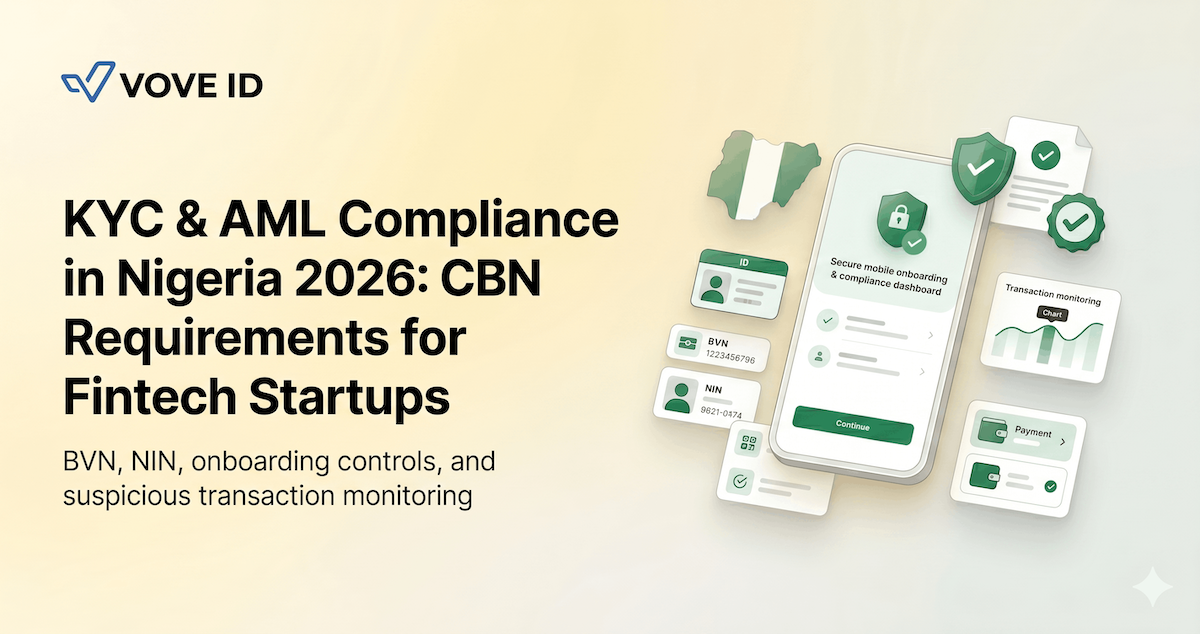
Nigeria remains one of the most attractive fintech markets in Africa, but the compliance bar is not getting lighter. In 2026, digital lenders, wallets, payment startups, and embedded finance products still need to design onboarding and monitoring around CBN customer due diligence rules, BVN and NIN identity controls, and suspicious transaction reporting obligations that run through the NFIU. Platforms like VOVE ID help fintech teams structure these workflows, but regulatory expectations ultimately define how systems must operate in practice.
Nigeria is a growth market, but it is also a supervision market.
If your fintech is onboarding customers in Nigeria, the real challenge is not finding a document-check vendor. It is making sure your onboarding flow, account controls, and AML monitoring actually match how the Central Bank of Nigeria expects regulated firms to identify customers, understand risk, and detect suspicious activity over time.
For founders, the core takeaway is simple: Nigerian compliance is not one check at signup. It is a connected workflow that starts with identity, continues through account profiling and transaction behavior, and ends with clear escalation and reporting when activity stops making sense.
Key compliance challenges in Nigeria
Nigeria is a sophisticated market, but it is not frictionless. Teams usually face the same operational issues:
BVN and NIN mismatch handling
Customer data is often incomplete or inconsistent across systems. Your onboarding flow needs clear decision rules for mismatches instead of relying on manual judgment.
Fraud pressure at scale
As products grow, they attract account farming, identity recycling, mule activity, and social-engineering-driven fraud. Manual review alone does not scale against these patterns.
Product growth outpacing compliance design
Many startups begin with simple wallets or lending flows and later expand into merchant onboarding, cards, or cross-border payments. Original KYC logic often becomes insufficient for the new risk profile.
Weak evidence retention
Some teams run checks but cannot reconstruct decisions months later. This becomes a serious issue during audits, partner due diligence, or regulatory reviews.
KYB / KYC workflow in Nigeria
A compliant setup in Nigeria is not a single step. It is a layered workflow that connects onboarding and monitoring.
1. Customer identification and verification
Under CBN CDD rules, firms must collect and verify core customer data using reliable, independent sources.
In practice, this usually includes:
- collecting customer profile data
- capturing BVN, NIN, or both depending on the product tier
- verifying identity documents or database records
- running biometric or liveness checks for remote onboarding
- confirming contact information and consistency signals
The goal is not just to confirm identity, but to reduce impersonation, duplicate accounts, and synthetic onboarding.
2. Tiering and proportional controls
Nigeria uses a tiered onboarding system. Lower tiers allow simplified due diligence, but ongoing monitoring still applies.
The key is progressive KYC:
- start with controls aligned to the initial tier
- define upgrade requirements clearly
- adjust controls as risk or product scope increases
3. Non-face-to-face onboarding controls
Remote onboarding is standard, which increases the importance of:
- liveness and anti-spoofing controls
- image quality thresholds
- device and session risk signals
- exception handling and manual review routing
Automation without clear fallback logic creates downstream risk.
4. Ongoing monitoring and AML integration
After onboarding, compliance continues through:
- sanctions and PEP screening
- transaction monitoring
- behavioral analysis
- escalation and reporting
If onboarding and monitoring are disconnected, teams often cannot explain decisions later.
Regulatory framework in Nigeria
Nigeria’s compliance environment is shaped by three core elements:
CBN Customer Due Diligence Regulations (2023)
These regulations define onboarding and ongoing due diligence requirements for regulated institutions. Firms must:
- identify and verify customers
- understand the purpose of the relationship
- assess source of funds
- apply a risk-based approach
- conduct ongoing monitoring
BVN and NIN identity requirements
Nigeria’s identity system relies heavily on:
- BVN (Bank Verification Number)
- NIN (National Identity Number)
CBN expectations:
- Tier 2 and 3 accounts → require both BVN and NIN
- Tier 1 accounts → require at least one
This makes identity verification more complex than standard document-based KYC.
NFIU and AML reporting obligations
The Nigerian Financial Intelligence Unit (NFIU) manages suspicious transaction reporting.
Firms are expected to:
- detect suspicious activity
- investigate and document cases
- report through appropriate channels
AML is an operational requirement, not a post-launch feature.
Nigeria compliance checklist for fintech founders
Before launch or expansion, make sure your team can clearly answer:
- Which CBN-regulated category does your product fall into?
- What onboarding tier applies to each account type?
- When do you require BVN, NIN, or both?
- How do you handle mismatches and failed verification?
- What behaviors trigger monitoring alerts?
- Where are sanctions, PEP, and transaction alerts reviewed?
- How does escalation to NFIU reporting work?
- Can you reconstruct a full customer decision trail?
If these answers are unclear, the issue is likely implementation rather than policy.
Conclusion
KYC and AML compliance in Nigeria in 2026 is not a document upload problem. It is an operating model problem.
The CBN expects firms to identify customers properly, apply risk-based due diligence, maintain accurate data, and monitor activity throughout the relationship. Nigeria-specific identity controls around BVN and NIN make this even more operationally important.
The strongest fintechs build compliance into the product from the start. Others add controls reactively, after risk has already accumulated.
Looking to structure a Nigeria-ready onboarding and AML workflow that scales with your product?